Day 23: The Hula Hoop Challenge
The hula hoop is one of the most underrated pieces of fitness equipment that exists, and most people have one sitting in their garage right now.
Hula hooping looks like a simple party trick. The body mechanics underneath it are genuinely sophisticated.
Why Hula Hooping Is a Legitimate Workout:
Keeping a hula hoop spinning around your waist requires continuous core engagement, rotational hip strength, and a level of rhythmic timing that very few other activities demand in quite the same way. The core is working the entire time the hoop is moving, not in isolated reps but in continuous, low-level, sustained contraction. This is fundamentally different from a plank or a crunch. It is core endurance training disguised as play, and it is also genuinely demanding cardiovascular work when sustained for several minutes at a time. Competitive hula hoop athletes train for hours, and recreational hooping for even a few continuous minutes elevates heart rate meaningfully. Beyond the waist hooping, today's workout uses hoops laid flat on the ground as an agility tool, stepping in and out of a line of hoops in different patterns is one of the oldest footwork drills in athletic training, predating the modern agility ladder by decades.
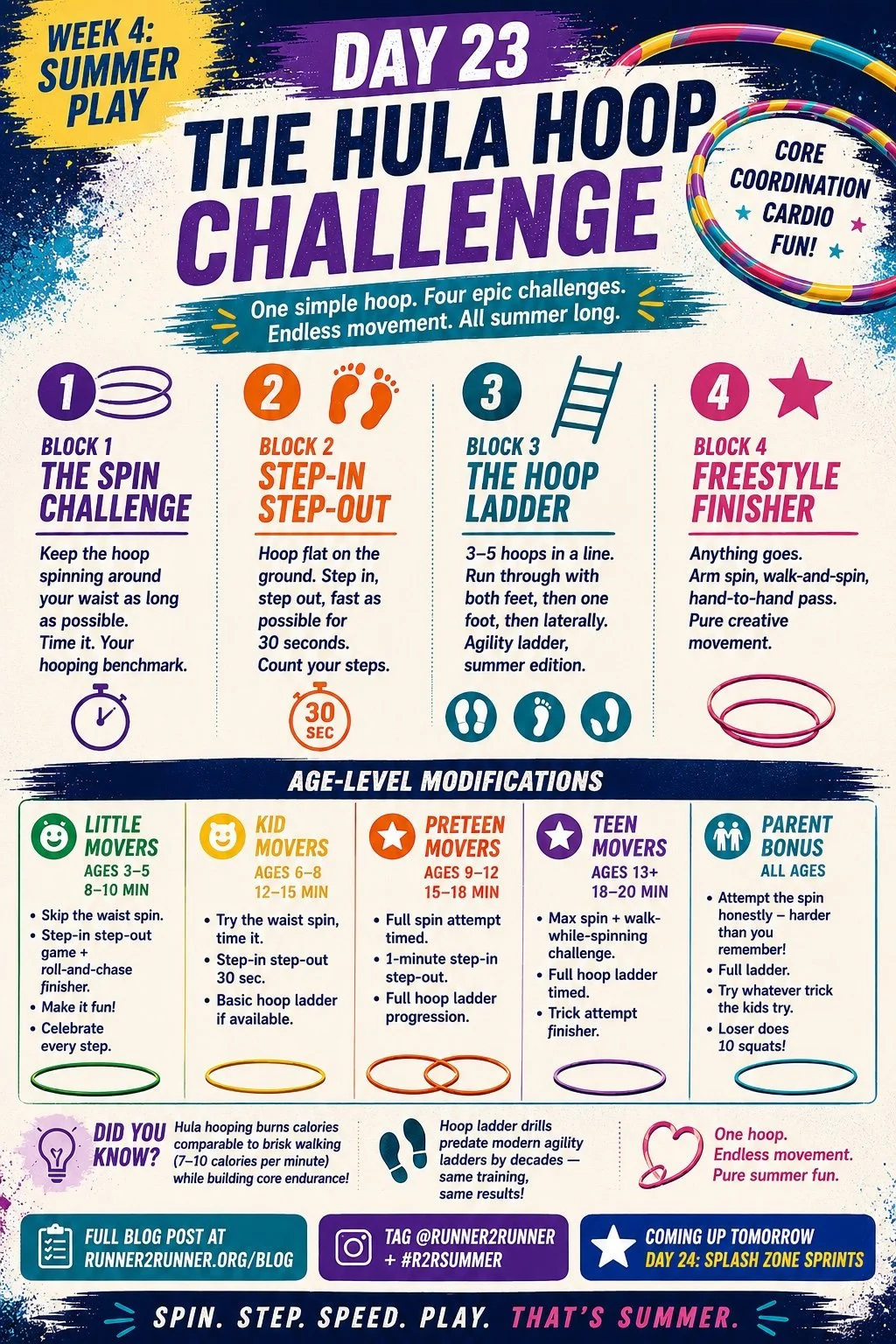
Today's Workout: The Hula Hoop Challenge
What you need: At least one hula hoop. More than one is ideal for the agility section. A substitute like a jump rope laid in a circle works if hoops aren't available.
Total time: 15 to 20 minutes.
Warm-Up: 10 hip circles each direction. 10 arm circles each direction. 30 seconds of easy jogging in place.
Block 1: The Spin Challenge: Get the hoop spinning around your waist and keep it going as long as possible. Time it. This is your hooping endurance benchmark.
Block 2: The Step-In Step-Out: Lay the hoop flat on the ground. Step in with both feet, step out, step in, step out, as fast as possible for 30 seconds. Count your total step-ins.
Block 3: The Hoop Ladder (multiple hoops needed): Lay 3 to 5 hoops in a line, slightly overlapping or spaced a foot apart. Run through stepping in each hoop with both feet, then with one foot at a time, then laterally. This mirrors agility ladder training using a tool most families already own.
Block 4: Freestyle Finisher: Anything goes. Spin it on an arm, try to keep it going while walking, attempt a hand-to-hand pass if there are two hoops. Pure creative movement to close out the workout.
Cool-Down: Walk one minute. Hip circles, slow, 10 each direction. Forward fold, hold 20 seconds.
Age Modifications
🟢 Little Movers: Ages 3–5 | 8–10 Minutes: Skip the waist spin if it's too difficult and focus entirely on the step-in step-out game in Block 2 — stepping into a hoop laid on the ground and back out, like a simple version of hopscotch. Make sound effects with every step. Block 3 with a single hoop is fine, just step in and out repeatedly. Freestyle finisher: roll the hoop along the ground and chase it.
🟡 Kid Movers: Ages 6–8 | 12–15 Minutes: Attempt the waist spin and time how long they can sustain it, even a few seconds is a start and something to beat next time. Step-in step-out for 30 seconds, count total steps. If multiple hoops are available, try the basic hoop ladder with both feet only.
🟠 Preteen Movers: Ages 9–12 | 15–18 Minutes: Full waist spin attempt, time it, this is the benchmark. Step-in step-out for a full minute. Hoop ladder with both feet, then single foot, then lateral if multiple hoops are available. Freestyle finisher with a creative trick attempt.
🟣 Teen Movers: Ages 13+ | 18–20 Minutes: Full waist spin for maximum time, then attempt to walk while keeping it spinning for an additional challenge. Step-in step-out for a full minute at maximum speed. Full hoop ladder progression through all three footwork patterns, timed. Freestyle finisher with an attempt at an arm spin or a hand-to-hand pass with a partner.
👨👩👧 Parent Bonus: Attempt the waist spin. It is harder than you remember from childhood and that is the point. Full hoop ladder progression alongside your kids. Freestyle finisher: attempt whatever trick your kids attempt, regardless of dignity outcome.
Did You Know?
Hula hooping burns comparable calories to brisk walking or light jogging. Research on hula hoop exercise has found that sustained hooping burns approximately 7 to 10 calories per minute for most participants, comparable to brisk walking and in some cases approaching light jogging intensity, while also providing significant core engagement that walking does not. The American Council on Exercise has recognized weighted hula hoop training as a legitimate cardiovascular and core exercise modality.
Tomorrow is Day 24: Splash Zone Sprints. Sprinkler running, water relay races, and the most refreshing workout of the summer so far. See you at 6am.