Day 36: Family Yoga Flow
This week we slow down, deliberately, purposefully, and with athletic intention.
Week 6 is Flexibility and Balance. Today is Family Yoga Flow.
Why Athletes Do Yoga
Here is something that surprises a lot of people: yoga is not a break from athletic training. It is athletic training. The flexibility built through yoga practice directly increases stride length in runners, a more mobile hip flexor means a longer, more powerful stride. The core stability demanded by balancing poses is the same stability that keeps a sprinter upright in the final meters of a race. The body awareness developed through yoga practice, knowing exactly where every limb is in space, is the same proprioception that makes a hurdler clear a barrier without looking at it.
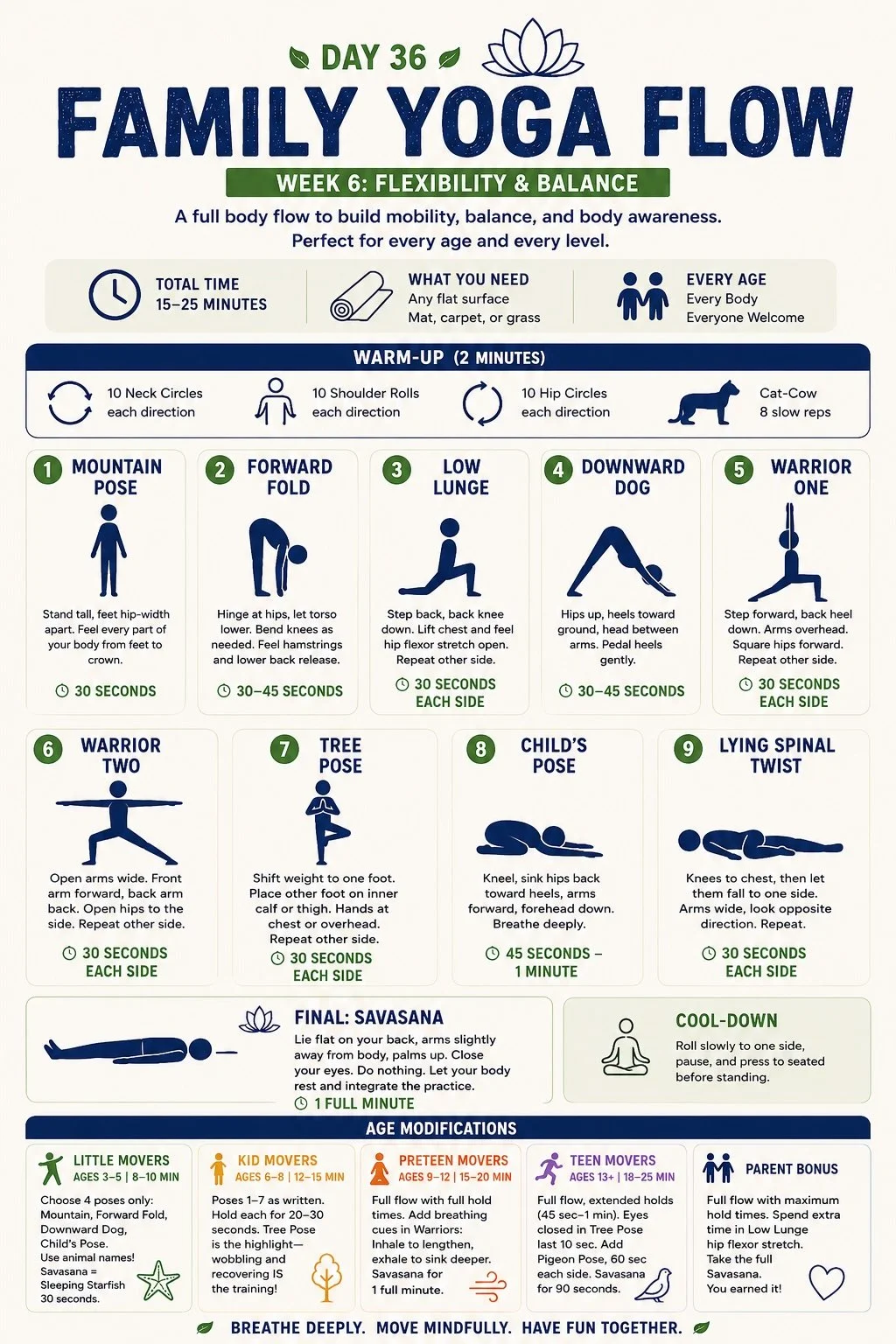
Today's Workout: Family Yoga Flow
What you need: Any flat surface. A mat, carpet, or soft grass. Enough space for each person to extend their arms fully without touching anyone else.
Warm-Up: 10 slow neck circles each direction. 10 shoulder rolls each direction. 10 hip circles each direction. Cat-cow — on hands and knees, arch the back up toward the ceiling then dip the belly toward the ground, 8 slow repetitions. You are ready.
Pose 1: Mountain Pose - Stand tall, feet hip-width apart, arms at sides, weight even across both feet. Eyes forward. Take three slow deep breaths and feel every part of the body from feet to the crown of the head. This is the foundation everything else builds from. Hold 30 seconds.
Pose 2: Forward Fold - From Mountain, hinge forward at the hips with a flat back, letting the torso lower toward the ground. Bend the knees generously if needed. Let the head hang heavy. Feel the hamstrings and lower back release. Hold 30 to 45 seconds. This is the most important stretch for runners.
Pose 3: Low Lunge - Step one foot back into a lunge position. Back knee rests on the ground. Front knee is directly above the front ankle. Lift the torso upright and feel the hip flexor of the back leg stretch open. This is the stretch runners need most and do least. Hold 30 seconds each side. Do not rush this one.
Pose 4: Downward Dog - From the lunge, bring both hands to the ground and lift the hips toward the ceiling, forming an upside-down V shape. Heels press gently toward the ground. Head hangs between the arms. Pedal the heels alternately to warm up the calves. Hold 30 to 45 seconds.
Pose 5: Warrior One - From Downward Dog, step one foot forward between the hands. Back heel presses down at roughly 45 degrees. Rise up and lift arms overhead, palms facing or touching. Square the hips as much as possible toward the front of the space. Hold 30 seconds each side. Feel the power in this one — it is not passive.
Pose 6: Warrior Two - From Warrior One, open the arms wide in opposite directions — front arm toward the front of the space, back arm toward the back. Hips open to the side. Gaze over the front hand. Hold 30 seconds each side. This is strength and flexibility working simultaneously.
Pose 7: Tree Pose - From standing, shift weight to one foot. Place the sole of the other foot on the inner calf or inner thigh — never on the knee. Bring hands together at the chest or raise them overhead. Find a fixed point to gaze at. Hold 30 seconds each side. When you fall out, which you will, get back up without comment and continue.
Pose 8: Child's Pose - Kneel on the ground, sink hips back toward heels, extend arms forward on the ground, and rest the forehead down. This is the recovery pose. Breathe slowly and deeply. Hold 45 seconds to 1 minute.
Pose 9: Lying Spinal Twist - Lie on the back. Bring both knees to the chest, then let them fall to one side. Arms extend wide. Look the opposite direction from the knees. This releases the lower back after everything else. Hold 30 seconds each side.
Final: Savasana - Lie completely flat on the back, arms slightly away from the body, palms facing up. Close the eyes. Do nothing. Hold for 1 full minute. This is not optional and it is not a joke. The body integrates the work of the session during Savasana. One minute is the minimum. Longer is better.
Cool-Down: Already built into the flow. After Savasana, roll slowly to one side, pause, and press to seated before standing.
Age Modifications
🟢 Little Movers: Ages 3–5 | 8–10 Minutes: Choose four poses only — Mountain, Forward Fold, Downward Dog, and Child's Pose. Give each one an animal name to make it concrete and memorable: Mountain is Tall Giraffe, Forward Fold is Sleeping Elephant, Downward Dog is Happy Puppy, Child's Pose is Curled-Up Hedgehog. Hold each for 15 to 20 seconds and move through the four poses twice. Savasana for this age is called Sleeping Starfish and lasts 30 seconds — get them to stay completely still for the full count. Most of them will manage it. Some of them will not. Both outcomes are perfect.
🟡 Kid Movers: Ages 6–8 | 12–15 Minutes: Poses 1 through 7 as written with 20 to 30 second holds. Tree Pose is the highlight for this age group — the wobbling and recovering is exactly the balance training being targeted, and kids this age find the challenge genuinely engaging once they understand that falling out is part of the practice. Savasana for 45 seconds. Remind them that doing nothing is harder than it sounds.
🟠 Preteen Movers: Ages 9–12 | 15–20 Minutes: Full flow as written with full hold times. In Warrior One and Warrior Two add a breathing cue — inhale to lengthen, exhale to sink deeper into the pose. Connecting breath to movement is the fundamental skill of yoga practice and preteens can access it meaningfully. Savasana for 1 full minute. Use this time to notice any part of the body that feels different from the start of the session.
🟣 Teen Movers: Ages 13+ | 18–25 Minutes: Full flow as written, extended holds — 45 seconds to 1 minute on each pose. In Tree Pose, challenge them to close their eyes for the last 10 seconds of each side — significantly harder and significantly more effective for proprioceptive training. After the main flow add one additional pose: Pigeon Pose, a deep hip opener particularly important for runners. Lie with one leg bent forward at roughly 90 degrees, the other extended back, and sink the hips toward the ground. Hold 60 seconds each side. Savasana for 90 seconds.
👨👩👧 Parent Bonus: Full flow as written with maximum hold times. The low lunge hip flexor stretch is the most important pose in today's session for adults — tight hip flexors are one of the most common contributors to lower back pain and running inefficiency in adults over 30. Spend extra time here. Do not rush Warrior One. Take the full Savasana. You have been showing up for five weeks. Your body deserves this.
Did You Know?
Flexibility training directly improves running economy. Research published in the Journal of Strength and Conditioning Research found that runners who incorporated regular flexibility training improved their running economy, the energy cost of running at a given pace, by a measurable amount over a 10-week period. More flexible hip flexors mean longer strides. More mobile ankles mean better ground contact.
This Week — Flexibility & Balance
Here's what's coming the rest of Week 6:
Tuesday — Balance Beam Challenge
Wednesday — Stretching Circuit
Thursday — Balance Challenge
Friday — Gymnastics Sampler
Saturday + Sunday — Weekend Edition: Mindful Movement Walk + Active Recovery
See you tomorrow at 6am.