Day 45: Relay Race Day
Yesterday we ran with intention and measured how far we’ve come. Today we race.
A relay combines individual speed with team coordination, the physical demand of sprinting with the mental demand of a clean baton exchange, and the shared experience of winning or losing together with the immediate motivation to run it again and do better. There is a reason the relay is one of the most watched events in track and field at every level from youth meets to the Olympics. It has drama built into every exchange. Anything can happen at any moment. The fastest individual doesn’t always produce the fastest team. Strategy, coordination, and execution matter as much as raw speed.
Today your family finds all of that out in the driveway.
Before You Start: Set Up Your Course. A relay course needs a start line, a finish line, and at least one exchange zone. Here is the simplest version that works for any family.
Mark a start and finish line 20 to 40 feet apart. Mark an exchange zone near the finish line, a 10-foot section where the baton must be passed from one runner to the next. The baton is whatever you have (a rolled-up sock, a small flag, a folded piece of paper, a wooden spoon.) With more space available, set up a larger course, a loop around the yard or driveway with the exchange zone at the start and finish point.
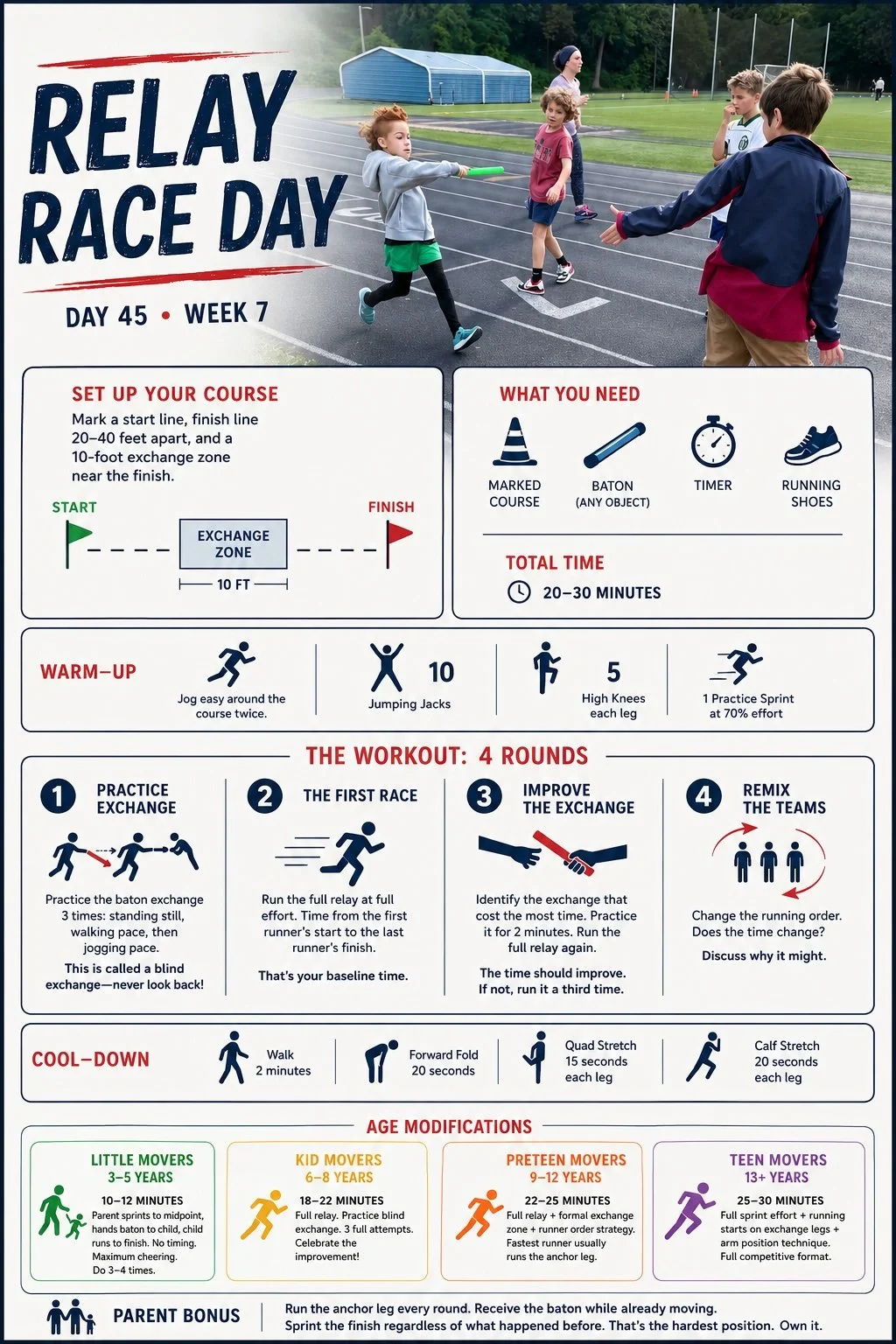
Today’s Workout: Relay Race Day
What you need: A marked course with a start line, finish line, and exchange zone. A baton of any kind. A phone for timing.
Warm-Up: Jog easy around the full course twice. 10 jumping jacks. 5 high knees each leg. One practice sprint at 70% effort to feel the course.
Round 1: The Practice Exchange - Before any competitive racing, practice the baton exchange three times standing still. Runner one holds the baton and extends it back. Runner two reaches forward with an open hand and takes it without looking. This is called a blind exchange and it is the technique used in competitive relay racing, the receiving runner never looks back because looking back breaks stride and costs time. Practice it slow. Practice it at walking pace. Then practice it at jogging pace. The exchange is the most important technical skill of today’s session.
Round 2: The First Race - Run the full relay at full effort. Each runner completes their leg, executes the exchange in the zone, and the next runner goes. Time the full relay from the first runner’s start to the last runner’s finish. That is your baseline time.
Round 3: Improve the Exchange - After Round 2 identify the exchange that cost the most time — the one that was fumbled, the one where the receiving runner slowed too much, the one where the pass happened outside the zone. Practice that exchange specifically for 2 minutes. Then run the full relay again. The time should improve. If it doesn’t the exchange practice needs more work. Run it a third time.
Round 4: Remix the Teams - Reorganize the team order. In competitive relay racing, team composition and runner order is one of the most strategically important decisions a coach makes. Try a different running order and see whether the time changes. Discuss why it might.
Cool-Down: Walk 2 minutes easy. Forward fold 20 seconds. Quad stretch 15 seconds each leg. Calf stretch 20 seconds each leg.
Age Modifications
🟢 Little Movers: Ages 3–5 | 10–12 Minutes: A simplified relay. Parent sprints to the midpoint, passes the baton to child, child runs to the finish. Do it together three or four times in a row. No timing, no pressure, maximum cheering. The baton exchange for this age is simply the parent crouching and handing the object directly to the child, no blind exchange yet. The joy of holding the baton and running to the finish is the whole workout.
🟡 Kid Movers: Ages 6–8 | 18–22 Minutes: Full relay format as written with a 20 to 25 foot course. Practice the blind exchange at walking pace twice before the competitive rounds. Run at least 3 full relay attempts, two to establish the baseline and one after the exchange practice to show improvement. Celebrate the improvement specifically. Keep running until they don’t want to stop, this age group will happily run relays for a long time.
🟠 Preteen Movers: Ages 9–12 | 22–25 Minutes: Full relay format as written with a 30 to 35 foot course and a formal 10-foot exchange zone. Introduce the concept of runner order strategy, in competitive relay racing the fastest runner typically runs the anchor leg, the second fastest runs the first leg to establish position, and the third and fourth fastest runners run legs two and three. Discuss whether that strategy applies to your family’s relay and adjust for Round 4 accordingly.
🟣 Teen Movers: Ages 13+ | 25–30 Minutes : Full relay format with full sprint effort on every leg. Introduce two additional technical elements: the standing start for the first runner versus the running start for exchange runners, exchange runners begin moving before receiving the baton to avoid stopping and restarting, and the outgoing runner’s arm position, extended straight back at hip height to provide a clear target for the incoming runner. Both elements produce measurable time improvements when executed correctly.
👨👩👧 Parent Bonus: Run a full relay leg on every round, not a modified or shortened version, the full leg at genuine effort. Your specific challenge today is the anchor leg, the final leg of the relay. The anchor runner receives the baton and must close out the race. It requires composure under pressure, a clean take of the baton while already moving, and a full sprint finish regardless of what happened on the previous legs.
Did You Know?
The relay race was invented in the United States and has roots in colonial history.
As mentioned in our 4th of July post, the relay race as a formal athletic event developed from the colonial postal relay system, riders passing messages across long distances by handing off at relay stations. The first formally organized relay race took place in Philadelphia in 1893. It became an official Olympic event in 1912 in Stockholm.
The baton exchange is where most relay races are won and lost. Analysis of elite relay performances consistently shows that the exchange zones, not the individual sprint legs, are where the largest performance differences between teams occur. A clean exchange executed at full speed with perfect technique can save three tenths of a second or more per exchange compared to a fumbled or slowed one.
Tomorrow is Day 46: The Halfway Celebration. The official midpoint of the 92-day R2R Summer Movement Challenge. 46 days behind you, 46 days ahead. The biggest milestone of the summer. See you at 6am.