Day 10: Interval Sprints
Yesterday we went slow. Today we go fast.
Interval Sprints, the most athletic workout of Week 2 and one of the most effective training methods in all of running regardless of age, experience, or fitness level. Sprint hard. Walk to recover. Repeat. Simple format with serious results.
If The Conversation Run taught your family what easy feels like, today teaches them what hard feels like and more importantly how to manage it, recover from it, and do it again.
Why Interval Training Works
Short version: your body adapts to what you ask it to do.
When you sprint at maximum effort your heart rate spikes, your muscles recruit fast-twitch fibers, and your cardiovascular system is pushed to its upper limit. Then you walk and recover. Then you sprint again. That cycle of hard effort followed by full recovery is what interval training is and it produces fitness adaptations that steady-state running at any pace simply cannot match.
Interval training improves maximum oxygen uptake, builds fast-twitch muscle fiber, increases stride power, develops mental toughness, and trains the body to recover quickly between hard efforts. It is used by every competitive runner from youth track athletes to Olympic sprinters. And in our experience it is the workout kids enjoy most once they realize they get to sprint as fast as they can and then fully rest before doing it again.
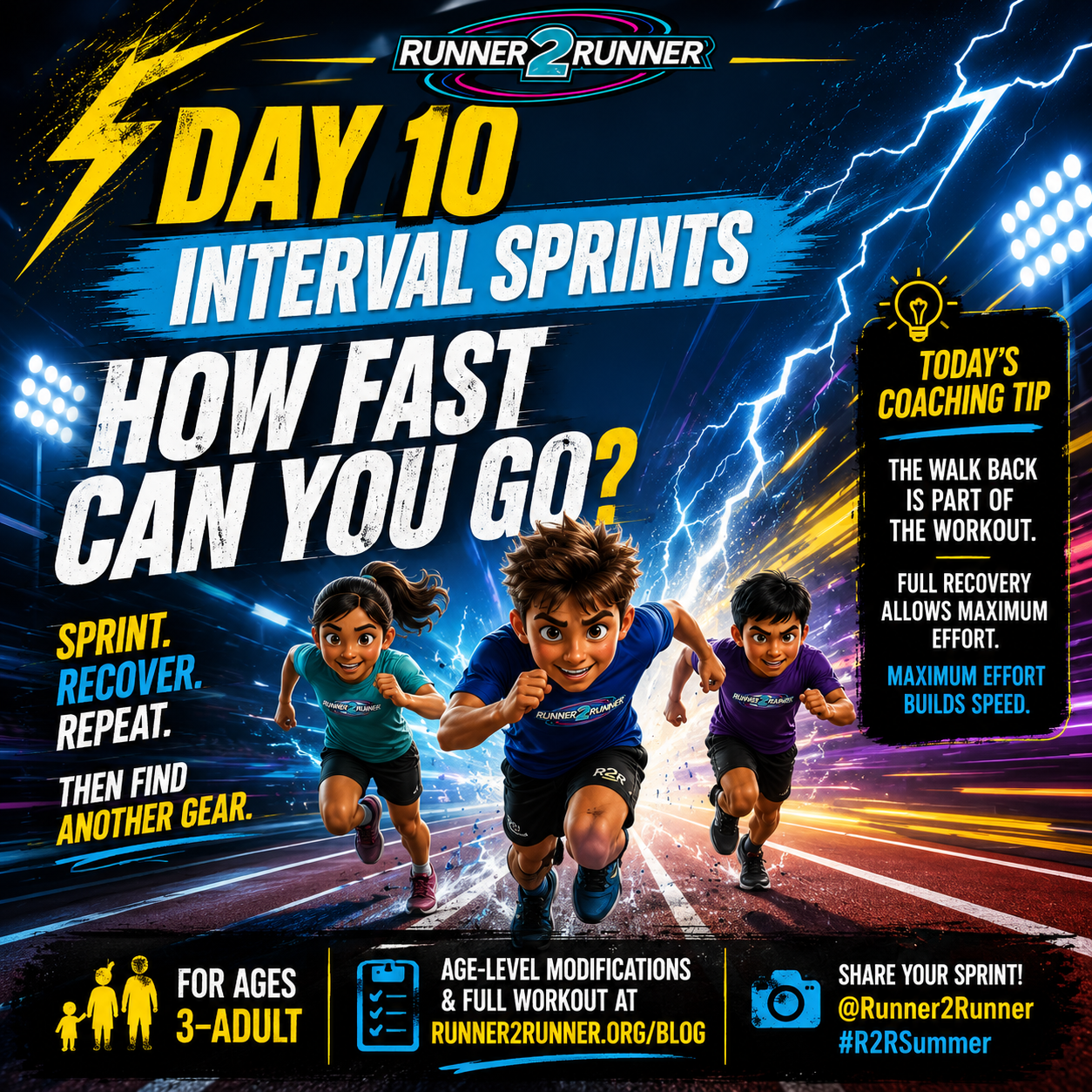
The walk back between sprints is not a break from the workout. It is the workout. Full recovery between efforts is what allows maximum effort on every sprint. Half rest produces half effort produces half the result. Walk the whole way back every single time.
Today's Workout — Interval Sprints
What you need: Any open space with a clear start and turnaround point. A course of 20 to 40 feet depending on your level. Chalk a start line and finish line if you want to make it official.
Total time: 15 to 22 minutes depending on your level.
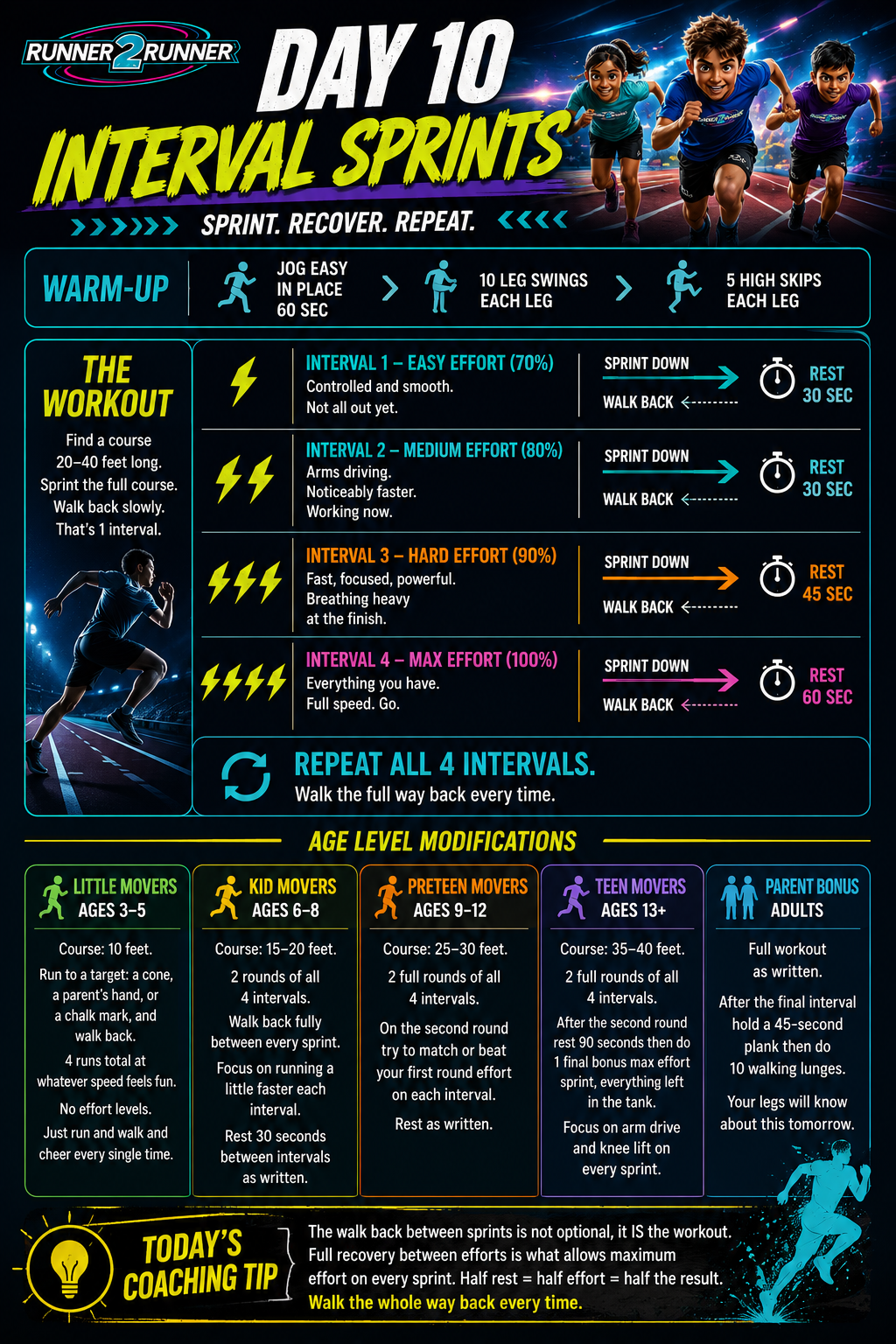
Warm-Up: Jog easily in place for 60 seconds. Do 10 leg swings forward and back on each leg. Do 5 high skips on each leg — big knee drive, big arm swing. You are ready.
The Workout
Sprint the full course. Walk back slowly. That is one interval. Work through all four effort levels, rest fully between each one, and go through the full set twice.
⚡ Interval 1 — Easy Effort Sprint (70%)
Run at about 70% of your maximum speed. Controlled and smooth, not all out yet. This first sprint is about finding your stride and getting the legs under you. You should feel like you could have gone faster.
Sprint down → Walk back slowly → Rest 30 seconds
⚡⚡ Interval 2 — Medium Effort Sprint (80%)
Pick it up to about 80% effort. You are working now. Arms driving, knees lifting, pace noticeably faster than Interval 1. You should feel like you were working but not at your limit.
Sprint down → Walk back slowly → Rest 30 seconds
⚡⚡⚡ Interval 3 — Hard Effort Sprint (90%)
90% effort. Fast, focused, and powerful. This should feel genuinely hard. Your breathing should be heavy at the finish. Your legs should know they sprinted.
Sprint down → Walk back slowly → Rest 45 seconds
⚡⚡⚡⚡ Interval 4 — Maximum Effort Sprint (100%)
Everything you have. Full speed. Arms pumping. Knees driving. Eyes forward. Go as fast as you possibly can for the full length of the course. Leave nothing on the driveway.
Sprint down → Walk back slowly → Rest 60 seconds — full rest, don't skip it
Repeat all 4 intervals.
The second time through you should have a clearer sense of what each effort level feels like. Try to match or slightly beat your first round on each interval.
Cool-Down: Walk two easy minutes. Forward fold toward toes, hold 20 seconds. Quad stretch standing, hold 15 seconds each leg. Calf stretch against a wall, hold 20 seconds each leg.
Age Modifications
🟢 Little Movers — Ages 3–5 | 8–10 Minutes
Course: 10 feet.
Keep it completely playful today. Set up a target (your hand held out, a cone, or a chalk mark) and tell them to run to it as fast as they can. Walk back together slowly after every run. Do 4 runs total at whatever speed feels fun. No effort levels, no instructions about pace. Just run to the target, walk back, cheer, and repeat. The target gives them a reason to sprint that doesn't require understanding percentages or effort levels. Four sprints to a target and back is a perfect interval workout for this age.
🟡 Kid Movers — Ages 6–8 | 12–15 Minutes
Course: 15–20 feet.
Do 2 full rounds of all 4 intervals exactly as written. Walk the full way back between every sprint, model it yourself so they follow. The most important coaching cue here is the walk back. Kids at this age naturally want to jog back or stand still and catch their breath quickly. Walk with them every time. When they understand that walking back is part of the workout and not cheating, the next sprint is always better for it.
🟠 Preteen Movers — Ages 9–12 | 15–18 Minutes
Course: 25–30 feet.
Do 2 full rounds of all 4 intervals as written. On the second round challenge them to match or slightly beat their first round effort on each interval. After the workout ask them to rate each sprint on a scale of 1 to 10. Interval 1 should feel like a 7, Interval 4 should feel like a 9 or 10. If Interval 4 felt the same as Interval 1 they started too hard. Use those ratings as real-time feedback to adjust on the second round.
🟣 Teen Movers — Ages 13+ | 18–22 Minutes
Course: 35–40 feet.
Do 2 full rounds of all 4 intervals as written. Shorten rest to 20 seconds on the second round for added challenge. After the second round rest 90 seconds then do 1 final bonus max effort sprint, everything left in the tank, nothing held back. Focus on arm drive and knee lift on every sprint. Introduce the concept of progressive loading across a set, each interval building on the last, arriving at maximum effort only when fully warmed up.
👨👩👧 Parent Bonus | 15–18 Minutes
Full workout as written alongside your child. After the final interval hold a 45-second plank then do 10 walking lunges before your cool-down. Your legs will be aware of themselves tomorrow. That is completely intentional and entirely worth it.
Did You Know?
Interval training was developed in the 1930s by an Olympic coach.
The interval training method was pioneered by German coach Woldemar Gerschler working with middle-distance runner Rudolf Harbig. Harbig broke the 800-meter world record using the method in 1939. The fundamental structure, hard effort followed by full recovery, repeated, has remained the backbone of sprint and middle-distance training ever since. Today your family used a system that has been producing world records for nearly 90 years.
Sprint intervals improve cardiovascular fitness faster than steady running.
Research published in the Journal of Physiology found that high-intensity interval training produces cardiovascular adaptations, improved VO2 max, increased cardiac output, better oxygen delivery to muscles, significantly faster than equivalent time spent at moderate steady-state pace. Six weeks of consistent interval training produces measurable improvements in aerobic capacity in children and adults alike.
The afterburn effect is real.
High-intensity sprint intervals elevate metabolism for hours after the workout ends, a phenomenon called Excess Post-exercise Oxygen Consumption or EPOC. Your body continues burning energy at an elevated rate while it repairs and rebuilds from the sprint efforts. The workout ends. The adaptation continues.
Hard efforts build mental toughness
Choosing to sprint at maximum effort when your body wants to slow down is a mental skill as much as a physical one. Research in sports psychology shows that athletes who regularly practice pushing through discomfort in training develop significantly better tolerance for effort in competition, and significantly better confidence in their own ability to handle hard things. Every max effort sprint today is building something that goes well beyond fitness.
Walking recovery is backed by science.
Active recovery, walking rather than standing still between sprint efforts, has been shown to clear lactate from muscles more effectively than passive rest. Walking keeps blood flowing to working muscles, accelerating the removal of metabolic byproducts and preparing the body more completely for the next sprint.
Coming Up Tomorrow — Day 11
Tomorrow is Day 11: The Neighborhood Explorer Run. Map a route, run or walk it together, and discover your neighborhood in a completely new way. Full details at runner2runner.org/blog at 6am.