Day 11: The Neighborhood Explorer Run
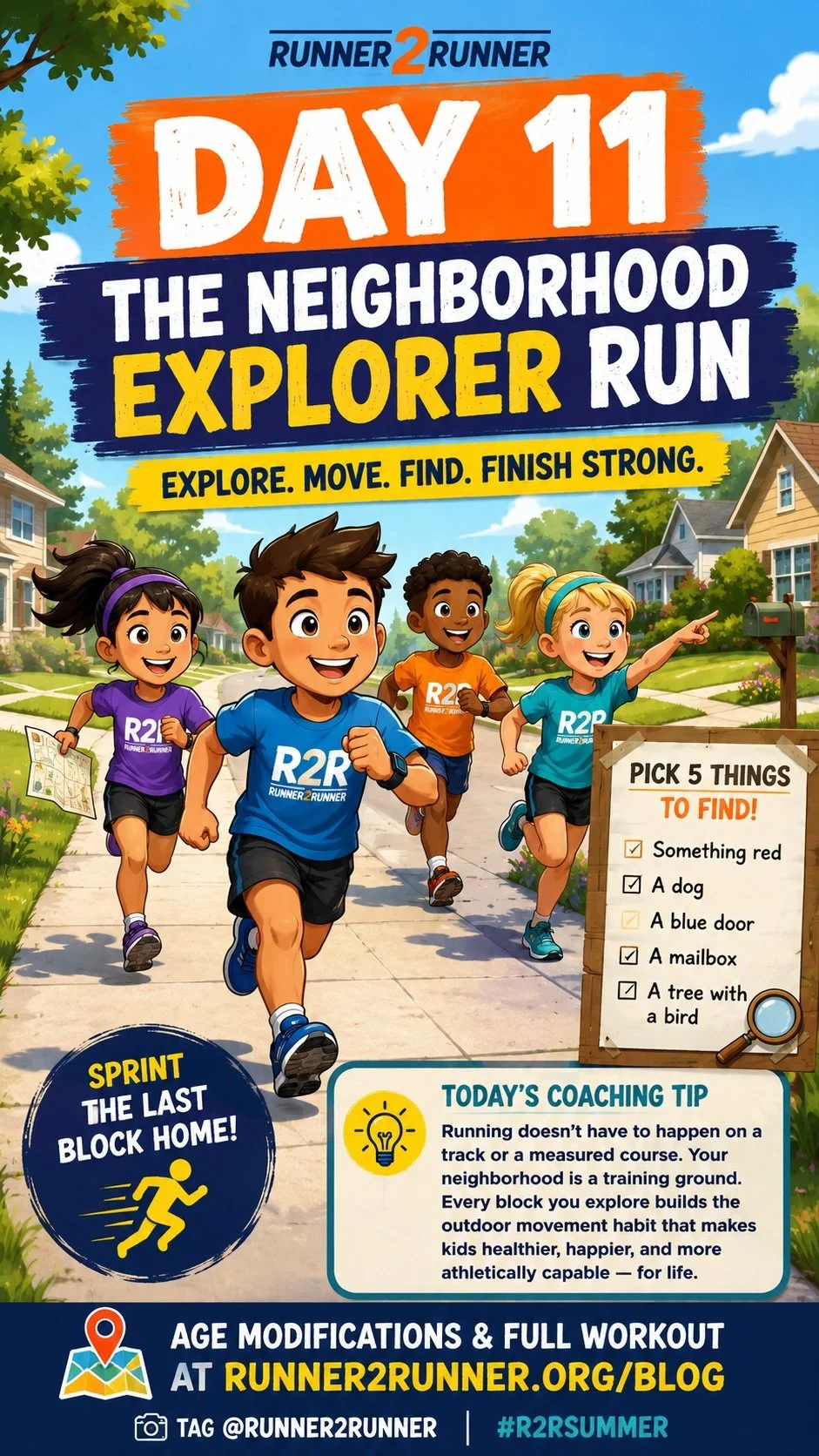
Today's challenge is The Neighborhood Explorer Run. Pick a route, write down 5 things to find before you leave, and run or walk between each one. When you've found all 5, sprint home!
No pace targets today. No intervals. No effort levels to hit. Just your family, your neighborhood, and a list of 5 things that turns an ordinary run into an adventure.
This is one of our favorite challenges of the whole summer, not because of what it does for fitness, but because of what it does for the relationship between kids and their own neighborhood. Children who explore on foot know their world differently. They notice more. They feel more at home in it. And they associate movement with discovery rather than obligation, which is exactly the association we want every child in this challenge to build.
Before You Leave, Make Your List
The most important step in today's workout happens before you take a single step outside. Sit down together and write your list of 5 things to find. Mix easy finds with harder ones. Let the kids contribute items. Let the challenge scale to your neighborhood and your family.
Here are ideas to get you started:
Easy finds: Good for toddlers and younger kids: Something red. A dog. A flower. A mailbox. A tree with a bird in it. A house with a porch. A parked bicycle.
Medium finds: Good for elementary ages: A house with a blue door. Something that makes a sound when the wind blows. A shadow shaped like something funny. A sprinkler running. Someone who waves back when you wave at them.
Hard finds: Good for preteens and teens: A house number that adds up to 10. Something that wasn't there last week. The oldest looking tree on the street. A smell that reminds you of something specific. Something that makes everyone on the run laugh out loud.
Write the list down before you leave. Take it with you. Check things off as you find them.
Today's Workout: The Neighborhood Explorer Run
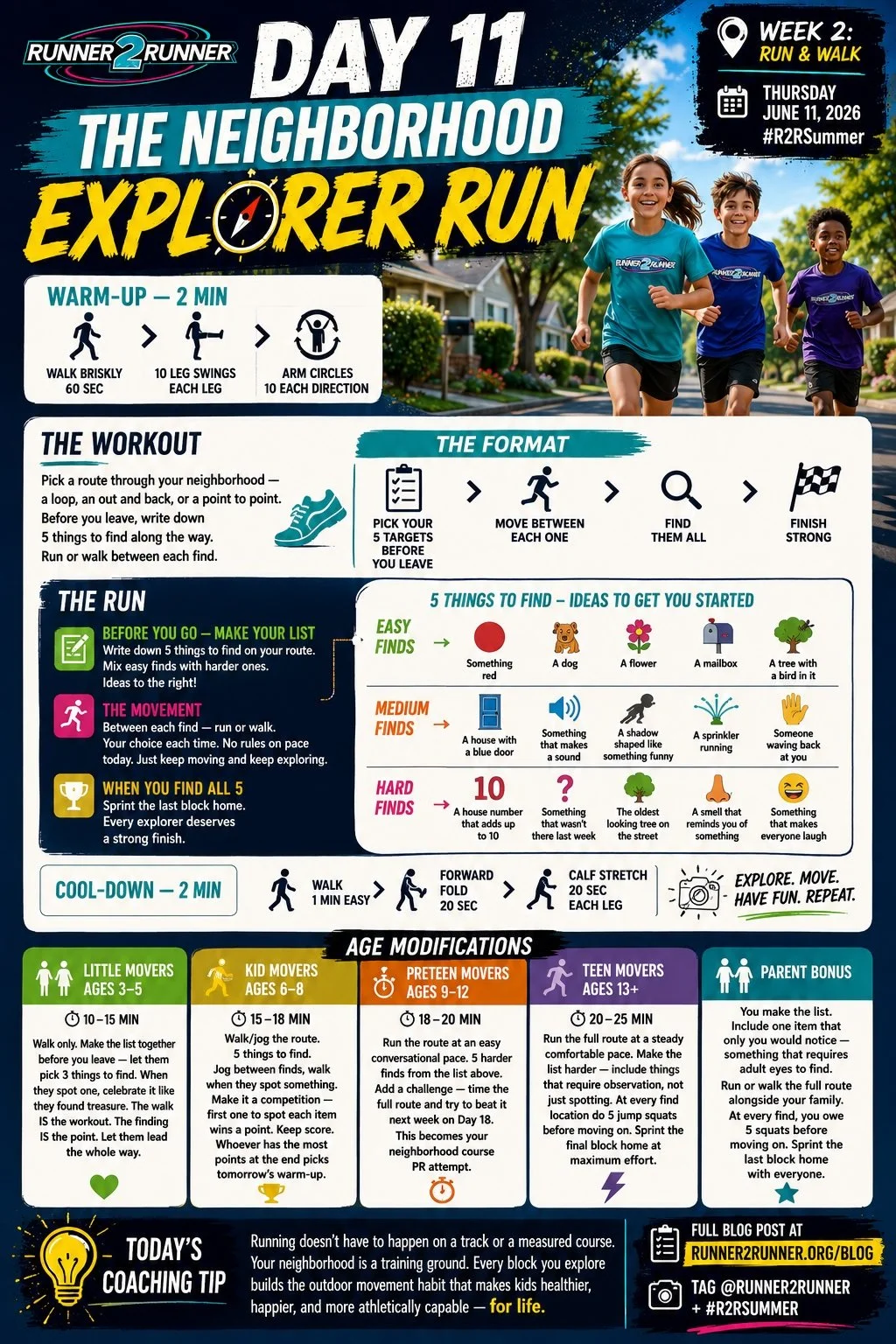
What you need: A route through your neighborhood, a loop, an out and back, or point to point. Your list of 5 things to find. No measured distance required. Work by time and exploration today.
Total time: 15 to 25 minutes depending on your level.
Warm-Up: Walk briskly for 60 seconds — swing your arms big and pick your feet up. Do 10 leg swings forward and back on each leg. Do 10 arm circles in each direction. You are ready.
The Run: Head out with your list. Move between each find, run or walk, your choice each time. When you spot something on the list, stop, confirm it, celebrate it, and then keep moving. When you find all 5, sprint the last block home.
Cool-Down: Walk 1 minute easy after the sprint home. Forward fold toward toes, hold 20 seconds. Calf stretch against a wall or step, 20 seconds each leg.
Age Modifications
🟢 Little Movers — Ages 3–5 | 10–15 Minutes
Walk only today, no running required. Make the list together before you leave and let them pick all 3 of the items on it. Keep the finds simple and easy to spot, something red, a dog, a flower. When they spot one, stop completely and celebrate it like they just found buried treasure.
🟡 Kid Movers — Ages 6–8 | 15–18 Minutes
Walk and jog the route. 5 things to find from the list, let them pick 3 and you pick 2. Jog between finds and walk when someone spots something.
🟠 Preteen Movers — Ages 9–12 | 18–20 Minutes
Run the route at an easy conversational pace. Choose 5 harder items from the medium and hard find lists above. Add a timing element, record how long the full route takes from front door to front door.
🟣 Teen Movers — Ages 13+ | 20–25 Minutes
Run the full route at a steady comfortable pace, conversational but purposeful. Choose hard finds only and make at least 2 of them genuinely observational rather than visual. At every find location stop and do 5 jump squats before moving on.
👨👩👧 Parent Bonus | 15–20 Minutes
You make the list. Include one item that only an adult would notice, something that requires experience or attention to spot, not just young eyes. Run or walk the full route alongside your family at their pace. At every find you owe 5 squats before you're allowed to move on.
Did You Know?
Children who explore their neighborhoods on foot have better spatial awareness and cognitive development.
Research from the University of London found that children who navigate their neighborhoods independently develop significantly better spatial reasoning, problem-solving ability, and environmental confidence than children who experience their neighborhood primarily from a car. Today's run is cognitive development disguised as a scavenger hunt.
Outdoor movement in varied environments builds more complete fitness than repetitive course running.
When you run on different surfaces, navigate turns, stop and start, and move through varied terrain, your body recruits a wider range of muscle groups and movement patterns than straight-line running on a flat surface. The Neighborhood Explorer Run builds athleticism that a track workout simply cannot replicate.
Coming Up Tomorrow, Day 12
Tomorrow is Day 12: The Traffic Light Game. Green means run. Yellow means walk. Red means freeze.