Day 12: Fun Friday - The Traffic Light Game
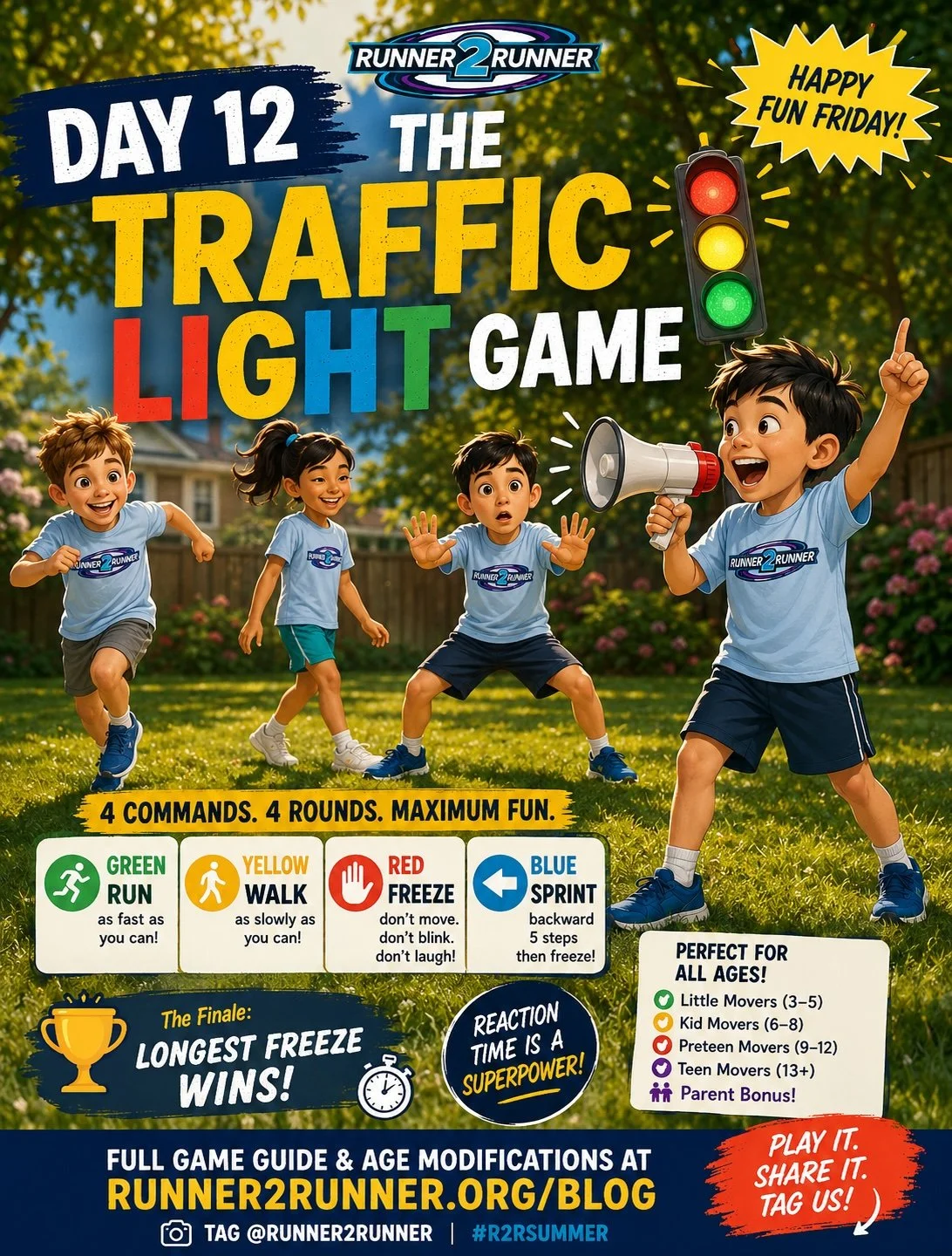
It's Fun Friday! The Traffic Light Game has one caller and one rule per color. Green means run. Yellow means walk. Red means freeze. The caller switches colors whenever they want, fast, slow, two reds in a row, a green that lasts half a second before switching to red. The players react as fast as they possibly can every single time.
It sounds simple. It is simple. It is also genuinely one of the best athletic training tools we have for kids of all ages — and the one that produces the most laughter per minute of any challenge in the R2R Summer program.
Happy Fun Friday. Let's play.
Why The Traffic Light Game Is Real Athletic Training
Here's something worth knowing before you head outside today.
Reaction time — the speed at which the nervous system processes a stimulus and initiates a physical response — is one of the most important and most undertrained athletic skills in youth sports. It determines how quickly a sprinter fires off a starting block. It determines how fast a relay runner initiates their exchange. It determines how explosively an athlete changes direction on a field or a court.
And here's the most important thing about reaction time: it is trainable. It is not fixed at birth. It is not determined by genetics. It is a skill that responds to practice exactly like any other physical skill — and the most effective way to train it, especially in children, is through reaction games that make the training feel like play.
Every color change in the Traffic Light Game is a reaction stimulus. Every freeze is the nervous system processing information and initiating a response under time pressure. Four rounds of this game — especially as the caller speeds up the commands in Rounds 3 and 4 — is genuine reaction training that produces real neurological development in young athletes.
They think they're playing a game. Both things are completely true.
Today's Workout — The Traffic Light Game
What you need: Any open space. Inside or outside. One person to be the caller. A phone with a voice loud enough to be heard during a full sprint is helpful but not required.
Total time: 15 to 20 minutes depending on level.
Warm-Up: March in place for 30 seconds. Do 10 jumping jacks. Jog easy in place for 60 seconds. You are ready.
The Commands
Before you start make sure everyone knows the four commands and what each one means.
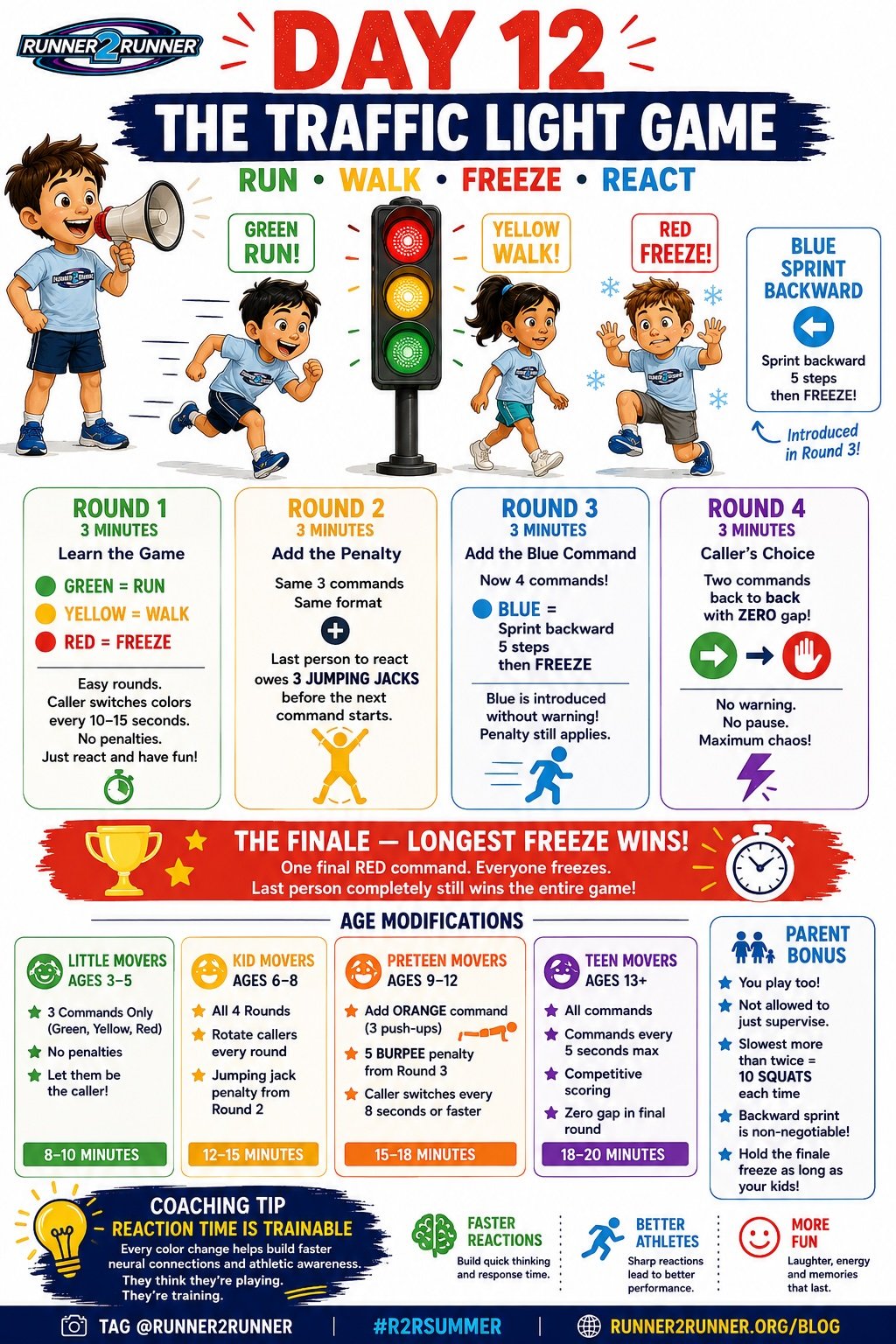
🟢 GREEN — RUN as fast as you can in any direction in your space. 🟡 YELLOW — WALK as slowly as you can. Exaggerate it. 🔴 RED — FREEZE completely still. Don't move. Don't blink. Don't laugh. (You will laugh.) 🔵 BLUE — SPRINT backward 5 full steps then freeze immediately. Blue gets introduced in Round 3. Keep it a surprise.
Round 1: Learn the Game. Easy rounds. Caller switches colors every 10 to 15 seconds. Let everyone find their footing. No penalties yet. Just green, yellow, and red. The goal of Round 1 is making sure every player understands the commands and has found the right amount of space to move in.
Round 2: Add the Penalty. Same three commands. Same format. One change: the last person to react to any command owes 3 jumping jacks before the next command starts. Caller waits for the jumping jacks to finish before calling the next color. This round gets competitive fast. The jumping jack penalty is small enough to be fair but just significant enough to make everyone push their reaction speed.
Round 3: The Fourth Command. Introduce the blue command without warning. Just call it. 🔵 BLUE means sprint backward 5 steps then freeze. The first time you call it the reactions will be wonderful. Some people will go the wrong direction. Some will forget the backward part. All of it is great. Now there are four commands. Reactions have to be faster because there are more possibilities to process. Jumping jack penalty still applies for last reactions.
Round 4: Caller's Choice. The caller can now chain two commands back to back with zero gap between them. GREEN, immediately RED. YELLOW, immediately BLUE. No warning. No pause. Pure reaction. This round produces the best moments of the entire game, mid-sprint freezes, almost-backward-sprints that turn into something else entirely, and laughter that interrupts the freezes consistently.
The Finale: Longest Freeze
One final RED command called at the end of Round 4. Everyone freezes. Caller steps back and watches. Last person standing completely still, no movement, no wobble, no laugh-induced shake, wins the entire game. Hold it as long as you possibly can.
Cool-Down: Walk one minute easy. Forward fold toward toes, hold 20 seconds. Quad stretch standing, hold 15 seconds each leg.
Age Modifications
🟢 Little Movers — Ages 3–5 | 8–10 Minutes
Three commands only today, green, yellow, and red. No blue backward sprint and no jumping jack penalty. Pure fun, zero pressure. Play 3 rounds of the basic game and keep every round short, 2 minutes maximum each.
🟡 Kid Movers — Ages 6–8 | 12–15 Minutes
All 4 rounds as written. This age group will want to play this game every single day for the rest of the summer. Let them. It is good training every time.
🟠 Preteen Movers — Ages 9–12 | 15–18 Minutes
All 4 rounds as written with two additions. First, add a fifth command: 🟠 ORANGE means drop to the ground, do 3 push-ups, and jump back to standing. Introduce it in Round 3 alongside blue. Second, increase the penalty from Round 3 onward to 5 burpees for the last reactor instead of 3 jumping jacks. Caller must switch commands every 8 seconds or faster from Round 2 onward. No slow rounds.
🟣 Teen Movers — Ages 13+ | 18–20 Minutes
All 4 rounds plus the orange command introduced in Round 3. Caller switches every 5 seconds maximum, no grace period, no slow rounds from the start. Add competitive scoring: keep a running total across all rounds of who was fastest to react and who was slowest. The player with the most fastest reactions wins.
👨👩👧 Parent Bonus | 12–15 Minutes
You are the caller for Round 1 and a full player for every round after that. You are not allowed to be the slowest reactor more than twice, if you are, 10 squats each time before play resumes. The finale freeze: you hold it as long as your kids. No letting them win by default. Make them beat you.
Did You Know?
Reaction time is fastest between ages 18 and 24, but the pathways that enable it are built in childhood.
The neural architecture underlying fast reaction time, the myelination of neural pathways, the development of motor cortex connections, the calibration of the sensorimotor system, is built during childhood and adolescence. Games that require rapid response to a stimulus during these years literally wire the brain for faster reactions. Every color change today is laying down faster neural connections.
Processing multiple possible commands trains cognitive flexibility.
When the Traffic Light Game has four or five possible commands instead of three, the player's brain must hold multiple possible responses ready simultaneously and select the correct one at speed. This is called cognitive flexibility, the ability to switch between different rules or responses rapidly, and it is associated with better academic performance, better athletic performance, and better social problem-solving in children. More commands equals more brain development.
The freeze after a sprint builds the same deceleration control used in injury prevention.
Stopping explosively from a full sprint and holding a static balance position requires eccentric muscle control, the same mechanism that prevents ACL tears, ankle sprains, and hamstring strains in young athletes. Every RED command after a GREEN sprint is deceleration training. Every freeze held after a backward sprint is proprioceptive training. The game is doing important injury prevention work dressed up as a Friday afternoon laugh.
Coming Up This Weekend: Day 13/14
Tomorrow is Day 13: Weekend Edition, The Progress Long Run. Head back to your Week 1 long run route and see how it feels the second time around.