Days 13 & 14 Weekend Edition: The Progress Long Run + Active Recovery Day
Week 2 Weekend Edition. Two days. Two very different purposes. Both equally important.
Saturday is The Progress Long Run, we go back to the same route we ran in Week 1 and find out what 7 days of consistent movement has already built. Sunday is Active Recovery Day, we stretch, rest, and submit our Week 2 tracker.
Let’s take them one at a time.
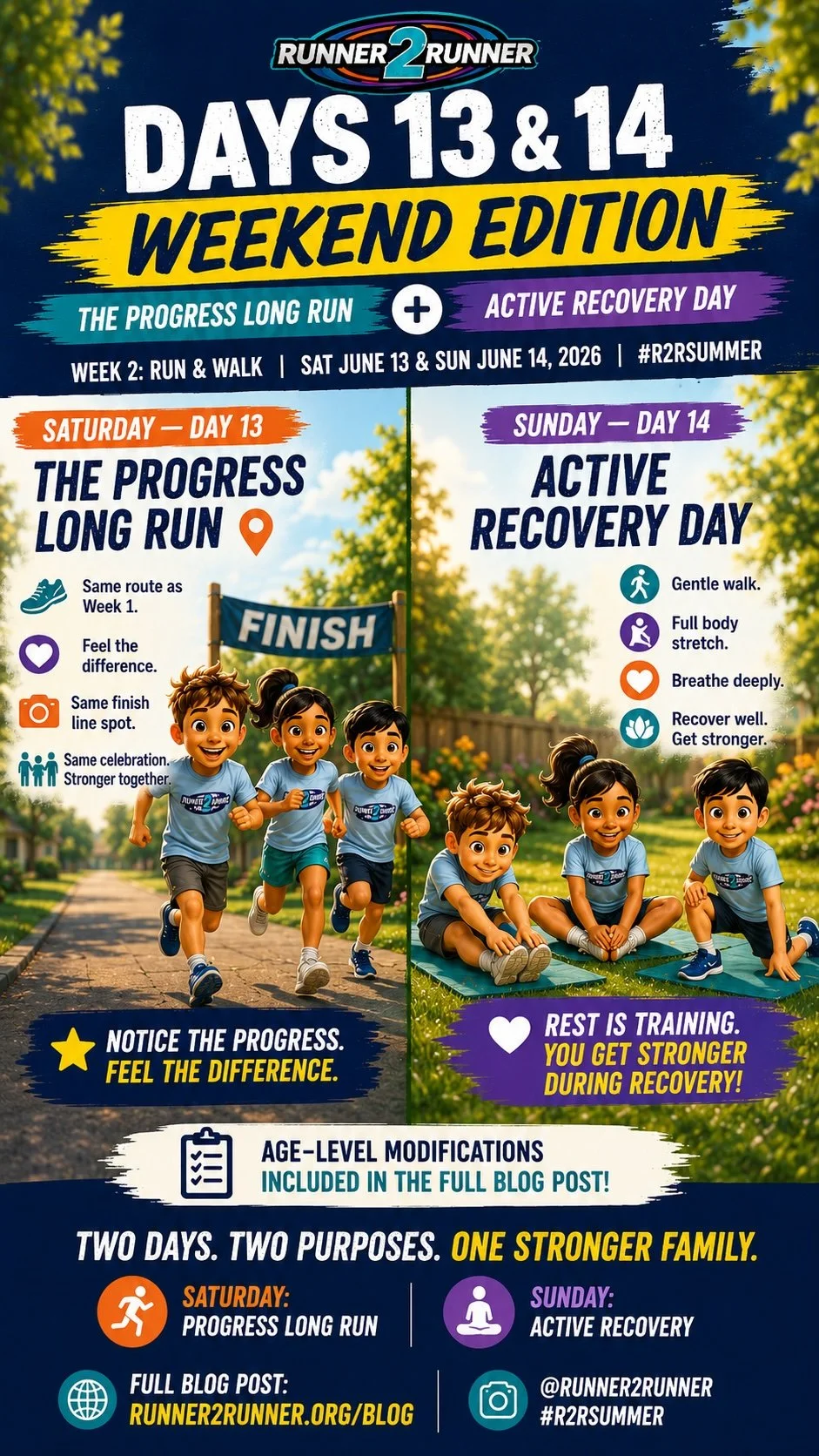
SATURDAY, DAY 13: THE PROGRESS LONG RUN
WARM-UP: Walk briskly 60 sec → 10 leg swings each leg → arm circles 10 each direction
THE WORKOUT
Head back to your Week 1 long run route. Before you go: Pull up your Week 1 long run notes, how far did you go? How did it feel? How long did it take? That’s your baseline. Today we find out what 7 days of consistent movement has already done.
The Run
Same route as Week 1. Run or walk it, same format as last week. As you move pay attention to these four things:
Does the first half feel easier than last week?
Is your breathing more comfortable at the same pace?
Are you recovering faster when you slow down?
Does the distance feel shorter even if the time is similar?
Any yes to any of those is real fitness progress showing up in your body right now.
The Finish
Same finish line spot as Week 1 if possible. Same celebration. Arms up. Everyone together.
COOL-DOWN: Walk 2 min easy → forward fold 20 sec → calf stretch 20 sec each leg → hip flexor lunge 20 sec each side
SATURDAY AGE MODIFICATIONS
🟢 Little Movers (Ages 3–5): 15–20 min
Same walk route as Week 1. No distance goal. Notice how much more confident they seem and tell them specifically what you see. That recognition matters more than any distance at this age.
🟡 Kid Movers (Ages 6–8): 18–22 min
Same route. Try to jog one more block than last week. Any increase is real progress.
🟠 Preteen Movers (Ages 9–12): 22–26 min
Same route. Try to run more of it continuously. Time the full run, this is your bench.
🟣 Teen Movers (Ages 13+): 25–30 min
Same route. Try a negative split, faster second half than first. Add one extra block if energy allows.
👨👩👧 Parent Bonus
Run every step at your child’s pace. At the exact halfway point tell them one specific thing you noticed about them this week. Something real and athletic. Run the second half on that. Finish together.
SATURDAY COACHING TIP
Progress in running rarely looks dramatic from the outside. It feels different from the inside, easier breathing, faster recovery, more comfort at the same pace. Pay attention to those feelings today. That’s fitness building in real time.
Saturday Fun Facts
Fitness adaptations begin within the first week of consistent training. Research in exercise physiology shows that measurable cardiovascular adaptations, increased stroke volume, improved oxygen delivery, more efficient energy metabolism, begin within 7 to 10 days of starting a consistent training program. After one week of the R2R Summer Challenge your family’s bodies have already begun adapting. Today’s run is the first time you’ll feel those adaptations from the inside.
Progressive overload is the fundamental principle of all athletic development. The body adapts to stress by becoming capable of handling more stress. Every week in the R2R Summer Challenge is slightly more demanding than the one before it. Week 2 builds on Week 1. Week 3 builds on Week 2. Your family is following the same progressive overload principle that builds Olympic athletes. The scale is different. The principle is identical.
SUNDAY, DAY 14: ACTIVE RECOVERY DAY
Rest days are not days off. They are days with a different purpose. Your body gets stronger during recovery, not during the workout. Today is gentle movement only. Keep everything slow, easy, and focused on how the body feels.
THE RECOVERY: 5 minutes, gentle walk, Walk slowly around the block or your yard. No pace target. Just moving.
Full body stretch. Work through each stretch slowly. Hold every position for at least 30 seconds. Breathe deeply through each one.
Arms overhead: reach as tall as possible, hold, release
Forward fold: bend at the hips, let everything hang, don’t force it
Seated butterfly: soles of feet together, gently press knees toward ground
Lying quad stretch: on your side, pull top foot toward glutes
Hip flexor lunge: one knee on ground, lean forward gently
Lying spinal twist: on your back, one knee crosses over the body, arms wide
Happy baby: on your back, knees to chest, rock side to side
Finish: Three slow deep breaths. You’re done. Well done.
SUNDAY AGE MODIFICATIONS
🟢 Little Movers (Ages 3–5): Happy baby pose, hug knees to chest and rock side to side. Make a bridge. Shake everything out like a wet dog.
🟡 Kid Movers (Ages 6–8): Slow walk around the block + 5 minutes of stretching. Arms overhead, forward fold, butterfly, lying knee hug. Hold each 20 seconds.
🟠 Preteen Movers (Ages 9–12): Full stretch sequence as written above. Focus especially on hip flexors and calves, the two areas that carry the most load from running.
🟣 Teen Movers (Ages 13+): 12–15 min
Full stretch sequence plus add pigeon pose each side (60 seconds each) and a 5-minute easy walk to finish. This is your body’s investment in next week’s performance.
👨👩👧 Parent Bonus: Full recovery sequence alongside your kids. Focus especially on hip flexors, lower back, and calves. Hold every stretch for 45 seconds. Breathe slowly. This is your recovery too.
Sunday Fun Facts
You don’t get stronger during a workout, you get stronger after it. Exercise creates microscopic stress in muscle tissue. Recovery is when the body repairs that tissue and builds it back stronger than before. Skipping recovery doesn’t make you tougher. It makes the next workout harder and increases injury risk significantly. Rest is not the absence of training. Rest is training. Gentle movement on recovery days accelerates repair.
Week 2. You Did That. Come back Monday for Week 3. We’re moving into Strength and Agility and things are about to get challenging in the best possible way. See you at 6am.