Day 16: Push-Up Variations
Most people think of running as a legs-only sport. However, it is more than that!
Watch an elite sprinter and the first thing you notice is the arms. They drive backward and forward in a powerful, controlled rhythm that generates momentum, maintains posture, and keeps the body upright under fatigue. The shoulders, chest, and triceps doing that work aren't built by running. They're built by pushing.
Today's challenge is Push-Up Variations. We work through three levels of push-up difficulty, building upper body strength that directly transfers to better running posture, more powerful arm drive, and a stronger finish when the legs start to tire.
Wall push-ups to knee push-ups to full push-ups to diamond push-ups. Every age has a level. Every level builds something real.
Before You Start. Let’s do a form check!
A push-up done with poor form builds poor movement patterns. Take 30 seconds before the workout to go through this with your family.
Body in a straight line from head to heels, or head to knees for the modified versions. Hands slightly wider than shoulder-width. Elbows tracking back at roughly 45 degrees, not flaring out to the sides. Lower until your chest nearly touches the ground or the wall. Push back up fully. That's one rep.
The most common mistake: letting the hips sag or pike up. Everything should stay in one straight line the whole way down and back up. Do one slow rep together before you start.
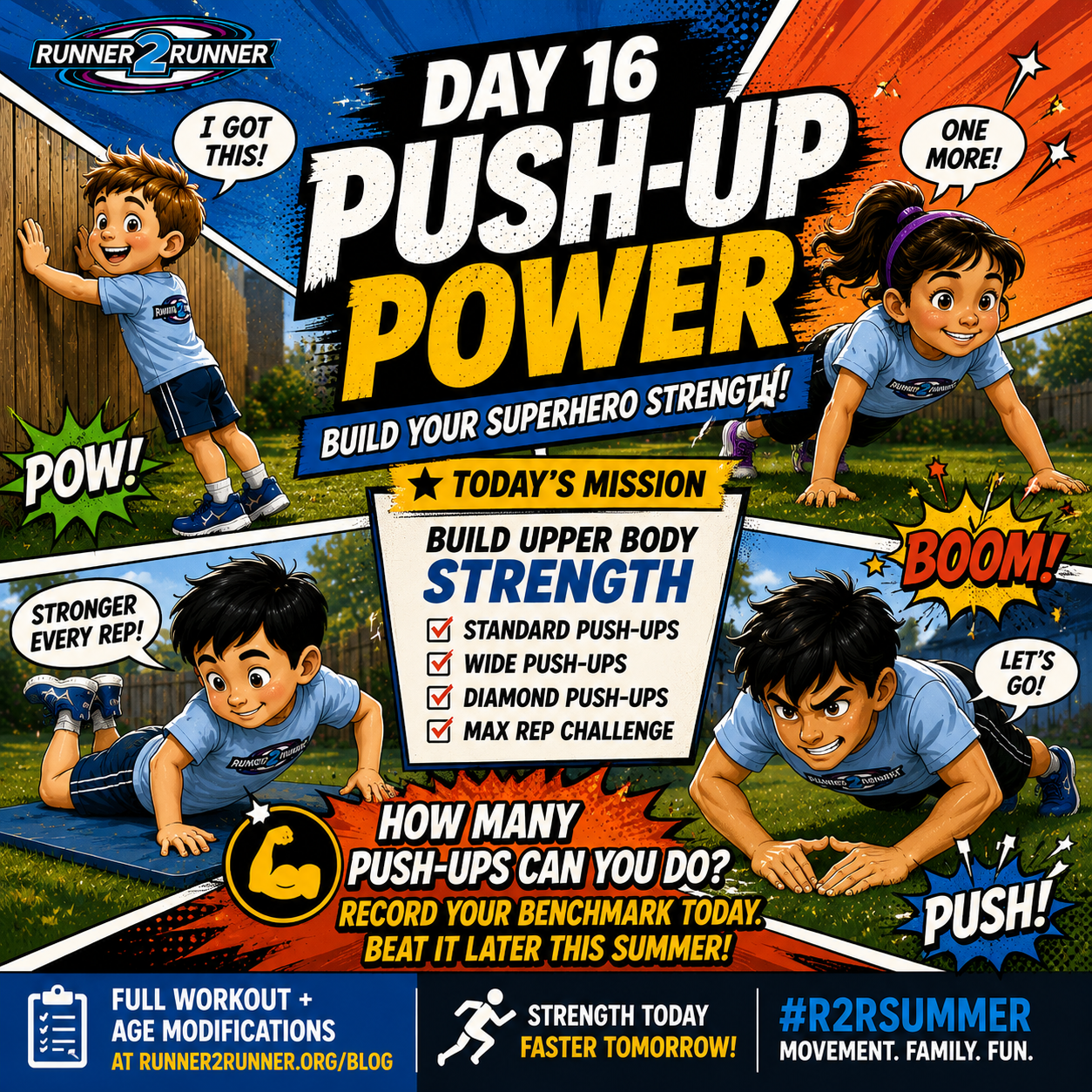
Today's Workout: Push-Up Variations
What you need: Any flat surface. A clear wall for the beginner level. No equipment required.
Total time: 15 to 25 minutes including warm-up, cool-down, and optional running add-on.
Warm-Up: 10 arm circles forward, 10 arm circles backward. 10 shoulder rolls each direction. 5 slow inchworms, fold forward, walk hands out to a plank position, walk feet back to hands, stand. You are ready.
Block 1: Standard Push-Ups: Your baseline push-up at your level. Controlled pace, full range of motion. This block establishes the movement pattern and builds the chest, shoulders, and triceps in their primary pushing plane.
Block 2: Wide Push-Ups: Hands placed wider than shoulder-width. This variation shifts more of the load onto the chest and the front of the shoulder. Slightly easier for most people than standard, use that to focus on depth and a full range of motion.
Block 3: Narrow Push-Ups: Hands placed closer together, directly below the shoulders or slightly inside them. This variation shifts the load toward the triceps and inner chest. Noticeably harder than standard for most people. Slow it down if needed.
Block 4: Finisher: Maximum push-ups without stopping at your level. No time limit. Go until you can't go anymore. Write down the number. This is your push-up benchmark for the summer.
Cool-Down: Walk one minute easy. Thread-the-needle shoulder stretch, in a plank position reach one arm under the body and rotate, hold 20 seconds each side. Child's pose, hold 30 seconds. Wrist circles 10 each direction, the wrists will need this after four blocks of push-ups.
Age Modifications
🟢 Little Movers: Ages 3–5 | 8–10 Minutes
All push-ups today are wall push-ups. Stand arm's length from a wall, place hands flat against it at shoulder height, and push in and out. This is a full and appropriate push-up for this age group, it builds the same movement pattern and the same muscles at a load that matches developing upper body strength. 3 rounds of 5 wall push-ups with a 20-second rest between rounds. Finisher: how many wall push-ups can they do without stopping? Count out loud together. No running add-on needed today.
🟡 Kid Movers: Ages 6–8 | 15–18 Minutes
Blocks 1 and 2 on knees, Block 3 attempt from toes if they're ready. Block 1: 3 rounds of 8 knee push-ups, 20 seconds rest. Block 2: 3 rounds of 8 wide knee push-ups, 20 seconds rest. Block 3: 3 rounds of 6 narrow knee push-ups, 30 seconds rest. Finisher: maximum knee push-ups without stopping, write down the number. Optional running add-on: after the cool-down jog ⅛ mile easy, 1 backyard lap at a comfortable pace.
🟠 Preteen Movers: Ages 9–12 | 18–22 Minutes
Full push-ups from toes throughout. If full push-ups aren't available yet drop to knees for Block 3 and the finisher only, everything else from toes. Block 1: 3 rounds of 10 full push-ups, 20 seconds rest. Block 2: 3 rounds of 10 wide push-ups, 20 seconds rest. Block 3: 3 rounds of 8 narrow push-ups, 30 seconds rest, these will be hard. Finisher: maximum push-ups without stopping. Record the number. Optional running add-on: ½ mile easy run after the cool-down.
🟣 Teen Movers: Ages 13+ | 20–25 Minutes
Full push-ups throughout with a tempo element added in Block 3. Block 1: 4 rounds of 12 push-ups, 15 seconds rest. Block 2: 4 rounds of 12 wide push-ups, 15 seconds rest. Block 3: 3 rounds of 8 diamond push-ups, hands forming a diamond shape directly below the chest with 30 seconds rest. These isolate the triceps almost entirely and are significantly harder than standard push-ups. Block 4 finisher: maximum push-ups without stopping. Record the number. This is your benchmark. Optional running add-on: ¾ mile easy run after the cool-down.
👨👩👧 Parent Bonus | 18–22 Minutes
Full push-ups throughout. Block 1: 4 rounds of 10 standard push-ups. Block 2: 4 rounds of 10 wide push-ups. Block 3: 3 rounds of 8 diamond push-ups. Finisher: maximum push-ups without stopping. Write down the number. This is your benchmark. Optional running add-on: ½ mile easy run after the cool-down. Note that upper body soreness tomorrow is normal and expected — it means the training is working.
The Optional Running Add-On
Same principle as yesterday. Aerobic fitness fades faster than strength fitness and short easy runs on strength days keep the cardiovascular base alive and building.
Little Movers: no add-on needed today.
Kid Movers: ⅛ mile easy jog after cool-down.
Preteen Movers: ½ mile easy run after cool-down.
Teen Movers: ¾ mile easy run after cool-down.
Parents: ½ mile easy run after cool-down.
Keep it easy. If it feels like a workout you are going too hard.
Did You Know?
Arm drive accounts for roughly 30% of sprinting speed. Research in biomechanics has shown that the arms contribute significantly to sprint velocity, not just as balance, but as active drivers of momentum. When arm drive breaks down under fatigue, stride length shortens and pace drops. Building upper body strength and endurance through push-up training directly improves the arm drive that keeps sprint mechanics intact when it matters most. Push-ups are one of the most studied exercises in sports science. Decades of research consistently confirm that the push-up is one of the most effective bodyweight exercises for building functional upper body strength
Tomorrow is Day 17: Core Blast. Planks, crunches, Superman holds, and dead bugs. A strong core is the foundation of every athletic movement and tomorrow we build it together. See you at 6am.