Day 18: Long Jump Practice
Run. Jump. Fly as far as you can. Land. Measure it. Also known as the Long Jump!
Children do this naturally, jumping over puddles, leaping off steps, bounding across grass. Today we channel that instinct into something deliberate. We set up a driveway long jump, learn the mechanics that make it go further, practice the approach and the takeoff, and measure every attempt. The combination of speed, power, and the concrete feedback of a measured distance makes long jump practice immediately compelling for every age group. Kids who have never thought about track and field will want to keep jumping long after the workout is technically over.
Before You Start: Set Up Your Jump Zone
You need a flat surface with enough room for a short approach run. A driveway works perfectly. A grassy area works too. Here's how to set it up:
Mark a takeoff line with chalk or cones. This is where the jump starts, the last foot to touch the ground before the jump. Mark it clearly so everyone uses the same spot.
From the takeoff line, mark distances along the landing zone, 2 feet, 3 feet, 4 feet, 5 feet, 6 feet, and beyond depending on age. Use chalk numbers so everyone can see exactly how far they jumped.
Soft landing surface is ideal if available, a patch of grass, a sandpit, a mat. If jumping on a hard surface, focus on very soft two-foot landings and avoid single-leg landings.
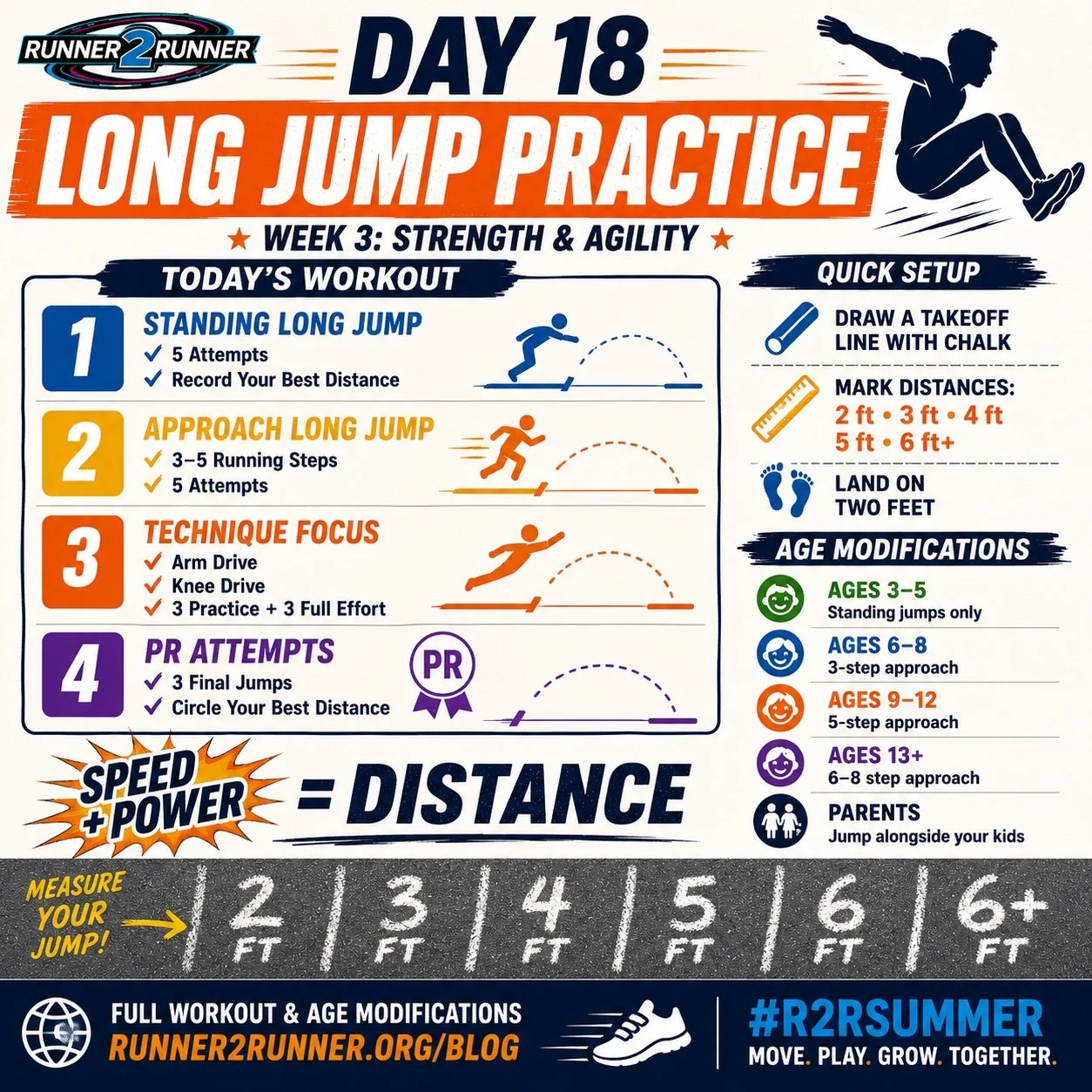
Today's Workout: Long Jump Practice
What you need: A flat surface, chalk, and about 10 to 15 feet of clear running approach space.
Total time: 15 to 25 minutes including warm-up, cool-down, and optional running add-on.
Warm-Up: Jog easy in place 30 seconds. 10 leg swings forward and back each leg. 5 two-foot jumps in place focusing on soft landings, land on both feet, absorb through ankles, knees, and hips. 5 broad hops forward for distance. You are ready.
Block 1: Standing Long Jump: No approach run. Stand at the takeoff line, swing your arms back, bend your knees, and explode forward as far as possible. Land on both feet. Measure from the takeoff line to the back of the nearest heel. 5 attempts. Record your best.
Block 2: Approach Long Jump: Take 3 to 5 running steps before the takeoff line, hit the line on one foot, and jump as far as possible. Land on both feet. The approach adds speed which adds distance — notice how much further this goes compared to Block 1. 5 attempts. Record your best.
Block 3: Technique Focus: Slower attempts focused on the two most important mechanics. First — arm drive on takeoff, both arms swing forward and up at the moment of takeoff to add lift and distance. Second — knee drive, the lead knee drives upward on takeoff which extends the jump arc. 3 slow focused attempts, then 3 full effort attempts using everything you've practiced.
Block 4: Personal Record Attempt: Full approach, full effort, everything you've learned in Blocks 1 through 3. 3 final attempts. Circle your best distance in chalk. This is your long jump personal record for the summer.
Cool-Down: Walk one minute easy. Forward fold, hold 20 seconds. Quad stretch, hold 20 seconds each leg. Calf stretch against the wall, hold 20 seconds each leg. The calves and quads work hard in the long jump takeoff and will appreciate the attention.
Age Modifications
🟢 Little Movers: Ages 3–5 | 8–10 Minutes
Skip the approach run entirely, all jumps are standing long jumps from a chalk line. The goal is simply to jump forward from two feet and land on two feet. Mark a target on the ground a comfortable distance away and jump to it. 8 to 10 total jumps spread across the session with walking rest between each. Measure one jump together and write the number in chalk next to the landing spot, seeing their distance written down is thrilling for this age group. No running add-on needed today.
🟡 Kid Movers: Ages 6–8 | 15–18 Minutes
Block 1: 5 standing long jumps, measure and record the best.
Block 2: 5 approach long jumps with a 3-step run-up, measure and record the best. Compare to the standing jump, the difference in distance is a tangible lesson in how speed adds power.
Block 3: 3 technique focus jumps then 3 full effort.
Block 4: 3 personal record attempts, circle the best in chalk.
Optional running add-on: after the cool-down jog ⅛ mile easy at a comfortable pace.
🟠 Preteen Movers: Ages 9–12 | 18–22 Minutes
Full workout as written.
Block 2 uses a 5-step approach.
Block 3 add explicit coaching on the takeoff foot, most athletes have a preferred takeoff foot, the one that feels more powerful and natural on the jump. Try 3 jumps off each foot and identify which produces more distance. Use that foot for Block 4.
Optional running add-on: ½ mile easy run after the cool-down.
🟣 Teen Movers: Ages 13+ | 20–25 Minutes
Full workout as written with a full 6 to 8 step approach run in Block 2 onward.
Block 3 add the Fosbury principle, at the peak of the jump the body should be horizontal, arms reaching forward, legs extended. Practice the body position in the air even on shorter jumps.
Block 4: 5 personal record attempts, not 3. Record every distance and track the progression.
Optional running add-on: ¾ mile easy run after the cool-down.
👨👩👧 Parent Bonus | 15–20 Minutes
Compete in every block alongside your kids. Your standing long jump distance in Block 1 becomes the target everyone tries to beat. Whether they beat you or not, make a big deal of the attempt. Block 4: 3 personal record attempts. Circle your distance. Compare it to your kids'.
Optional running add-on: ½ mile easy run after the cool-down.
The Optional Running Add-On
Little Movers: no add-on needed today.
Kid Movers: ⅛ mile easy jog after cool-down.
Preteen Movers: ½ mile easy run after cool-down.
Teen Movers: ¾ mile easy run after cool-down.
Parents: ½ mile easy run after cool-down.
Keep it easy. Aerobic maintenance on a strength and power day.
Did You Know?
The long jump is one of the oldest athletic events in human history. The long jump appeared in the ancient Greek Olympics, the only jumping event included in the original games. Athletes used hand weights called halteres to increase their distance by swinging them forward at takeoff. The event has been continuously contested in major athletics competitions for over 2700 years.
Coming Up Tomorrow, Day 19 - Fun Friday. The Obstacle Course Challenge