Day 2: The Jumping Jack Challenge — Start Summer Strong, One Rep at a Time
Today’s Challenge: Jumping Jacks!
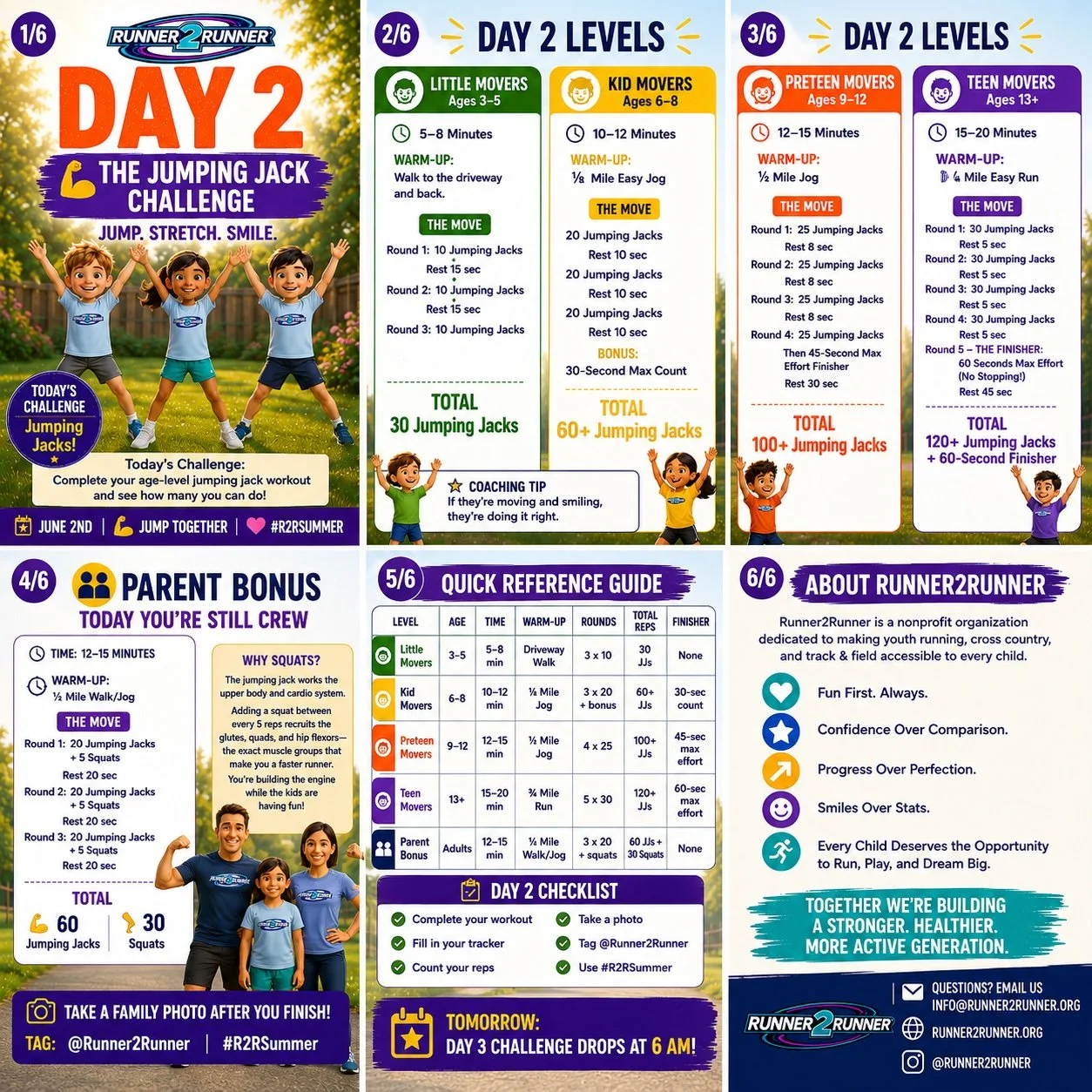
Welcome back. You showed up for Day 1. You did the Family Lap. And now Day 2 is here and we're keeping the momentum going with one of the greatest all-ages exercises ever invented.
Today's challenge is the Jumping Jack Challenge.
Yes, jumping jacks. The move you've been doing since you were a child! The one that looks too simple to matter. The one that, we promise, is going to feel a whole lot less simple by the time you hit the finisher in Round 4.
Every level today starts with a short warm-up run to get the blood moving, works through timed jumping jack rounds built for your age and fitness level, and finishes with a cool-down. Five to twenty minutes depending on your level. No equipment. Any open space. The whole family, all at once, each at their own pace.
Today's Workout — The Jumping Jack Challenge
🟢 Little Movers — Ages 3–5 | 5–8 Minutes
Warm-Up — 1 minute
Walk to the end of the driveway and back. That's enough. You're just waking the legs up.
The Move — 4–5 minutes
Round 1: 10 jumping jacks. Count out loud together. Make the biggest star shapes you possibly can.
Rest: Shake your hands and wiggle your feet for 15 seconds.
Round 2: 10 jumping jacks. Try to jump a little higher than Round 1.
Rest: 15 seconds. Take a big breath together.
Round 3: 10 jumping jacks. Best effort finish — give it everything!
Cool-Down — 1 minute
Walk slowly around the yard once and take three big deep breaths together.
Total: 30 jumping jacks
A note for parents: At this age, form doesn't matter at all. If they're jumping and their arms are going somewhere, they're doing it perfectly. Count every single rep out loud and cheer like it's the Olympics. The goal here isn't fitness — it's fun. The fitness follows.
🟡 Kid Movers — Ages 6–8 | 10–12 Minutes
Warm-Up — 2 minutes
Jog one lap around your yard or driveway (roughly ⅛ mile). Easy, comfortable pace — this is just to warm up, not to wear out.
The Move — 7–8 minutes
Round 1: 20 jumping jacks — steady pace, focused on form.
Rest: 10 seconds.
Round 2: 20 jumping jacks — pick up the pace a little from Round 1.
Rest: 10 seconds.
Round 3: 20 jumping jacks — faster than Round 2. Push yourself!
Rest: 10 seconds — shake it out, catch your breath.
Bonus Round (optional): Set a timer for 30 seconds. How many jumping jacks can you do? Count every single one and remember the number.
Cool-Down — 1–2 minutes
Walk one lap around the yard. Stretch arms overhead, hold for 10 seconds. Then try to touch your toes and hold for 10 seconds.
Total: 60+ jumping jacks
Coaching tip: Challenge your kid to keep their feet together when they land. It's one small focus point that makes the move harder and builds the ankle coordination that carries directly into sprinting and jumping events.
🟠 Preteen Movers — Ages 9–12 | 12–15 Minutes
Warm-Up — 3 minutes
Jog ½ mile at an easy pace — that's 2 backyard laps or 1 lap around a standard track. Comfortable, conversational. You should be able to talk.
The Move — 8–9 minutes
Round 1: 25 jumping jacks — controlled pace, good form, arms and legs working together.
Rest: 8 seconds.
Round 2: 25 jumping jacks — pick up the speed.
Rest: 8 seconds.
Round 3: 25 jumping jacks — faster again. You should be breathing hard.
Rest: 8 seconds.
Round 4 + The Finisher: 25 jumping jacks, then without stopping go immediately into max speed — no pausing, no slowing — for 45 full seconds straight. This is your finisher. Give it absolutely everything you have.
Rest: 30 seconds. You earned it.
Cool-Down — 2 minutes
Walk ¼ mile slowly. Forward fold stretch, hold 20 seconds. Quad stretch, hold 15 seconds each leg.
Total: 100+ jumping jacks
Coaching tip: In the later rounds you'll notice the arms start to disconnect from the legs — they stop moving at the same time. That's where form breaks down and where the real training happens. Arms and legs should always move together. That coordination is exactly the skill that builds relay exchange timing and sprint mechanics.
🟣 Teen Movers — Ages 13+ | 15–20 Minutes
Warm-Up — 4 minutes
Run ¾ mile at an easy pace — 3 laps around a standard track or equivalent. Conversational pace. If you can't hold a sentence, slow down.
The Move — 9–10 minutes
Round 1: 30 jumping jacks — controlled, focused, perfect form.
Rest: 5 seconds.
Round 2: 30 jumping jacks — increase the pace.
Rest: 5 seconds.
Round 3: 30 jumping jacks — faster still. You're building.
Rest: 5 seconds.
Round 4: 30 jumping jacks — near maximum effort. Feel it.
Rest: 5 seconds.
Round 5 — The Finisher: 60 full seconds unbroken at absolute maximum effort. No stopping. No slowing down. Count every single rep and remember the number — we want to see it in the comments.
Rest: 45 seconds. Completely still. Let your heart rate come down.
Cool-Down — 2–3 minutes
Walk ¼ mile. Full stretch sequence — hamstrings, quads, hip flexors, and shoulders. Hold each for 20 seconds.
Total: 120+ jumping jacks + 60-second max effort finisher
Coaching tip: That 60-second finisher is interval training — the exact format that elite track and cross country athletes use to build cardiovascular fitness and mental toughness simultaneously. When your legs are burning and you want to stop, that's precisely when the training is working. Count every rep. Post your number in the comments. We want to see it.
👨👩👧 Parent Bonus — Adults | 12–15 Minutes
Warm-Up — 2–3 minutes
Walk or easy jog ½ mile. Use this time to line up alongside your child and set your space for the workout.
The Move — 8–9 minutes
Round 1: 20 jumping jacks, then 5 squats. Rest 20 seconds.
Round 2: 20 jumping jacks, then 5 squats. Rest 20 seconds.
Round 3: 20 jumping jacks, then 5 squats. The squats should be feeling very present by now. Rest 20 seconds — honest, full rest.
Why add squats? The jumping jack is doing the work for your upper body and cardiovascular system. Adding a squat between every 5 reps recruits the glutes, quads, and hip flexors — the exact muscle groups that make you a stronger, faster runner. You're building the engine while the kids are having fun with the challenge. That's the goal.
Cool-Down — 2 minutes
Calf stretch against a wall, 30 seconds each leg. Hip flexor lunge stretch, 30 seconds each side. This will matter tomorrow.
Total: 60 jumping jacks + 30 squats
Honest warning: Your legs will be aware of themselves tomorrow morning. That is completely intentional and entirely worth it.
Did You Know? Fun Facts About Jumping Jacks
We said today's move looked simple. Here's what's actually happening when your family jumps.
🌟 The jumping jack was popularized by a U.S. Army general.
General John "Black Jack" Pershing is credited with bringing the jumping jack into mainstream use as a military fitness drill in the early 1900s. The move your kids just did in the driveway has been used by soldiers for over a century. That's a pretty good endorsement.
💪 One jumping jack works more muscles than most people realize.
A single jumping jack simultaneously recruits your calves, quads, glutes, hip abductors, deltoids, and core. It's a full-body coordination exercise dressed up as a simple warm-up move, and it's one of the most efficient movements in all of fitness for that exact reason.
❤️ Ten minutes of jumping jacks can elevate a child's heart rate into the aerobic training zone.
That means real cardiovascular benefit, improved lung capacity, stronger heart muscle, and better circulation, from something your kids can do in their driveway in whatever they happen to be wearing. No gym required.
🧠 Jumping jacks are actually brain training.
The move requires both hemispheres of the brain to fire together simultaneously, coordinating opposite limbs in real time. For young children especially, this bilateral coordination is directly linked to reading readiness, academic focus, and processing speed. The science on this is solid. Your kids are building brain function one jumping jack at a time.
Day 2 Checklist
✅ Completed your level — every round, including the warm-up
✅ Filled in Day 2 on your weekly tracker — Download it Free Here
✅ Tagged us on Instagram and Facebook — @Runner2Runner
✅ Used the hashtag — #R2RSummer
See You Tomorrow — Day 3 Drops at 6am
Tomorrow is Day 3: Freeze Dance Sprints. Dancing, freezing, sprinting, laughing, it's exactly as fun as it sounds and it counts as real athletic training. Follow us at @Runner2Runner on Instagram and Facebook and check back here at runner2runner.org/blog for the full Day 3 breakdown.
Two days down. Ninety to go. You're doing it.