Day 3: Freeze Dance Sprints
The best workout is the one that doesn't feel like a workout.
Today's challenge is built entirely around that idea. There's no counting reps, no worrying about form, no convincing anyone to go outside. There's music, there's dancing, there's sprinting, and there are freeze poses so ridiculous your family will be talking about them at dinner.
Today is Freeze Dance Sprints — and it's exactly as fun as it sounds.
How It Works
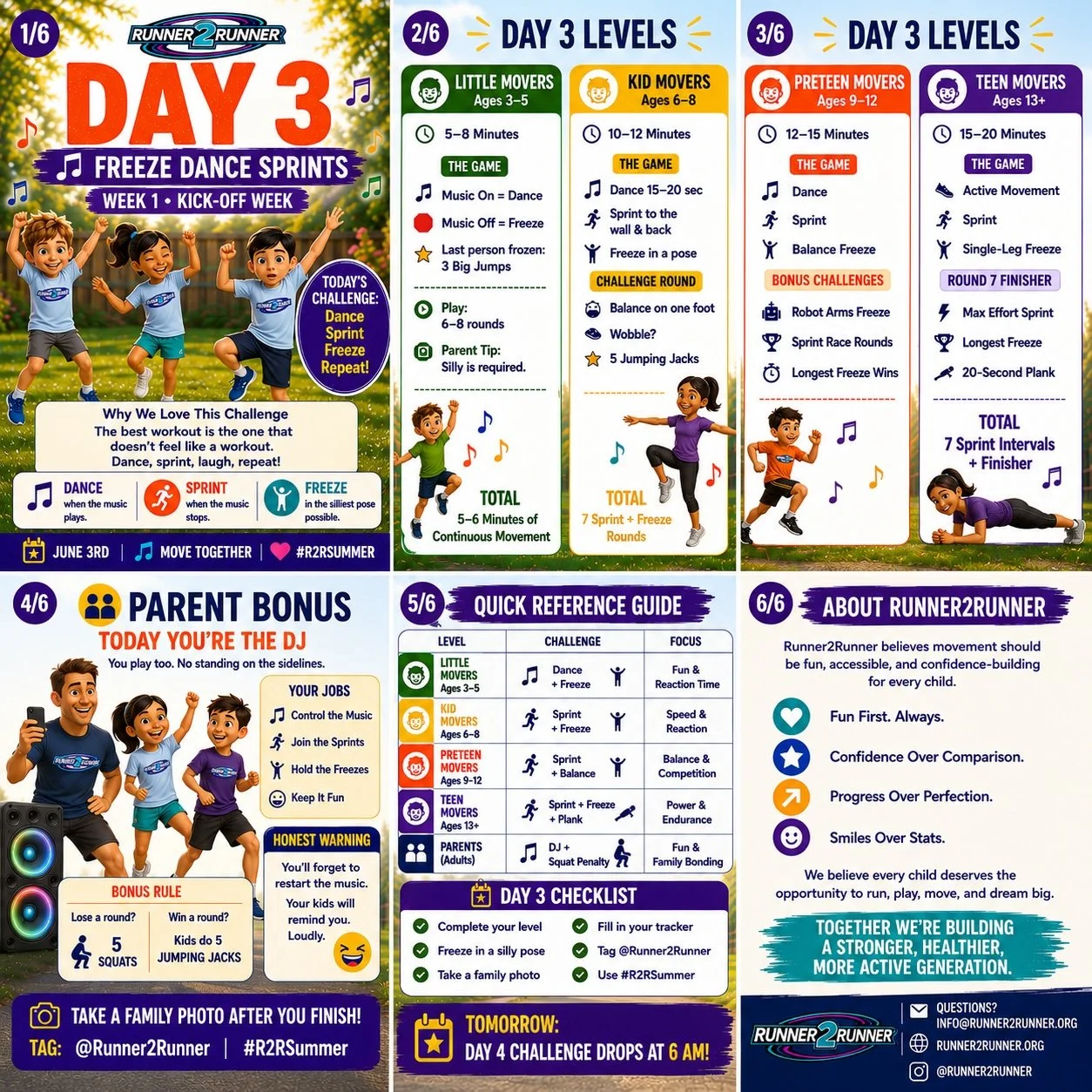
Simple. When the music plays, everyone dances however they want. When the music stops, everyone sprints to a designated point and back as fast as they possibly can, then freezes in whatever position they land in. Hold the freeze until the music plays again.
That's it. Find your level below, grab your phone, and go.
Today's Workout — Freeze Dance Sprints
🟢 Little Movers — Ages 3–5 | 5–8 Minutes
Warm-Up — 1 minute
March in place lifting your knees up high. Count to 20 together out loud. Swing your arms big with every step.
The Move — 4–5 minutes
You need any open space — a living room, a backyard, a driveway — and a phone with music. Parent controls the music.
Music plays: everyone dances however they want. Silly is not optional — it's required.
Music stops: FREEZE like a statue. Hold it!
Last one to freeze does 3 big jumps before the music starts again.
Play 6–8 rounds. Switch who calls the stop each time.
Cool-Down — 1 minute
Sway side to side slowly like a tree in the wind. Take 3 big deep breaths together.
Total: 6–8 rounds of freeze and dance fun
A note for parents: Toddlers will freeze about half a second after everyone else and that is completely perfect. The reaction training is happening even when it looks like pure chaos. Keep it giggly. Keep it short. Stop before they want to stop — always leave them wanting one more round.
🟡 Kid Movers — Ages 6–8 | 10–12 Minutes
Warm-Up — 2 minutes
Jog in place for 30 seconds. 10 arm circles each direction. 5 high knee skips across the yard. Repeat twice.
The Move — 7–8 minutes
Clear a space with a sprint lane at one end — a wall, a tree, a chalk mark, or a cone works perfectly. The sprint distance should be about 15–20 feet each way.
Round format: Music plays for 15–20 seconds of free dancing. Music stops: sprint to the wall and back as fast as possible, then FREEZE in an athletic pose — one foot up, arms wide, whatever feels cool. Hold the freeze until the music starts again.
Rounds 1–2: Music → dance → sprint → freeze. Get the legs under you.
Rounds 3–4: Increase the sprint distance slightly. The freeze must now be held for a full 5 seconds.
Rounds 5–6: The freeze must be on ONE FOOT only. Anyone who wobbles before the music starts owes 5 jumping jacks before the next round.
Round 7 — The Finale: Longest dance break of the whole game, then a full-speed sprint, then the silliest freeze pose they can possibly hold. Vote on the best one.
Cool-Down — 1–2 minutes
Walk slowly in a circle. Reach arms up overhead and hold for 10 seconds. Forward fold toward toes and hold for 10 seconds.
Total: 7 rounds of sprint and freeze intervals
Coaching tip: The moment from music-stop to first sprint step is the actual athletic skill being trained here. It's the same reaction skill used in a relay race start and a sprint race reaction to the starter's gun. Your kids don't need to know any of that. Just let them play. The development happens anyway.
🟠 Preteen Movers — Ages 9–12 | 12–15 Minutes
Warm-Up — 3 minutes
Jog ¼ mile easy — that's 2 backyard laps or 1 lap around a standard track. Comfortable, conversational pace. Finish with 10 high knees, 10 butt kicks, and 5 leg swings each leg.
The Move — 8–9 minutes
Set up a sprint lane of 20–30 feet with a clear start line and turnaround point marked with chalk or cones.
Music plays: active movement of their choice — dancing, jogging in place, lateral shuffles. Music stops: all-out sprint to the turnaround and back, then hold a single-leg balance freeze — one leg, arms out — until the music plays again.
Rounds 1–2: Standard sprint and balance freeze. Get the rhythm.
Rounds 3–4: Add a rule — the freeze must include slow arm movement, like a robot powering down. Core engagement goes up significantly.
Rounds 5–6: Competitive scoring. First person back to the start AND frozen cleanly wins the round. Keep a running score.
Round 7 — The Burner: Music plays for 30 full seconds of active dancing — no standing still, actually moving the whole time. Music stops: immediate all-out sprint, then the longest single-leg balance freeze they can hold. Time the freeze. Try to beat it.
Bonus: Play the music unpredictably — very short bursts followed by long ones, or two stops back to back. Reaction time training at its best.
Cool-Down — 2 minutes
Walk ¼ mile. Hip flexor lunge stretch 20 seconds each side. Quad stretch 15 seconds each leg.
Total: 7 rounds of sprint intervals and reaction training
Coaching tip: The balance freeze immediately after a full sprint is genuinely difficult. Stopping from maximum speed and holding a single-leg balance requires deceleration control and proprioception — two skills that directly reduce injury risk in track and cross country. Your preteen is doing injury prevention training and they think they're playing a game. That's exactly the goal.
🟣 Teen Movers — Ages 13+ | 15–20 Minutes
Warm-Up — 4 minutes
Run ¾ mile easy — 3 laps around a standard track or a short neighborhood loop. Finish with a full dynamic warm-up: 10 high knees, 10 butt kicks, 5 leg swings each leg, and 5 lateral shuffles each direction.
The Move — 9–10 minutes
Set up a 30–40 foot sprint lane with a clear start and finish.
Music plays: active recovery movement the entire time — jogging in place, lateral shuffles, arm swings. No standing still between rounds. Music stops: immediate explosive sprint for the full lane length and back, then hold a single-leg balance freeze until the music plays again.
Rounds 1–2: Standard sprint and freeze. Focus entirely on the explosive first step at the music stop.
Rounds 3–4: Add a backward sprint — sprint forward to the line, sprint backward to the start. Trains coordination and deceleration mechanics.
Rounds 5–6: Competitive scoring. First person frozen in a clean, stable balance wins the round. Falling off balance earns 5 burpees before the next round starts. No mercy.
Round 7 — Max Effort: Music plays for 45 full seconds of continuous active movement — jogging, shuffling, no stopping whatsoever. Music stops: absolute maximum effort sprint, then hold the longest single-leg freeze possible, then immediately drop into a 20-second plank. No rest between.
Rest: 45 seconds after Round 7. Completely still. You earned every second of it.
Cool-Down — 2–3 minutes
Walk ¼ mile. Full stretch sequence — hamstrings, quads, hip flexors, calves, and shoulders. 20 seconds each.
Total: 7 rounds of maximum effort sprint intervals with reaction, balance, and core training
Coaching tip: The active recovery between rounds — keeping the body moving at a moderate level during the music — is the secret ingredient in today's workout. It keeps heart rate elevated between sprint efforts without letting it fully recover. This is called active recovery interval training and it's exactly how track and cross country coaches structure workouts for competitive athletes. The total cardiovascular load today is significant even though it feels like a dance party.
👨👩👧 Parent Bonus — Adults | 12–15 Minutes
Warm-Up — 2–3 minutes
Walk or easy jog ½ mile alongside the kids during their warm-up. Use this time to pull up a playlist and set up the music.
The Move — 8–9 minutes
Here's the deal: you play the full game with the kids. Same rules. Same sprints. Same freezes. No standing back. No watching from the porch. You are a full and equal participant.
Your extra challenge is that you control the music. You choose when to stop it, how long the dance breaks last, and when to throw in two stops back to back just to watch everyone scramble. You are the DJ, the coach, and a player simultaneously.
Additional scoring layer for parents:
Every round you lose — last one frozen or wobble on the balance — you owe 5 squats before the next round starts.
Every round you WIN — first frozen and stable — your kids each owe 5 jumping jacks.
Keep score out loud. Make it competitive.
Cool-Down — 2 minutes
Hip flexor stretch against a wall, 30 seconds each side. Calf stretch, 30 seconds each leg. Then stand in the yard for a full minute while everyone catches their breath and declares a winner.
Total: Full game participation plus DJ duties plus squat penalty system
Honest note: Being the DJ while also sprinting and freezing is genuinely harder than it sounds. You will absolutely forget to restart the music after a freeze at least once. Your kids will remind you at significant volume. This is part of the experience and entirely worth it.
Here's what's actually happening during Freeze Dance Sprints:
The dancing phase is active cardiovascular recovery, keeping the heart rate elevated at a moderate level between sprint efforts. The sprint phase is high-intensity interval training, short bursts of maximum effort that build speed, power, and cardiovascular fitness faster than steady-state exercise. The freeze phase is proprioceptive and balance training, teaching the body to decelerate and stabilize after explosive movement, which is one of the most effective injury prevention skills in all of youth athletics.
We package it as a dance game because that's how kids access it. A child who thinks they're playing will always outwork a child who knows they're exercising. Every game in the R2R Summer Challenge has a real athletic purpose underneath it. We just don't always announce what it is.
That's the whole philosophy. Fun first. Development follows.
Did You Know?
🎵 Music literally makes you run faster.
A study published in the Journal of Sport and Exercise Psychology found that listening to motivating music during exercise increases effort by up to 15% without the exerciser perceiving that they're working any harder. Your kids aren't just having fun today. The music is actively making them perform better without them realizing it.
⚡ Reaction time is a trainable skill, and the best time to train it is childhood.
Reaction time peaks between ages 18 and 24, but the neural pathways that enable fast reactions are built during childhood. Games that require rapid response to a sudden stimulus, like a music stop, directly develop the nervous system's processing speed. Every freeze in today's workout is laying down faster wiring.
🕺 Dancing is legitimate cardiovascular exercise.
Moderate-intensity dancing elevates heart rate to the aerobic training zone, the same zone targeted by jogging, cycling, and swimming. The American Heart Association recognizes dance as a recommended form of cardiovascular exercise for children. The dance breaks in today's workout aren't rest. They're training.
🦶 Stopping from a sprint is one of the hardest things an athlete does.
Decelerating from a full sprint requires eccentric muscle control, the ability of the quads and hamstrings to produce force while lengthening. This is the same mechanism that prevents ACL tears, ankle sprains, and hamstring pulls. Teaching young athletes to stop and balance after sprinting is some of the most important injury prevention work you can do. Today's freeze poses are doing exactly that.
😂 Laughing during exercise makes it work better.
Research from Oxford University found that laughter triggers endorphin release, the same neurochemicals produced during intense exercise. Laughing while working out makes the effort feel easier, increases pain tolerance, and builds social bonds between the people exercising together. The sillier the freeze pose, the better the workout. That is not an exaggeration. Science confirmed it.
Playlist Suggestions
The music you choose makes a real difference. Here are some family-tested favorites for the Freeze Dance Sprint playlist. Mix fast songs with slow ones to keep the stops unpredictable:
Fast songs for high-energy sprints: Happy by Pharrell Williams, Can't Stop the Feeling by Justin Timberlake, Shake It Off by Taylor Swift, Uptown Funk by Bruno Mars, Can't Hold Us by Macklemore
Medium songs for good dancing: Levitating by Dua Lipa, Dynamite by BTS, Blinding Lights by The Weeknd
The trick stop: Slip in a slow classical piece right after a fast song. Your kids will be in the middle of their wildest dance moves when the music suddenly changes and then stops. The freeze is always the funniest one of the game.