Day 25: Park Scavenger Hunt Run
Today is a similar challenge to the Neighborhood Explorer Run. The Park Scavenger Hunt Run takes the discovery-plus-movement format and places it somewhere with more natural variety than a neighborhood street, more trees, more textures, more wildlife, more space to actually run.
The principle is the same as: pick your finds, write them down, move between each one, and finish with energy. The setting is what changes, and the setting changes everything about what you’ll discover.
Before You Leave, Make Your Park List
Write your list of 5 things to find before you leave for the park. Here are park-specific ideas organized by difficulty:
Easy finds: A squirrel. A pinecone. Three different colors of leaves. A bench. Someone walking a dog.
Medium finds: A tree with exposed roots. A bird you don’t recognize. A bug on the ground. Water, a pond, stream, or sprinkler. The tallest tree you can find in the park.
Hard finds: Two different types of tree bark. A spot where the path changes surface, pavement to dirt for example. Evidence of an animal that isn’t currently visible, tracks, a chewed pinecone, a nest. The oldest looking tree in the park. Something that makes a sound when the wind blows.
Write the list down and bring it with you. Check things off as you find them.
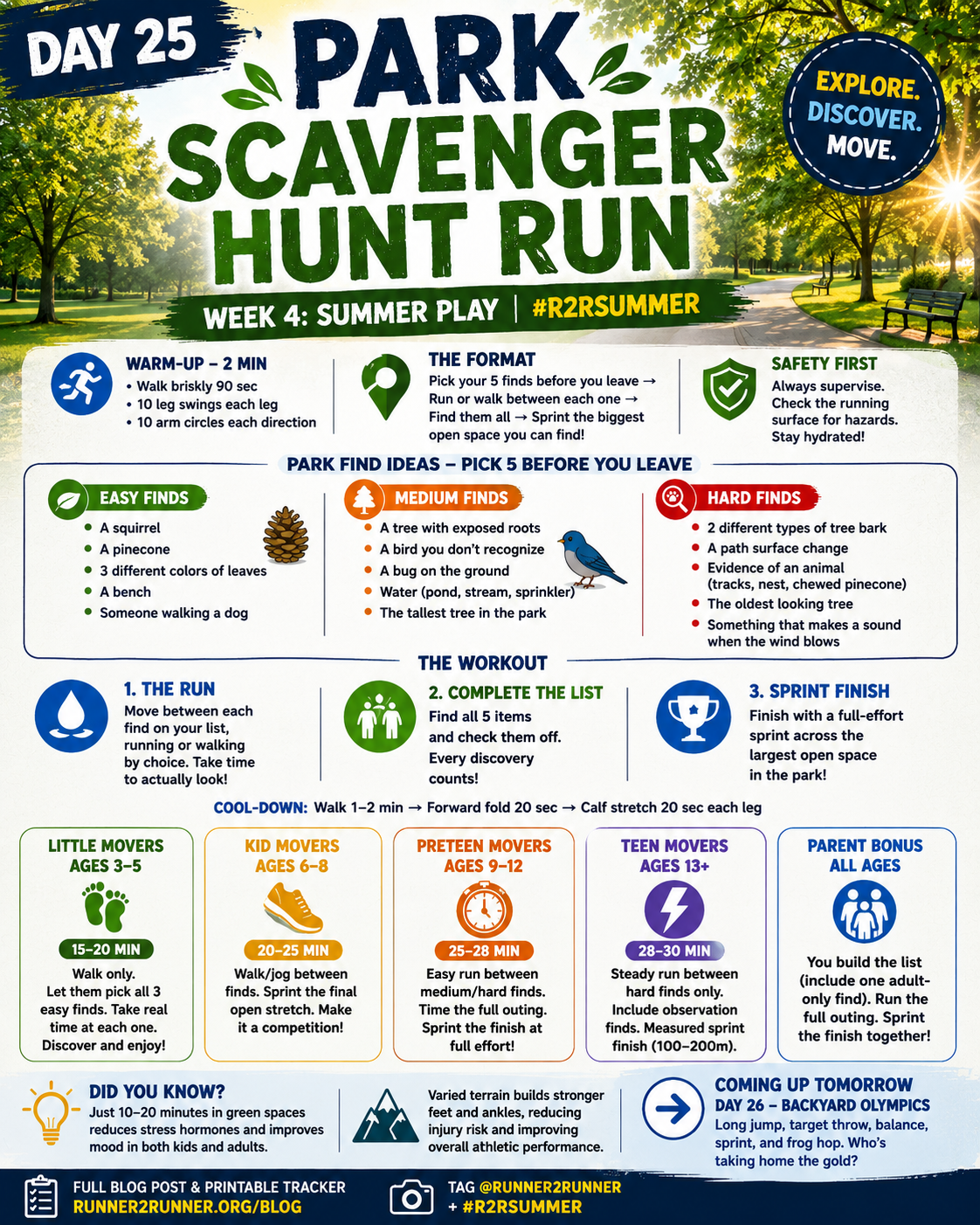
Today’s Workout: Park Scavenger Hunt Run
What you need: A local park or large green space. Your list of 5 finds. Water for the trip.
Total time: 20 to 30 minutes depending on your level, slightly longer than the neighborhood version since parks tend to have more ground to cover.
Warm-Up: Walk briskly for 90 seconds upon arrival. 10 leg swings each leg. 10 arm circles each direction.
The Run: Move between each find on your list, running or walking by choice. Take the time to actually look at what you find, parks reward a little extra attention. When you’ve found all 5, finish with a genuine sprint across the largest open space you can find in the park, fields exist for exactly this purpose.
Cool-Down: Walk 1 to 2 minutes. Forward fold, hold 20 seconds. Calf stretch, 20 seconds each leg.
Age Modifications
🟢 Little Movers: Ages 3–5 | 15–20 Minutes: Walk only. Let them pick all 3 finds from the easy list before you leave. Take genuine time at each find, parks are full of small wonders worth stopping for at this age. The walk and the noticing are the entire workout.
🟡 Kid Movers: Ages 6–8 | 20–25 Minutes: Walk and jog between finds, choosing 3 from the easy list and 2 from the medium list. Sprint the final open stretch at the end. Make it a competition if there’s more than one child, first to spot each item wins a point.
🟠 Preteen Movers: Ages 9–12 | 25–28 Minutes: Run between finds at an easy conversational pace, choosing all 5 from the medium and hard lists. Time the full outing from arrival to the final sprint. Sprint the final open stretch at full effort.
🟣 Teen Movers: Ages 13+ | 28–30 Minutes: Run between finds at a steady purposeful pace, choosing hard finds only. Make at least one find require genuine observation rather than quick spotting. Sprint a measured distance, 100 to 200 meters if the park allows, for the finish rather than an unmeasured open stretch.
Parent Bonus: You design the list, including at least one find that requires real attention to notice, the kind of thing that comes with experience rather than sharp young eyes. Run the full outing alongside your family. Sprint the finish together.
Did You Know?
Time spent in green spaces measurably reduces stress hormones in children and adults. Multiple studies, including research published in Environmental Health Perspectives, have found that time spent in parks and green spaces measurably reduces cortisol levels and improves mood, with effects appearing within as little as 10 to 20 minutes of exposure.
Tomorrow is Day 26: Backyard Olympics. Long jump, target throw, balance, sprint, and frog hop, who’s taking home the gold in your family. See you at 6am.