Day 37: Balance Beam Challenge
Yesterday we moved slowly through yoga poses and discovered that stillness is its own kind of training. Today we take the balance work from yesterday and make it dynamic.
The Balance Beam Challenge uses chalk lines, tape strips, or any straight edge you have available to create a beam on the ground. A beam on the ground is identical in every athletic way to a beam in the air, the balance demands are the same, the proprioceptive training is the same, and the body control required is the same. The only difference is that falling off a chalk line is funny rather than dangerous.
Today’s challenge gets progressively harder across four levels, walking the line, balancing on one spot, moving through a series of poses on the line, and completing a full beam routine that combines everything.
Why Balance Training Matters for Runners
Every single running stride requires a moment of single-leg balance. For a fraction of a second the entire body’s weight is supported by one foot while the other drives forward. How efficiently the body manages that fraction of a second, how much energy it wastes in wobble and correction versus how cleanly it transfers force into the next stride, directly determines running speed and running economy.
Balance training teaches the body to manage that single-leg moment more efficiently. It strengthens the stabilizing muscles of the ankle, knee, and hip. It develops the proprioceptive system the body’s internal sense of position that makes every footstrike more precise and every direction change more controlled.
Athletes who train balance specifically run faster, change direction more effectively, and get injured significantly less often than those who don’t.
Set Up Your Beam
Before you start, create your beam. A single straight line about 10 to 15 feet long works perfectly. Here are the options from easiest to set up:
Chalk line on a driveway or sidewalk, draw it about 2 to 3 inches wide so there’s a real target to stay on.
Tape line on a flat floor, painter’s tape or masking tape works well indoors.
A garden edging strip, a low wooden board lying flat, or even a row of flat stones in a straight line on the grass.
The line should be straight, clearly visible, and long enough to take at least 8 to 10 steps across.
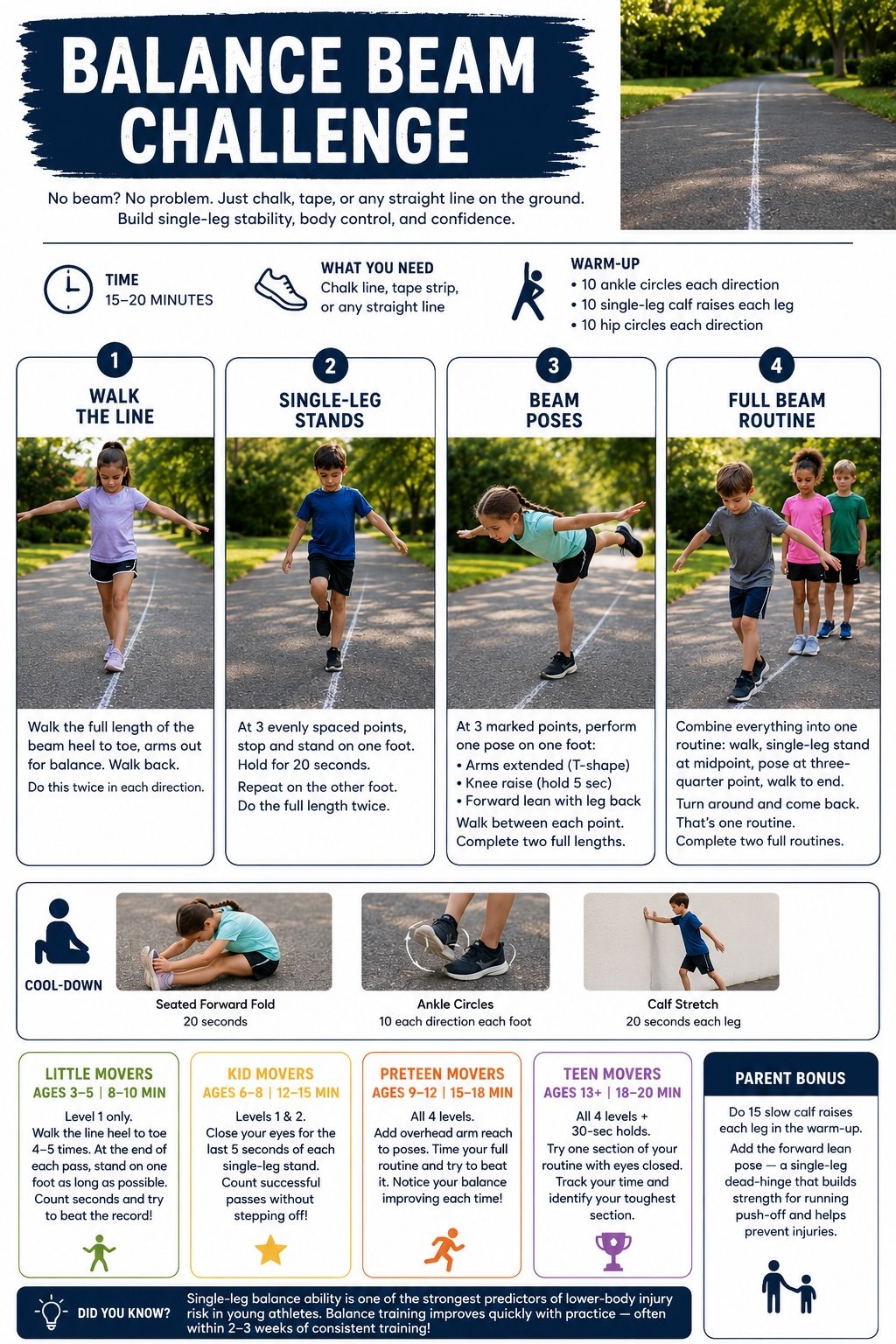
Today’s Workout: Balance Beam Challenge
What you need: A chalk line, tape strip, or equivalent beam surface. No equipment required.
Warm-Up: 10 ankle circles each direction each foot. 10 single-leg calf raises each leg, stand on one foot and rise onto the toes slowly, lower slowly. 10 hip circles each direction.
Level 1: Walk the Line: Walk the full length of the beam heel to toe, each step places the heel of the front foot directly against the toes of the back foot. Arms out to the sides for balance. Walk the full length and back. Do this twice in each direction.
Level 2: Single-Leg Stands: At three evenly spaced points along the beam, stop and stand on one foot. Hold each single-leg stand for 20 seconds. Do not let the raised foot touch the beam or the ground. Arms can be anywhere that helps. Walk to the next point and repeat. Do the full length twice, once on each foot as the standing leg.
Level 3: Beam Poses: Walk the beam and at each of three marked points perform one of the following poses while balanced on one foot: arms extended forward and back in a T-shape, a slow knee raise held for 5 seconds, or a slight forward lean with one leg extended behind. Walk between each pose point. Complete two full lengths.
Level 4: Full Beam Routine: Combine everything into one continuous routine down the length of the beam, heel to toe walk for the first third, single-leg stands at the midpoint, a beam pose at the three-quarter point, and a final walk to the end. Turn around and come back. That is one full routine. Complete two full routines.
Cool-Down: Seated forward fold 20 seconds. Ankle circles 10 each direction each foot. Calf stretch against a wall 20 seconds each leg.
Age Modifications
🟢 Little Movers: Ages 3–5 | 8–10 Minutes: Level 1 only, walk the line heel to toe for the full length and back, repeated 4 to 5 times. At the end of each pass, stop and try to stand on one foot for as long as possible, count the seconds out loud together. The record they set today is something to try to beat tomorrow. No formal levels, no pressure. Just walking the line as carefully as they can and celebrating every successful pass.
🟡 Kid Movers: Ages 6–8 | 12–15 Minutes: Levels 1 and 2 as written. For the single-leg stands in Level 2 challenge them to close their eyes for the last 5 seconds of each hold, significantly harder and significantly more effective for balance training. Count successful passes of the full beam without stepping off. Keep a running total and try to beat it on the second attempt.
🟠 Preteen Movers: Ages 9–12 | 15–18 Minutes: All four levels as written. For Level 3 beam poses add a slow arm reach overhead on the standing leg holds, extending the arm on the same side as the standing leg increases the balance challenge meaningfully. Time each full beam routine and try to beat it on the second attempt. Compare to how steady the first pass felt versus the final pass, the improvement within a single session is usually noticeable.
🟣 Teen Movers: Ages 13+ | 18–20 Minutes: All four levels with extended hold times, 30 seconds on single-leg stands in Level 2. For Level 4 add a challenge: complete the full beam routine with eyes closed for any single section of their choice. Identify which section they feel most and least confident attempting with eyes closed, that self-awareness is the athletic intelligence being developed. Time all routine attempts and track the progression.
👨👩👧 Parent Bonus: Full workout as written. The calf raises in the warm-up deserve particular attention for adults, calf strength is one of the most undertrained qualities in recreational runners and one of the most protective against Achilles tendon issues. Do 15 of them slowly on each leg, not 10. For the beam poses, attempt the forward lean with one leg extended behind, this is a single-leg deadhinge pattern that directly trains the hamstring and glute strength used in running push-off.
Did You Know?
Single-leg balance ability is one of the strongest predictors of lower-body injury risk in young athletes.
Research published in the British Journal of Sports Medicine found that athletes with measurably weaker single-leg balance scores had significantly higher rates of ankle sprains, knee injuries, and lower-limb stress fractures over a competitive season compared to athletes with stronger balance scores. Balance training is injury prevention in its most direct form. Today’s chalk line is protecting your child’s ankles and knees with every wobble and recovery.
The balance system improves rapidly with practice at every age.
Tomorrow is Day 38: Stretching Circuit. See you at 6am.