Day 38: Stretching Circuit
Today we stretch. Properly. Deliberately. For the full time each stretch deserves. The Stretching Circuit is not a cool-down tacked onto something else. It is today’s workout. It is a complete, intentional session targeting the specific muscle groups that carry the most load in running, jumping, and every other athletic movement your family has been building all summer. Done correctly and held for real time, today’s circuit will produce flexibility improvements your family will feel during tomorrow’s session and carry for the rest of the challenge.
Why Stretching Gets Skipped…and Why That’s a Problem
Here is the honest reason most people skip stretching: it doesn’t feel like exercise. There’s no sweat, no elevated heart rate, no satisfying exhaustion at the end. It feels like waiting. But flexibility is a physical quality exactly like strength or speed, it can be built, it can be lost, and it directly determines athletic performance. A tight hip flexor shortens stride length. A tight calf increases Achilles tendon stress. A tight hamstring limits running economy and dramatically increases injury risk. Tight muscles are not a minor inconvenience. They are an athletic limitation and an injury waiting to happen. For young athletes especially, flexibility training during growth periods is critically important. As bones lengthen during growth spurts, the muscles attached to them can tighten significantly if not regularly and deliberately stretched. This is one of the primary drivers of overuse injuries in adolescent athletes, not too much running, but too much running with muscles that haven’t kept pace with bone growth. Today’s circuit addresses exactly that.
How to Stretch Correctly
Before you start, three rules that make today’s session actually work.
Hold every stretch for a real 30 seconds minimum. Stretching for 10 seconds does almost nothing to change muscle length. The research is clear, meaningful flexibility adaptations require holds of at least 30 seconds, and 45 to 60 seconds is better. Count slowly. Use a timer if needed.
Never bounce. Ballistic stretching, bouncing at the end range of a stretch, activates the stretch reflex and causes the muscle to contract rather than release. Ease into the end range slowly and hold there without bouncing.
Breathe into it. On every exhale, let the body relax a little deeper into the stretch. You don’t force flexibility, you breathe into it.
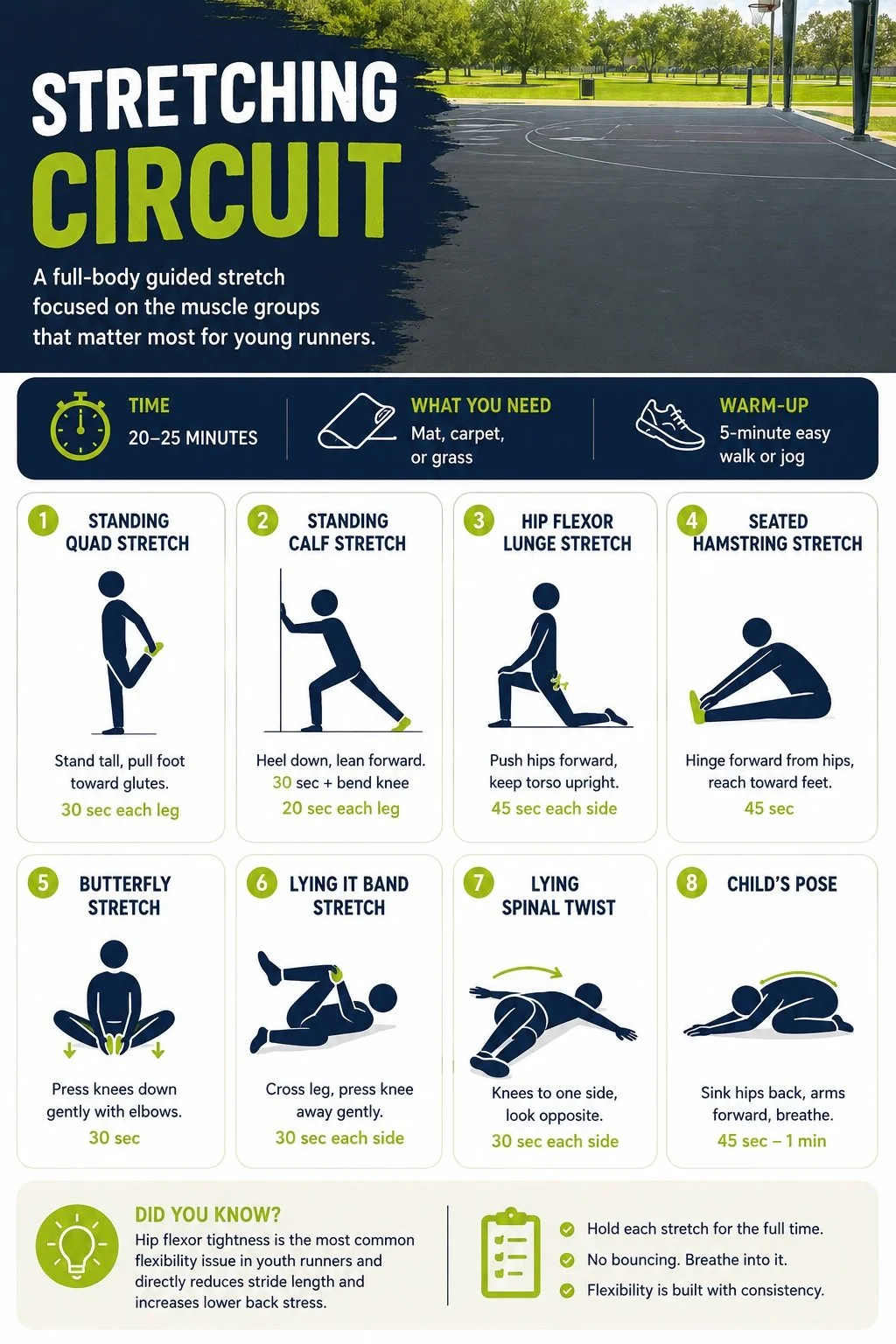
Today’s Workout: Stretching Circuit
What you need: Any flat surface. A mat, carpet, or grass. No equipment required.
Warm-Up: 5-minute easy walk or jog. You should never stretch a completely cold muscle. The walk is not optional.
Stretch 1: Standing Quad Stretch, Stand on one foot. Bend the other knee and pull the foot toward the glutes, holding the ankle. Keep both knees together. Stand tall. Hold 30 seconds each leg. This targets the quadriceps, the muscle group that absorbs the most force in running and jumping.
Stretch 2: Standing Calf Stretch, Step one foot back and press the heel flat into the ground. Lean forward slightly with a straight back leg. Feel the stretch deep in the calf. Hold 30 seconds then bend the back knee slightly to target the deeper soleus muscle underneath the calf. Hold another 20 seconds. Switch legs. Two parts, two muscles, both critical for runners.
Stretch 3: Hip Flexor Lunge Stretch, Step one foot forward into a lunge. Lower the back knee to the ground. Push the hips gently forward while keeping the torso upright. Feel the stretch across the front of the hip on the back leg side. This is the most important stretch in today’s circuit for runners. Hold 45 seconds each side. Do not rush this one.
Stretch 4: Seated Hamstring Stretch, Sit on the ground with both legs extended forward. Keeping the back as flat as possible, hinge forward at the hips and reach toward the feet. Hold wherever the stretch is felt — this does not need to be the toes. The hamstring stretch point is behind the knee and into the upper leg, not in the lower back. If the lower back is what’s working, bend the knees slightly. Hold 45 seconds.
Stretch 5: Butterfly Stretch: Sit on the ground with the soles of both feet pressed together, knees falling out to the sides. Hold the feet and gently press the knees toward the ground with the elbows. This targets the inner thigh and hip adductors, often neglected and directly involved in lateral movement and stride mechanics. Hold 30 seconds.
Stretch 6: Lying IT Band Stretch, Lie on your back. Cross one leg over the other, placing the foot flat on the ground outside the opposite knee. Gently press the crossed knee away from the body while keeping both shoulders flat on the ground. This targets the IT band and outer hip — the most common site of overuse injury in young runners. Hold 30 seconds each side.
Stretch 7: Lying Spinal Twist, Lie on your back. Bring both knees to the chest then let them fall to one side while the arms extend wide and the gaze goes the opposite direction. This releases the lower back and the thoracic spine, areas that carry significant tension after sustained running and strength training. Hold 30 seconds each side.
Stretch 8: Child’s Pose, Kneel, sink hips back toward heels, extend arms forward on the ground, rest the forehead down. Breathe slowly and deeply. This is the recovery position for the whole circuit. Hold 45 seconds to 1 full minute.
Cool-Down is built in. After Child’s Pose, roll slowly to one side and press to seated before standing.
Age Modifications
🟢 Little Movers: Ages 3–5 | 8–10 Minutes: Four stretches only — quad stretch, calf stretch, butterfly, and child’s pose. Give each one a story: the quad stretch is a flamingo standing on one leg, the calf stretch is a dog doing a big morning stretch, the butterfly is a butterfly opening and closing its wings, and child’s pose is a tiny mouse curled up in its house. Hold each for 15 to 20 seconds. Move through all four twice.
🟡 Kid Movers: Ages 6–8 | 12–15 Minutes: Stretches 1 through 6 as written with 30-second holds. For the hamstring stretch, challenge them to get a tiny bit further each time they exhale, make it a game of millimeters. The IT band stretch may feel unfamiliar at first and that unfamiliarity is the signal that it’s needed. Two full passes through the circuit.
🟠 Preteen Movers: Ages 9–12 | 15–18 Minutes: Full circuit as written with full hold times. The hip flexor lunge stretch in particular should get extended holds, 45 seconds minimum, 60 seconds if they can. Preteens in growth spurts often have significantly tighter hip flexors than they realize, and this stretch is one of the most valuable things in today’s entire session for this age group. Two full passes through the circuit.
🟣 Teen Movers: Ages 13+ | 18–22 Minutes: Full circuit as written with extended holds, 45 to 60 seconds on every stretch. After the second full pass add a pigeon pose on each side, 60 seconds each — the deepest hip opener in today’s session and the one that will produce the most noticeable flexibility improvement over time. Finish with a 90-second child’s pose. Breathe slowly throughout.
👨👩👧 Parent Bonus: Full circuit with maximum hold times. Pay particular attention to the IT band stretch and the hip flexor lunge, these are the two areas that carry the most chronic tension in adults who run and the two that most directly contribute to lower back pain and knee issues over time. If the hip flexor lunge feels particularly tight on one side, spend an extra 30 seconds there.
Did You Know?
Hip flexor tightness is the most common flexibility issue in youth runners, and one of the most preventable. Research from the American College of Sports Medicine found that tight hip flexors are present in a significant majority of youth distance runners and directly correlate with reduced stride length, anterior pelvic tilt, and increased lower back stress during running. The hip flexor lunge in today’s circuit is not a minor accessory stretch. It is one of the most athletically valuable movements in the entire summer challenge.
Flexibility gains from consistent stretching appear within two to four weeks. Studies on flexibility training consistently show that meaningful increases in muscle extensibility, actual changes in muscle length and joint range of motion, appear within two to four weeks of daily or near-daily stretching sessions.
Tomorrow is Day 39: The Balance Challenge. Single-leg holds, dynamic balance drills, and a timed challenge that gets harder every round. See you at 6am.