Day 39: The Balance Challenge
Two days ago we walked a chalk line. Yesterday we stretched every major muscle group. Today we combine the balance work and the flexibility work into something more dynamic!
The Balance Challenge is a series of progressively harder balance drills that train the proprioceptive system, the body’s internal GPS, under increasing levels of difficulty. Each round removes one sensory input or adds one movement demand, forcing the nervous system to find stability with less information or more interference. By the end of today’s challenge most family members will have discovered at least one balance drill that genuinely surprises them with its difficulty. That surprise is the nervous system encountering a real training stimulus. That is exactly what we are looking for.
One Concept Worth Understanding Before You Start
The proprioceptive system: The network of sensors in the muscles, joints, and skin that tells the brain where every body part is in space. It is not vision, though vision helps. It is not strength, though strength supports it. It is a separate sensory system that can be trained directly and specifically.
The most effective way to train it is to challenge it progressively, first with eyes open on a stable surface, then with eyes closed, then with movement added, then with an unstable surface, then with all of these combined. Today’s challenge works through exactly that progression. Each level is harder than the last for a specific neurological reason, not just because it looks more impressive.
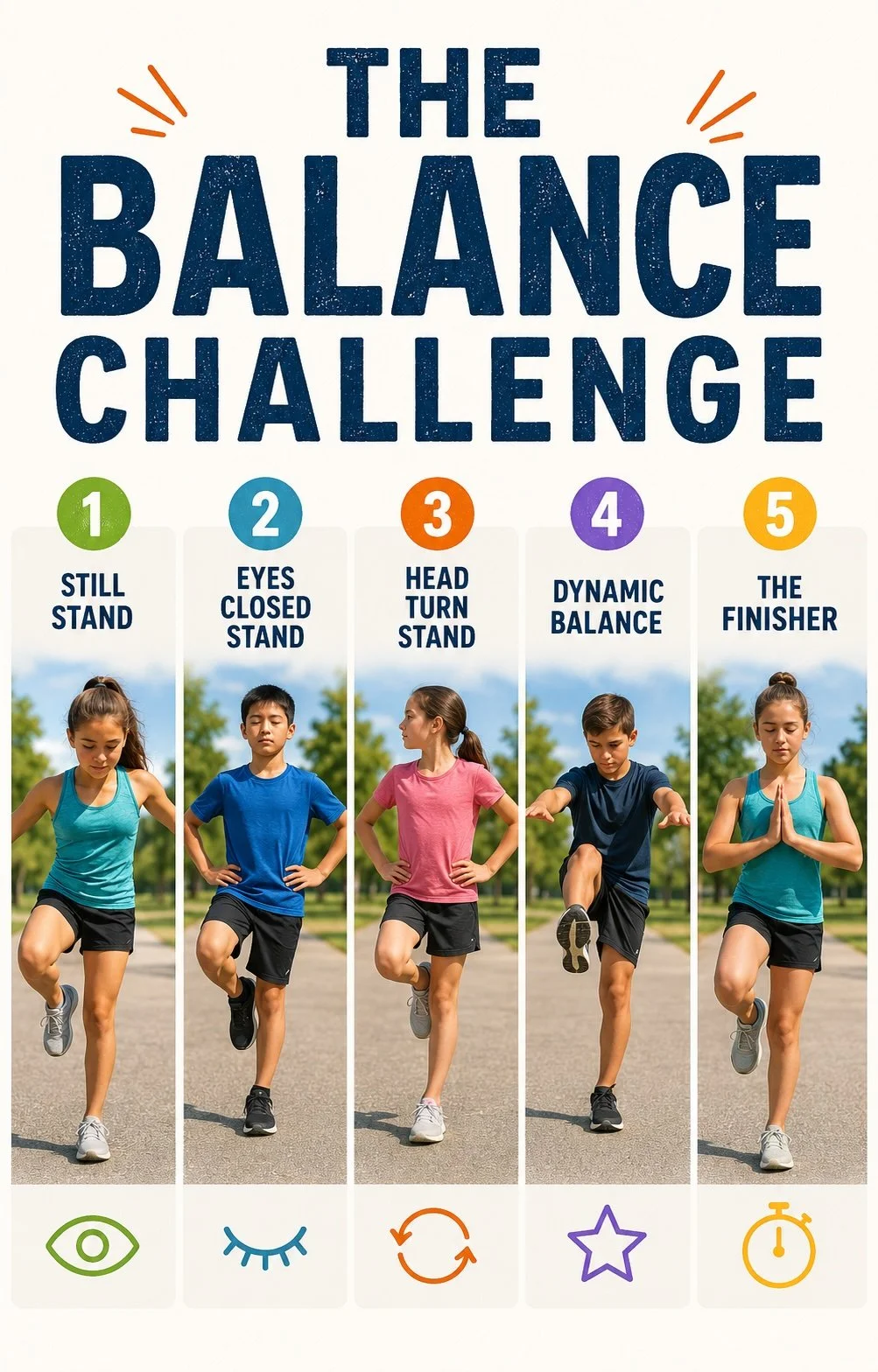
Today’s Workout: The Balance Challenge
What you need: Any flat surface. A chalk line or tape strip. No equipment required.
Warm-Up: 10 ankle circles each direction each foot. 10 single-leg calf raises each leg slowly. Walk briskly for 2 minutes.
Round 1: Still Stand - Stand on one foot with eyes open. Hold as still as possible. Timer starts when the foot lifts. Stop when the raised foot touches the ground or the standing foot moves significantly. Record the time. Do both feet. This is your baseline. Rest 20 seconds between legs.
Round 2: Eyes Closed Stand - Same as Round 1 but eyes completely closed. Dramatically harder for most people. The visual system contributes significantly to balance even when we don’t notice it — removing it forces the proprioceptive system to work alone. Record time on each foot. Rest 20 seconds between legs.
Round 3: Head Turn Stand - Eyes open. Stand on one foot. Slowly turn the head left and right, full range of motion, chin toward each shoulder, while maintaining the single-leg balance. The vestibular system in the inner ear is disrupted by head movement and has to recalibrate in real time. This is the drill used by sports medicine professionals to assess and train vestibular balance. 30 seconds each foot. Rest 20 seconds between legs.
Round 4: Dynamic Balance - Stand on one foot. Slowly reach the free leg forward, then out to the side, then behind, while keeping the standing leg slightly bent and the hips level. This is called the Star Excursion Balance Test in sports medicine and it is one of the most reliable assessments of functional balance and injury risk in athletes. 5 reach sequences each foot. Rest 30 seconds between legs.
Round 5: The Finisher - Stand on one foot. Eyes closed. Slowly count to 30 out loud without stopping. That is the whole challenge. It sounds simple. It is not simple. Every second of counting is a second of single-leg proprioceptive training without visual input. Record the time reached before touching down on each foot. That is today’s balance PR.
Cool-Down: Seated forward fold 20 seconds. Hip flexor lunge 30 seconds each side. Child’s pose 45 seconds.
Age Modifications
🟢 Little Movers — Ages 3–5 | 8–10 Minutes: Round 1 only — standing on one foot with eyes open, timed. Make it a game: can they hold it while they sing the alphabet? While they count to 10? While they name their favorite animals? The cognitive task makes the balance challenge more interesting for this age and also happens to make it harder. 3 to 4 attempts each foot, keep the best time, celebrate loudly.
🟡 Kid Movers — Ages 6–8 | 12–15 Minutes: Rounds 1 and 2 as written. For Round 2 eyes-closed stand, count out loud together so they know time is passing and have something to focus on other than the wobbling. Add a simple version of Round 4 dynamic balance — reach the free leg only forward and back, not the full star excursion pattern. Keep a record of best times on both rounds.
🟠 Preteen Movers — Ages 9–12 | 15–18 Minutes: All 5 rounds as written. The head turn in Round 3 is the most surprising round for this age group — most preteens assume it will be easy and discover quickly that it is not. Record best times on each round and track improvement within the session. The dynamic balance in Round 4 should feel genuinely challenging on the third or fourth reach sequence — that fatigue is the training.
🟣 Teen Movers — Ages 13+ | 18–20 Minutes: All 5 rounds with full hold times. For Round 4 dynamic balance perform the full star excursion pattern — forward, forward diagonal, side, back diagonal, behind, and back on the other side. Record the furthest reach on each direction and compare left to right — asymmetry between sides is information that directly predicts injury risk. For Round 5 finisher extend the target to 45 seconds eyes closed.
👨👩👧 Parent Bonus: Full workout as written. Pay attention to any significant difference between the left and right foot on both Round 1 and Round 2 — a consistent balance discrepancy between sides is one of the most common precursors to ankle and knee injuries in adult recreational runners and worth noting. The head turn in Round 3 is also a vestibular assessment — dizziness or significant instability during head turns while standing on one foot is worth mentioning to a doctor.
Did You Know?
The Star Excursion Balance Test predicts injury risk with remarkable accuracy. Research published in the Journal of Athletic Training found that athletes with significant asymmetries in their Star Excursion Balance Test scores where one leg reaches meaningfully further than the other in the same direction, had dramatically higher rates of lower-extremity injury over a competitive season. The dynamic balance reach in Round 4 today is a simplified version of that same test. Noticing a difference between left and right is genuinely useful athletic health information.
Eyes-closed balance training produces faster proprioceptive improvements than eyes-open training.
Research in motor learning science has found that removing visual input during balance training accelerates proprioceptive adaptation the nervous system is forced to rely more heavily on the sensory inputs it needs to develop and responds by developing them faster. Round 2 and Round 5 of today’s challenge are not harder versions of Round 1 for the sake of difficulty. They are more effective training stimuli because they force the right system to do the work.
Tomorrow is Day 40: Gymnastics Sampler/Fun Friday! Cartwheels, forward rolls, handstands, and a family gymnastics routine!