Day 6: The Family Long Run
SATURDAY — THE FAMILY LONG RUN
The Long Run is a weekend tradition in runner culture for a reason. It's longer than your weekday efforts, slower than your sprint days, and done with the people you love. It builds endurance, mental toughness, and the kind of shared experience that sticks with a family for years.
Today's distance depends entirely on your age group, and that’s very intentional. One of the most important principles in youth athletic development is that mileage should be age-appropriate, gradually introduced, and carefully capped. That’s important!
First, find your route. A neighborhood loop, a park path, a measured route using MapMyRun or Google Maps, all of these work. Whatever gets your family moving outside together is the right route. If you don’t know mileage or have a way to track it, going for time works too!
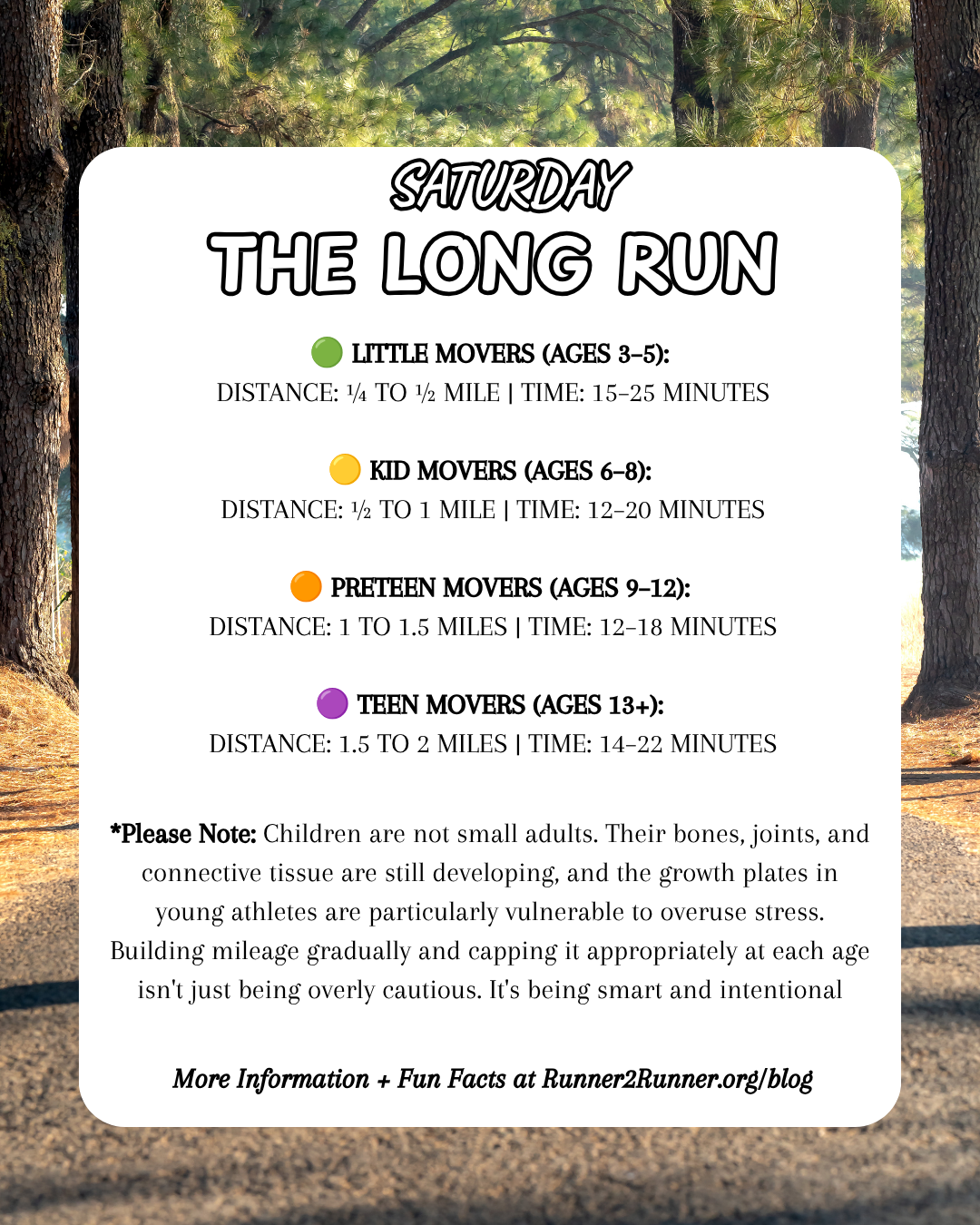
Long Run Workout Levels
🟢 Little Movers — Ages 3–5Distance: ¼ to ½ mile | Time: 15–25 minutes
Walk and jog, or walk the whole thing. Hold hands if they want. Point out everything you see along the way… a dog, a flower, a funny shaped cloud. Stop and look at things. Let them lead.
The goal at this age is time on feet, not miles logged. Fifteen to twenty-five minutes of gentle outdoor walking is exactly the right long run for a three to five year old. Don't push further. This is perfect. If you are new to any type of movement five minutes is also great! Don’t overdo it, but try a little bit of a challenge!
🟡 Kid Movers — Ages 6–8Distance: ½ to 1 mile | Time: 12–20 minutes
Walk and jog intervals, try jogging for one minute, walking for one minute, and repeating until you reach your distance. Pick a point on the route that feels like a natural halfway mark and turn around there. By the end of the summer this distance will feel easy. Today you're building the foundation.
🟠 Preteen Movers — Ages 9–12Distance: 1 to 1.5 miles | Time: 12–18 minutes
Run at a comfortable, steady conversational pace, you should be able to say a full sentence while running. Don't sprint the first half. If you have a track nearby, time yourself. You'll run this same distance again in Week 13 on Day 92 and compare. That number you record today is your summer baseline.
🟣 Teen Movers — Ages 13+Distance: 1.5 to 2 miles | Time: 14–22 minutes
Run the full distance at a purposeful pace, if you can! If not, walk run! Focus on running the second half slightly faster than the first, this is called a negative split. Time yourself. Write it down. Everything you do this summer is building toward a faster, stronger version of this run.
👨👩👧 Parent BonusDistance: Match your child
Run alongside your child at their pace. Match them step for step.
Age-Appropriate Distance Guide — What You Need to Know
This section matters and is important. Please take a moment to read it.
One of the most well-intentioned mistakes parents and coaches make with young runners is too much mileage too soon. Children are not small adults. Their bones, joints, and connective tissue are still developing, and the growth plates in young athletes are particularly vulnerable to overuse stress. Building mileage gradually and capping it appropriately at each age isn't being cautious. It's being smart.
Here is the guide we follow at Runner2Runner, and the one we recommend for every family in this challenge:
Ages 3–5 — Cap: ½ mile per outing
At this age the focus is entirely on movement enjoyment, not distance. Short walks and play-based movement are ideal. The goal is building a positive association with being active outdoors, nothing more. Running more than half a mile at a stretch is unnecessary and potentially stressful on developing joints. Keep it short, keep it fun, stop before they want to.
Ages 6–8 — Cap: 1 mile per outing
Children in this age range are developing aerobic capacity but their skeletal structure is still growing rapidly. One mile is a meaningful and appropriate distance. Walk-jog intervals are ideal, they allow the cardiovascular system to develop without placing repetitive stress on joints that aren't ready for sustained impact. Try not to push past a mile at this age regardless of how capable they seem.
Ages 9–11 — Cap: 2.5 miles per outing
Preteens can handle slightly more sustained effort but mileage should still be introduced gradually. The one-to-one-and-a-half mile range is appropriate for this age group in a fitness context. If your child is in a structured cross country program the mileage may be higher under coach supervision, but for recreational summer running this is the right ceiling.
Ages 12–13 — Cap: 4 miles per outing
Early adolescents have greater aerobic capacity and can handle more sustained running, but growth plates are still active and overuse injuries like shin splints and stress fractures are common in this age group when mileage increases too quickly. Two miles is appropriate. Four is doable More than that should be introduced only gradually over several weeks and ideally under coach guidance.
Ages 14+ — Cap: 5 miles per outing for recreational running
High school athletes in structured programs will run more than this under coach supervision. For recreational summer running outside a program, three to five miles is a sensible ceiling for unsupervised distance running. The emphasis at this age should still be on effort quality and consistency rather than mileage volume.
The general rule at every age: never increase weekly mileage by more than 10% from one week to the next.
This is called the 10% rule and it is the single most widely cited injury prevention principle in running medicine. It applies to adults and it applies to children. If your child ran 2 miles total last week, they should run no more than 2.2 miles total this week. Gradual progression is not timidity, it’s the foundation of sustainable athletic development.
Long Run Fun Facts
🏃 Slow running builds the aerobic base that makes fast running possible. Easy, conversational-pace running develops the mitochondria in muscle cells, the energy-producing structures that determine aerobic capacity. The slow runs are not the unimportant ones. They are the foundation everything else is built on.
💪 Consistency matters more than distance at every age. A child who runs a comfortable half mile three times a week will develop more aerobic fitness than a child who runs two miles once a week and does nothing else. Frequency and consistency are the variables that matter most in youth running development. This challenge is built around that principle.
❤️ Families who run together stay connected. Research from the Journal of Sport and Exercise Psychology found that families who exercise together report significantly higher levels of connection, communication, and mutual respect. The shared difficulty of a physical challenge, even a gentle one, builds bonds that sitting on the couch together simply cannot replicate.
SUNDAY — ACTIVE RECOVERY DAY
Rest days are not days off. They are days with a different purpose.
Active recovery is one of the most important, and most overlooked, principles in athletic development at every level. Your muscles don't get stronger during a workout. They get stronger during recovery from a workout. Sleep, nutrition, and gentle movement after intense effort are when the body adapts, rebuilds, and comes back better than before.
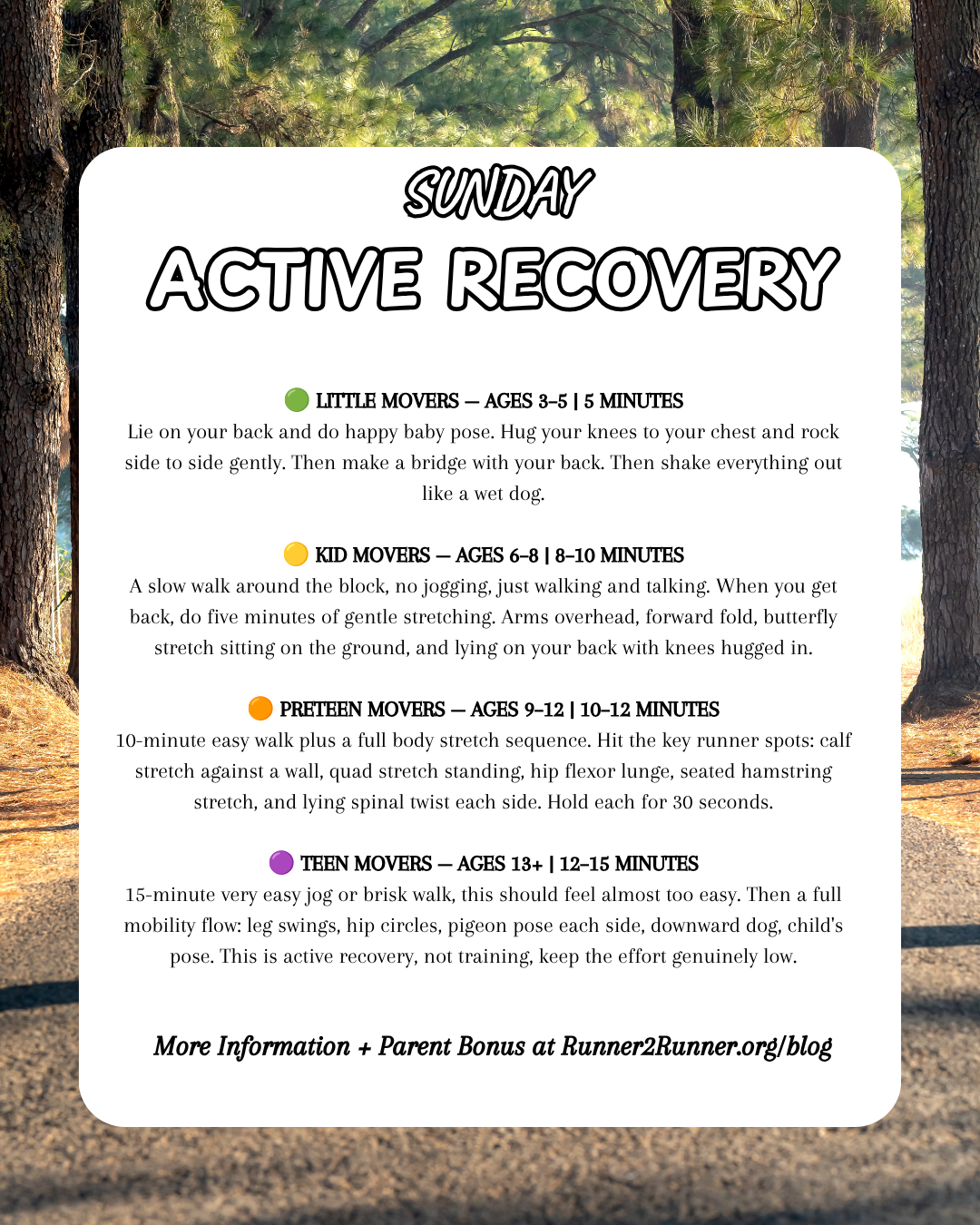
Today's Active Recovery — All Ages
The goal today is gentle movement that increases blood flow without adding training stress. Keep everything slow, easy, and focused on how the body feels.
🟢 Little Movers — Ages 3–5 | 5 minutes
Lie on your back and do happy baby pose. Hug your knees to your chest and rock side to side gently. Then make a bridge with your back. Then shake everything out like a wet dog.
🟡 Kid Movers — Ages 6–8 | 8–10 minutes
A slow walk around the block, no jogging, just walking and talking. When you get back, do five minutes of gentle stretching. Arms overhead, forward fold, butterfly stretch sitting on the ground, and lying on your back with knees hugged in.
🟠 Preteen Movers — Ages 9–12 | 10–12 minutes
10-minute easy walk plus a full body stretch sequence. Hit the key runner spots: calf stretch against a wall, quad stretch standing, hip flexor lunge, seated hamstring stretch, and lying spinal twist each side. Hold each for 30 seconds.
🟣 Teen Movers — Ages 13+ | 12–15 minutes
15-minute very easy jog or brisk walk, this should feel almost too easy. Then a full mobility flow: leg swings, hip circles, pigeon pose each side, downward dog, child's pose. This is active recovery, not training, keep the effort genuinely low.
👨👩👧 Parent Bonus
Do the full recovery sequence alongside your kids. Focus especially on hip flexors, lower back, and calves, the three areas that carry the most tension after a week of movement for adults. Hold each stretch for 45 seconds. Breathe slowly.
Why Active Recovery Matters
You don't get stronger during a workout, you get stronger after it. Exercise creates microscopic stress in muscle tissue. Recovery is when the body repairs that tissue and builds it back stronger. Skipping recovery doesn't make you tougher, it makes the next workout harder and increases injury risk. Rest is training.
Gentle movement on recovery days is better than complete rest. Light activity on recovery days, walking, gentle stretching, easy movement, increases blood flow to recovering muscles and accelerates the repair process without adding new training stress. This is why elite athletes do easy recovery runs the day after a hard race rather than sitting completely still.
Sleep is the most powerful recovery tool available. For children especially, the majority of athletic adaptation happens during deep sleep. If your child is sleeping well, moving daily, and eating reasonably, they are doing everything right. The challenge is working even when it doesn't feel like it.
A Note About Week 2: We’re Changing Things Up
Starting Monday we're making a small but meaningful change to how we post the daily challenges.
Instead of breaking the workout into separate level posts, each day in Week 2 will feature one circuit-style workout with clear modifications for each age group built right in. Same challenge, same levels, same fun, just presented in a way that's easier to follow in one place and easier to do together as a family. Thank you to our amazing families for this feedback!