Day 8: The Pace Game — Learning to Run Slow, Medium, and Fast
Welcome to Week 2 of the R2R Summer Movement Challenge.
You made it through Week 1. Five challenge days, a long run, and an active recovery day. A Family Lap, jumping jacks, freeze dance sprints, an animal race, silly sprints, and your first summer long run. Your family built a real week of movement from nothing in seven days.
This week the theme is Run & Walk, and we're going deeper on the most fundamental skill in all of running.
Not just going fast. Not just covering distance. Actually learning to run with intention, with control, and with a real understanding of what different efforts feel like from the inside.
Today's challenge is The Pace Game.
A Quick Note on the New Format
Starting this week each daily challenge is written as one circuit-style workout with age modifications added. Same challenge, same levels, same fun, just easier to follow in one place and easier to do together as a family. Thank you to all the amazing families for their feedback!
Why Pace Matters — The Most Important Running Skill Nobody Teaches
Here's something most kids have never been taught, and honestly most adults haven't either. Running is not one speed.
There is easy running, where you can hold a full conversation and your breathing is comfortable and relaxed. There is moderate running, where you can say a few short words but you're clearly working. And there is hard running, where you are focused, breathing heavy, and giving real effort.
Every experienced runner knows exactly what each of these feels like from the inside. They can shift between them deliberately. They can choose the right gear for the right moment. That ability to feel your effort and control your pace is one of the most valuable athletic skills a young runner can develop.
Most beginner runners make the same mistake every single time. They go out too fast, feel terrible by the middle, and conclude that running is hard and they hate it. The truth is they just haven't learned to pace themselves yet. The problem was never their fitness. It was never having been taught what easy feels like.
The Pace Game teaches exactly that. Today your family practices all three speeds deliberately feeling the difference between them, learning to recognize each one from the inside, and discovering that choosing the right pace is a real athletic skill that every great runner has spent years developing.
This is one of the most important things we teach in Runner2Runner programs. Today we're teaching it in your backyard.
Today's Workout — The Pace Game
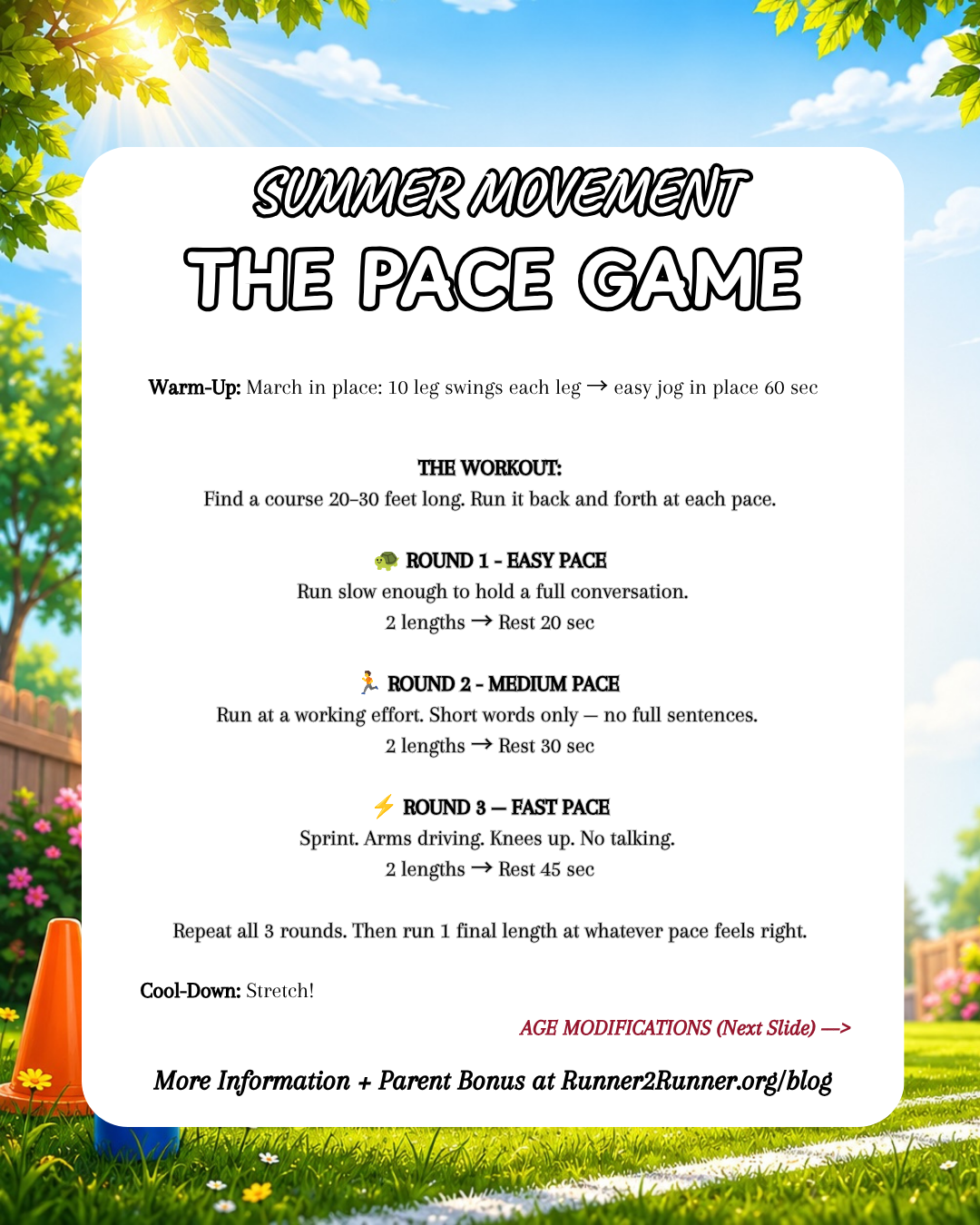
What you need: Any open space with a clear start and finish point. A course of 20 to 30 feet works well, a driveway, a section of yard, or a stretch of sidewalk. No equipment needed.
Total time: 15 to 20 minutes including warm-up and cool-down.
Warm-Up — 2 Minutes
March in place for 30 seconds — big high knees, big arm swings. Do 10 leg swings forward and back on each leg. Then jog very easily in a small circle for 60 seconds. You're ready.
The Circuit
The workout has three rounds. Each round focuses on one pace. You move through all three back to back with a short rest between each round.
🐢 Round 1 — Easy Pace
Move from your start to your finish and back at your easiest possible running pace. This should feel almost too easy. You should be able to hold a full conversation, tell a story, say the alphabet, count backward from 20, while you're moving. If you can't talk, you're going too fast. Slow down.
2 lengths of your course. Rest 20 seconds.
This is your aerobic base pace. Every great distance runner spends the majority of their training time here. Easy running builds the cardiovascular infrastructure.
🏃 Round 2 — Medium Pace
Pick it up to a pace that feels like genuine effort. Not sprinting, but working. You can say a few short words but you cannot hold a conversation. You are breathing noticeably harder. Your legs know they are running.
2 lengths of your course. Rest 30 seconds.
This is your tempo pace, the effort level that sits just below your maximum sustainable speed. Training at this pace builds your aerobic threshold, which is the point at which your body shifts from easy to hard effort. The higher your threshold, the faster you can run before things feel difficult. This round is doing important work.
⚡ Round 3 — Fast Pace
Give it real speed. Not quite an all-out sprint but close, powerful, focused, and fast. You cannot talk. Your arms are driving. Your knees are up. You are going.
2 lengths of your course. Rest 45 seconds.
This is your speed work. Short hard efforts recruit fast-twitch muscle fibers that easy running never touches. Done consistently over time, sprint efforts change the actual composition of muscle tissue, increasing fast-twitch fiber proportion and building top-end speed. Two lengths at full effort today is real training.
Repeat the Full Circuit
Go through all three rounds again (easy, medium, fast). The second time through you should have a clearer sense of what each pace actually feels like from the inside. Focus on the contrast between them. Notice how different Round 1 feels from Round 3. That awareness is the skill being built today.
Finisher — Pace Choice
One final length of your course at whatever pace feels right. No instruction. No target. Just run how your body wants to run right now. Notice what you choose. There is no wrong answer.
Cool-Down — 2 Minutes
Walk one slow lap around your space. Forward fold toward your toes and hold for 20 seconds. Quad stretch standing on one foot, hold 15 seconds each leg. Three big deep breaths.
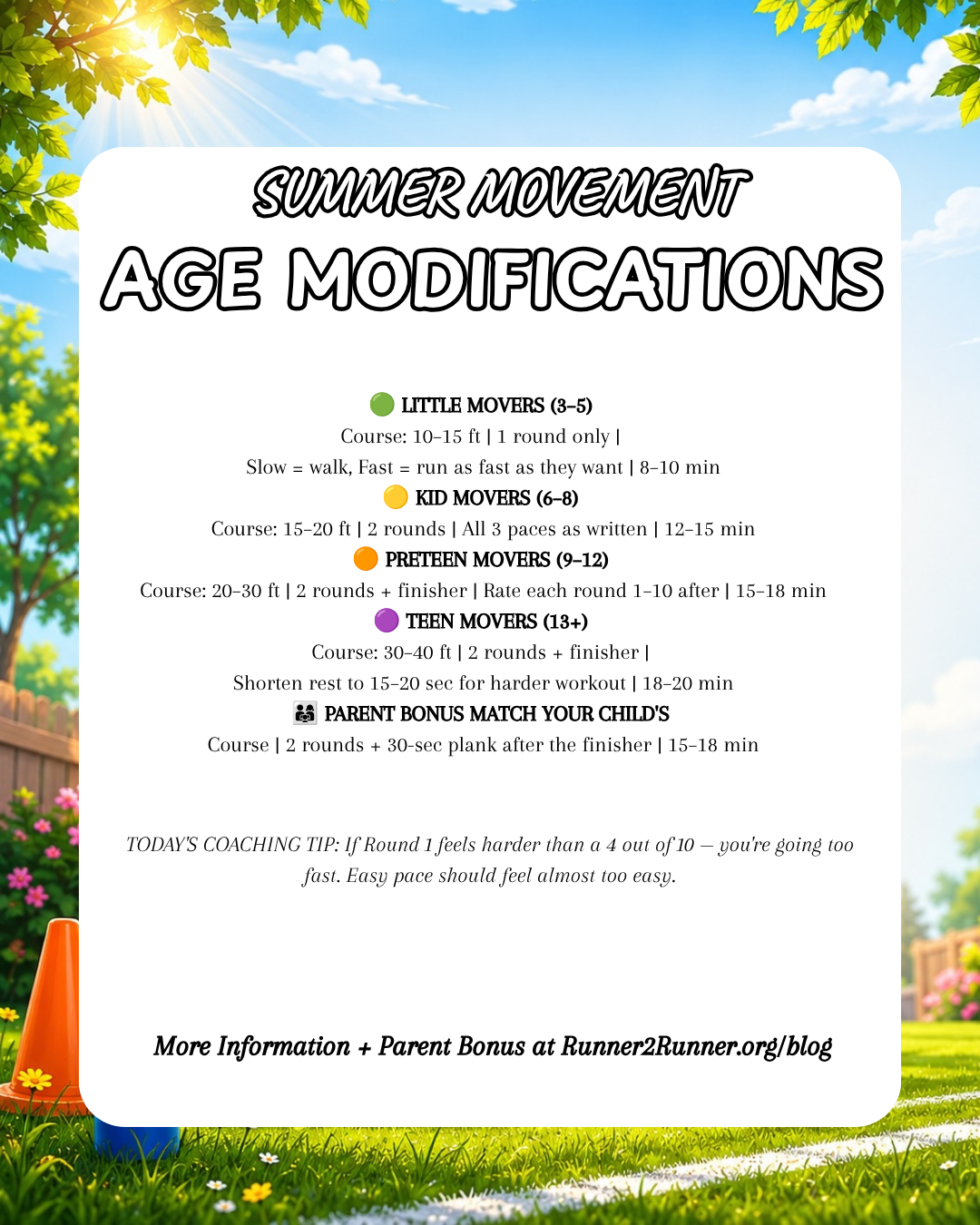
Age Modifications
Coaching Notes for Parents
Running with toddlers: The Pace Game for Little Movers is really a Walk/Jog Game. At ages 3 to 5, understanding that movement has different intensities is the whole lesson. Walking slowly versus walking fast versus running a short burst is a meaningful and developmentally appropriate distinction. Don't push for sustained jogging. Let their fast pace be whatever fast means to them. That is enough and it is perfect.
Running with 6 to 8 year olds: The most valuable thing you can do in Round 1 is run alongside them at their easy pace and hold a normal conversation. When they realize they can talk and run at the same time, that running doesn't have to feel hard, that surprise is the lesson landing. That moment is worth more than any rep count.
Running with 9 to 12 year olds: After each round ask them to rate their effort on a scale of 1 to 10. Round 1 should feel like a 3 or 4. Round 2 should feel like a 6 or 7. Round 3 should feel like an 8 or 9. If Round 1 feels like a 6 they are going too fast on the easy pace, the most common mistake in youth running and the most important one to correct early.
Running with teens: Introduce RPE (Rate of Perceived Exertion). On a scale of 1 to 10: Round 1 targets a 3 to 4, Round 2 targets a 6 to 7, Round 3 targets an 8 to 9. This is the exact framework used by competitive runners and coaches worldwide to manage training load without heart rate monitors or GPS watches. Your teen just learned a real coaching tool.
Did You Know?
🐢 Easy running builds more fitness than most people realize.
The majority of training done by elite distance runners is performed at an easy conversational pace. Up to 80% of their weekly mileage is genuinely easy. Easy running builds aerobic capacity, trains fat burning as a fuel source, and develops the cardiovascular infrastructure that makes faster running possible. The slow round today is not filler. It is the foundation.
💬 The Talk Test is used by cardiologists and coaches worldwide.
The ability to hold a conversation during exercise, the basis of Round 1, is a clinically validated indicator of aerobic training intensity. When you can talk comfortably, you're in the aerobic zone. When you can't, you've crossed into the anaerobic zone. Physicians use this test in cardiac rehabilitation programs. Olympic coaches use it to calibrate training loads. Today your kids used it in the backyard.
🎯 Pacing is a learnable skill, and earlier is better.
Research in sports science consistently shows that the ability to accurately judge and control running pace is a trainable cognitive skill, not an innate talent. Young athletes who practice deliberate pacing, feeling and choosing their effort rather than always running by competition or by how they feel in the moment, develop significantly better race performance and significantly lower injury rates over time. Today's workout is building that skill.
⚡ Sprint training changes muscle fiber composition.
Short hard sprint efforts, Round 3 of today's workout, recruit fast-twitch muscle fibers that easy running never accesses. Regular sprint training over time literally changes the composition of muscle tissue, increasing the proportion of fast-twitch fibers and improving explosive speed. Even short distances done consistently produce real adaptations. Two lengths at full effort today matters more than it might seem.