Day 85: Fresh Legs Monday
Welcome to the strangest week of the challenge. For twelve weeks we have asked your family to do more. Starting today, we ask them to do less, deliberately, on purpose, and it is going to feel wrong. This is a taper. It is the part of training that wins races, and it is the part almost everyone gets wrong.
The One Rule. If you finish today's run feeling like you could have done more, you did it correctly.
That sentence is the whole week. Every instinct your kids have says the opposite: the finish line is coming, so push harder, cram more in, prove something. Every one of those instincts is wrong, and following them is the single most common way athletes ruin the day they've been training for.
Why Doing Less Makes You Faster
Here's the thing nobody explains to young athletes: the fitness for Day 92 is already built. It was built in June, and July, and over the hardest week of the summer that ended two days ago. You cannot add fitness in seven days. It doesn't work that way, the body takes weeks to turn training into adaptation.
But you can absolutely arrive tired.
A taper doesn't touch the fitness. It just lets the fatigue drain off, so that what's underneath finally shows up. That's why runners routinely set personal bests after a week of doing barely anything, and why a well-rested athlete beats a better-trained tired one.
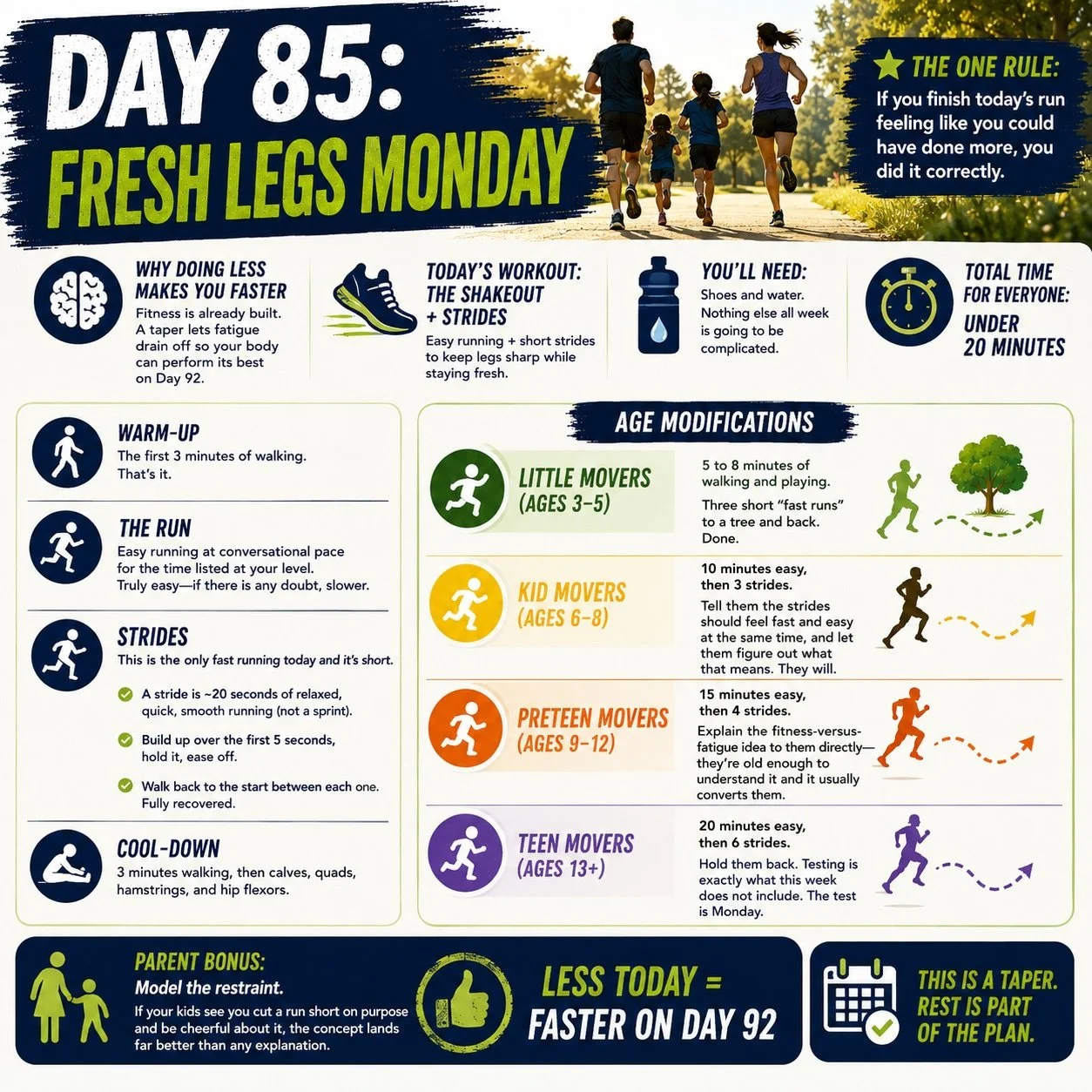
Today's Workout: The Shakeout + Strides
You'll need: shoes and water. Nothing else all week is going to be complicated.
Warm-up: the first three minutes of walking. That's it.
The Run: Easy running at conversational pace, for the time listed at your level. Truly easy, if there is any doubt, slower.
Then: Strides. This is the only fast running today and it's short. A stride is about 20 seconds of relaxed, quick, smooth running, not a sprint. Build up over the first five seconds, hold it, ease off. Walk back to the start between each one, fully recovered.
Strides are how you keep legs sharp while doing almost nothing. They tell the nervous system "we still run fast around here" without adding any fatigue worth mentioning.
Cool-down: 3 minutes walking, then calves, quads, hamstrings, and hip flexors.
Total time today, for everyone: under twenty minutes.
Age Modifications
🟢 Little Movers (Ages 3–5): 5 to 8 minutes of walking and playing. Three short "fast runs" to a tree and back. Done.
🟡 Kid Movers (Ages 6–8): 10 minutes easy, then 3 strides. Tell them the strides should feel fast and easy at the same time, and let them figure out what that means. They will.
🟠 Preteen Movers (Ages 9–12): 15 minutes easy, then 4 strides. This is the age group most likely to fight the taper. Explain the fitness-versus-fatigue idea to them directly, they're old enough to understand it and it usually converts them.
🟣 Teen Movers (Ages 13+): 20 minutes easy, then 6 strides. Hold them back. A teen who has trained all summer will want to test themselves this week, and testing is exactly what this week does not include. The test is Monday.
👨👩👧 Parent Bonus: Model the restraint. If your kids see you cut a run short on purpose and be cheerful about it, the concept lands far better than any explanation.
Did You Know?
Tapering is one of the most reliably effective things in all of sports science. When researchers look at what happens when trained athletes cut their training volume sharply for one to three weeks before a competition, while keeping some intensity, exactly like today's strides, performance improves measurably.
Tomorrow is Day 86: Celebration Sprints. See you tomorrow at 6am.