Day 88: Walk the Course
Today you go back to where this started.
On June 1st, your family found an open space (a driveway, a backyard, a park path, a neighborhood loop) and did laps together. That was Day 1. On Monday you're going to run that exact loop again, at the same distance, and compare. Today, you walk it.
Why Walking a Course Is a Real Thing Athletes Do
Before a marathon, elite runners study the elevation profile. Before a cross-country meet, teams walk the course the morning of. Before a track final, athletes stand on the track. This isn't superstition, it's information.
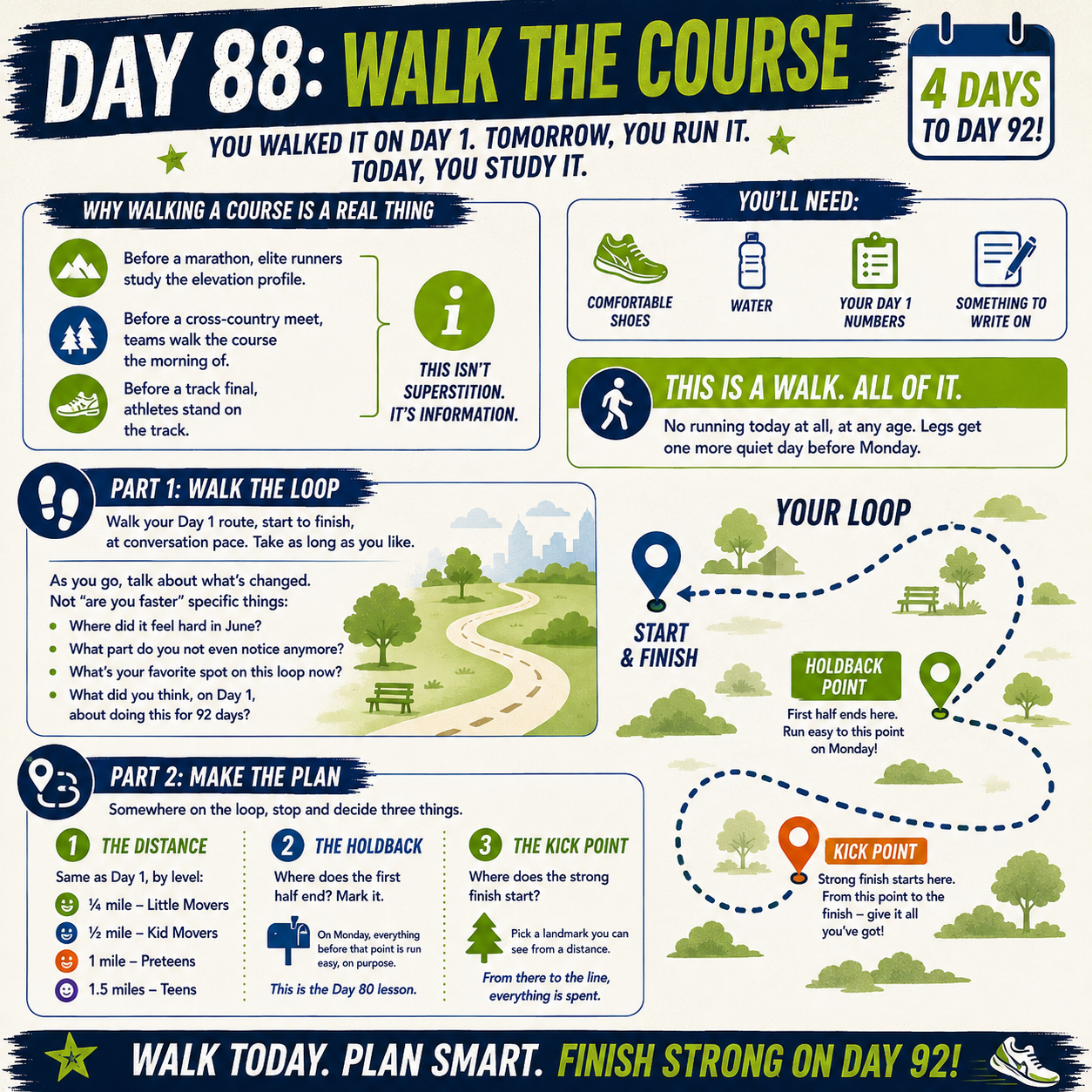
Today's Workout: Walk the Course
You'll need: comfortable shoes, water, your Day 1 numbers, and something to write on.
This is a walk. All of it. No running today at all, at any age. Legs get one more quiet day before Monday.
Part 1: Walk the Loop
Walk your Day 1 route, start to finish, at conversation pace. Take as long as you like.
As you go, talk about what's changed. Not "are you faster" specific things:
Where did it feel hard in June?
What part do you not even notice anymore?
What's your favorite spot on this loop now?
What did you think, on Day 1, about doing this for 92 days?
Part 2: Make the Plan
Somewhere on the loop, stop and decide three things.
1. The distance. Same as Day 1, by level: ¼ mile for Little Movers, ½ mile for Kid Movers, 1 mile for Preteens, 1.5 miles for Teens.
2. The holdback. Where does the first half end? Mark it, a mailbox, a corner, a tree. On Monday, everything before that point is run easy, on purpose. This is the Day 80 lesson and it is the single biggest thing standing between your kids and a good time.
3. The kick point. Where does the strong finish start? Pick a landmark you can see from a distance. From there to the line, everything is spent.
Age Modifications
🟢 Little Movers (Ages 3–5): Walk a piece of the loop, not necessarily the whole thing. Show them where the finish line is going to be on Monday. That's the memory worth building today.
🟡 Kid Movers (Ages 6–8): Walk the whole loop. Let them pick and name the kick-point landmark. They'll remember a landmark they named.
🟠 Preteen Movers (Ages 9–12): Full walk, full plan, written down. Have them tell you their pacing plan back to you at the end without looking at the paper.
🟣 Teen Movers (Ages 13+): Full walk and a real race plan: Day 1 time, target time, holdback point, kick point. Then say the honest thing, the first quarter is where this gets thrown away, and it will feel far too easy at the time. That's how they'll know it's right.
👨👩👧 Parent Bonus: Somewhere on this walk, tell your kids what you thought on June 1st about whether you'd all make it to 92. Honestly. It's a better story than they expect and they've earned it.
Did You Know?
You are a terrible judge of your own progress, and there's a reason for it. Improvement in endurance and strength happens in increments far too small to perceive day to day. A child might get a fraction of a percent fitter in a week, invisible on any given morning. Meanwhile the effort of running stays roughly constant, because as fitness improves, people unconsciously run a little faster to keep the effort the same. So it always feels about as hard as it did before.
Tomorrow is Day 89: Neighborhood Finish Line. See you tomorrow at 6am.