Day 30: Reaction Ball Game
Yesterday we worked on running fast. Today we work on something different but equally important, reacting fast.
Speed isn't only about how quickly your legs can move. In nearly every sport, the first and often most decisive moment is the reaction, the split second between something happening and your body responding to it. A faster reaction time means a better start off the line, a quicker reflex to catch a ball, and a sharper response to a sudden change in a game.
The Reaction Ball Game trains exactly that, using nothing more than a ball, a partner, and a bit of unpredictability.
Why Reaction Time Is Trainable
Reaction time is partly genetic, but it is also trainable through repeated practice. The nervous system gets faster at processing visual information and triggering a motor response the more often it practices doing exactly that under realistic, varied conditions. This is why athletes in reaction-dependent sports drill this specific skill constantly, separate from their sport-specific practice. A simple drop-and-catch ball game, especially with an unpredictable bounce, is one of the most accessible ways to train this for any age.
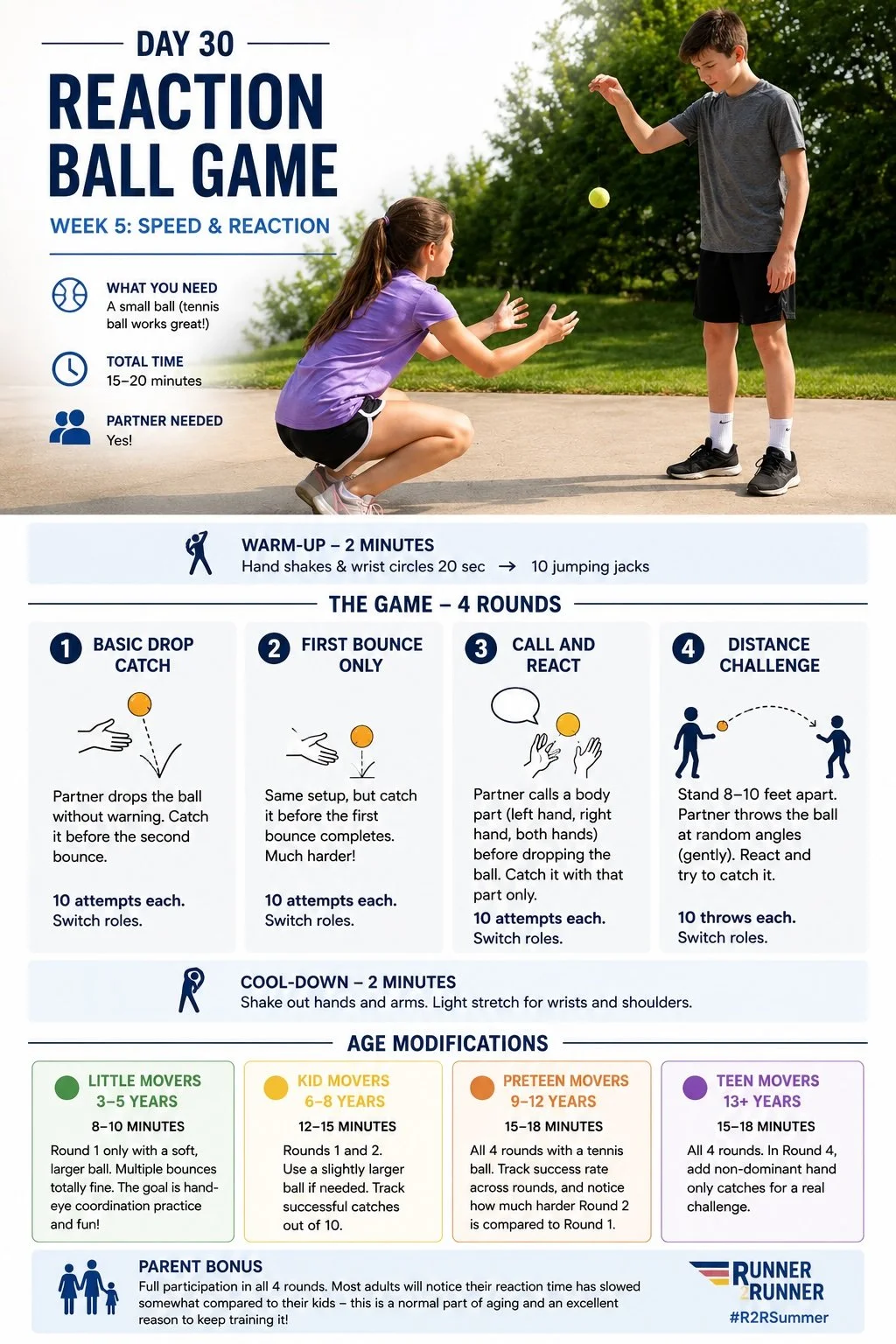
Today's Workout: Reaction Ball Game
What you need: A small ball, a tennis ball works particularly well because of its unpredictable bounce, or any ball you have on hand.
Warm-Up: 20 seconds of hand shakes and wrist circles. 10 jumping jacks to get the whole body moving.
Round 1: Basic Drop Catch: Partner holds the ball at shoulder height and drops it without warning, you try to catch it before the second bounce. 10 attempts, switch roles.
Round 2: First Bounce Only: Same setup, but now you must catch it before the first bounce completes, much harder. 10 attempts, switch roles.
Round 3: Call and React: Partner calls out a body part, left hand, right hand, both hands, before dropping the ball, you must catch it with the called part only. 10 attempts, switch roles.
Round 4: Distance Challenge: Stand 8 to 10 feet apart, partner throws the ball at random unpredictable angles, gently, you react and try to catch it. 10 throws, switch roles.
Cool-Down: Shake out hands and arms. Light stretch for wrists and shoulders.
Age Modifications
🟢 Little Movers: Ages 3–5 | 8–10 Minutes: Round 1 only, with a soft, larger ball, and a generous bounce allowance, catching after multiple bounces is completely fine. The goal is hand-eye coordination practice and fun, not speed.
🟡 Kid Movers: Ages 6–8 | 12–15 Minutes: Rounds 1 and 2, with a slightly larger ball if a tennis ball proves too difficult. Track how many successful catches out of 10 attempts in each round.
🟠 Preteen Movers: Ages 9–12 | 15–18 Minutes: All 4 rounds with a tennis ball. Track success rate across rounds, noting how much harder Round 2 is compared to Round 1.
🟣 Teen Movers: Ages 13+ | 15–18 Minutes: All 4 rounds, with Round 4 extended to include some non-dominant hand only catches, a meaningfully harder variation that most teens haven't specifically trained.
👨👩👧 Parent Bonus: Full participation in all 4 rounds. Most adults will notice their reaction time has slowed somewhat compared to their kids, this is a normal part of aging and an excellent reason to keep training it.
Did You Know?
Reaction time peaks in the early twenties and gradually slows with age, but training can offset much of that decline. Research in motor control science shows that simple reaction time peaks around ages 20 to 25 and slows gradually afterward, but individuals who regularly engage in reaction-based activities maintain significantly faster reaction times than sedentary peers of the same age, well into older adulthood. Today's game is genuine, lifelong-relevant training, not just a kids' activity.
Tomorrow is Day 31: Chalk Ladder Drills. The agility footwork pattern used by serious athletes worldwide, recreated entirely with sidewalk chalk. See you at 6am.