Day 31: Chalk Ladder Drills
There is a piece of training equipment found in professional football locker rooms, Olympic sprint training facilities, and elite soccer academies worldwide. It costs around twenty dollars, takes thirty seconds to set up, and produces measurable improvements in foot speed, coordination, and agility in athletes of every level.
Today we recreate it entirely with sidewalk chalk.
The agility ladder, and the chalk version your family will draw today, is nothing more than a series of boxes on the ground that athletes step through in specific patterns as quickly as possible. The boxes force the feet to move precisely, quickly, and in coordination with each other, building the neuromuscular connections that underlie all athletic quickness.
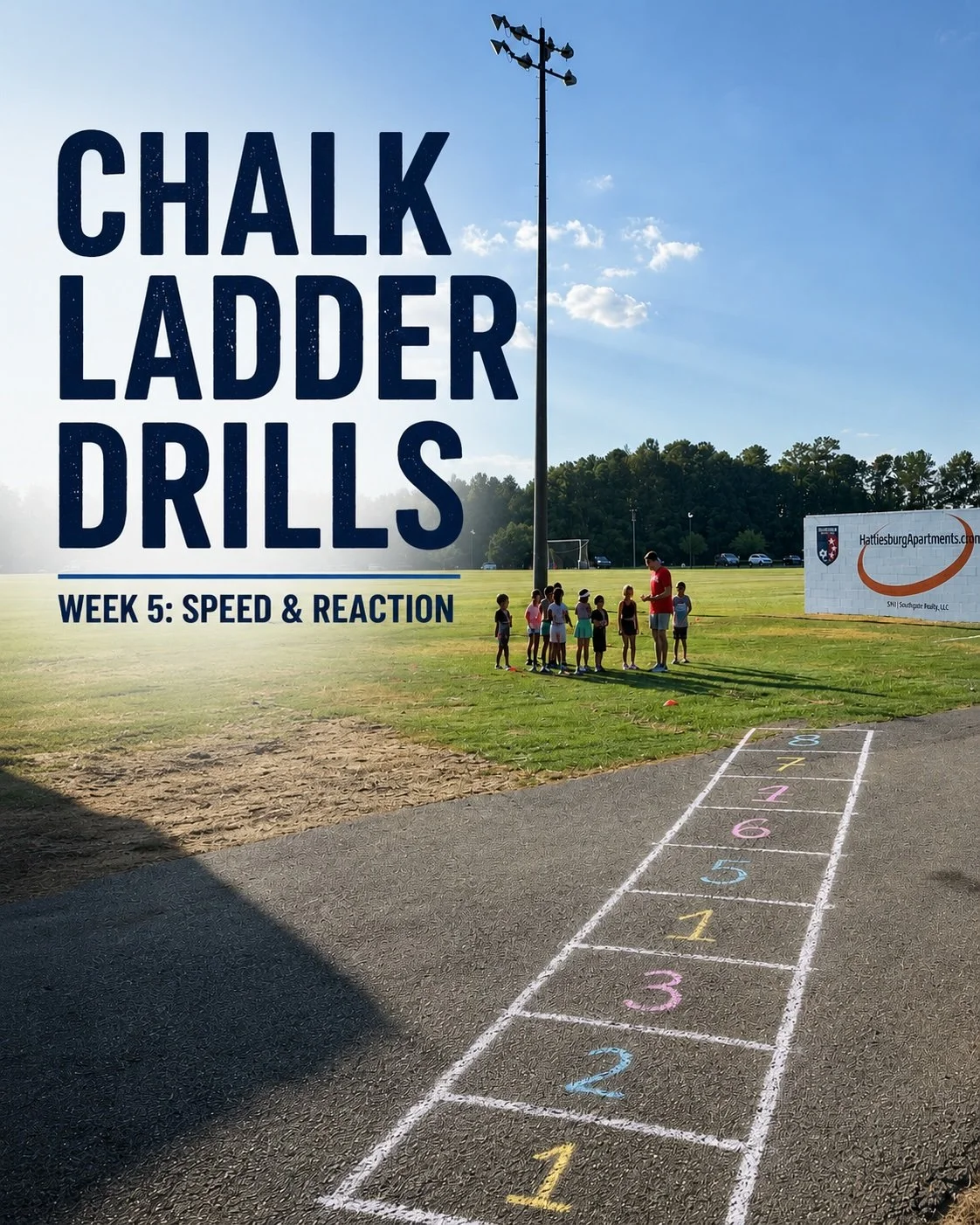
Draw Your Ladder
Before you start, draw the ladder on the driveway or any flat paved surface. The measurements don’t need to be exact.
Draw two parallel lines about 18 inches apart running lengthwise down the driveway. Add rungs across every 18 inches or so to create boxes. Eight to ten boxes is plenty. Use chalk to number each box 1 through 8 so everyone knows where they are in the pattern.
If you don’t have chalk or pavement, use tape on a garage floor, rope laid out on grass, or flat garden markers. The pattern matters more than the material.
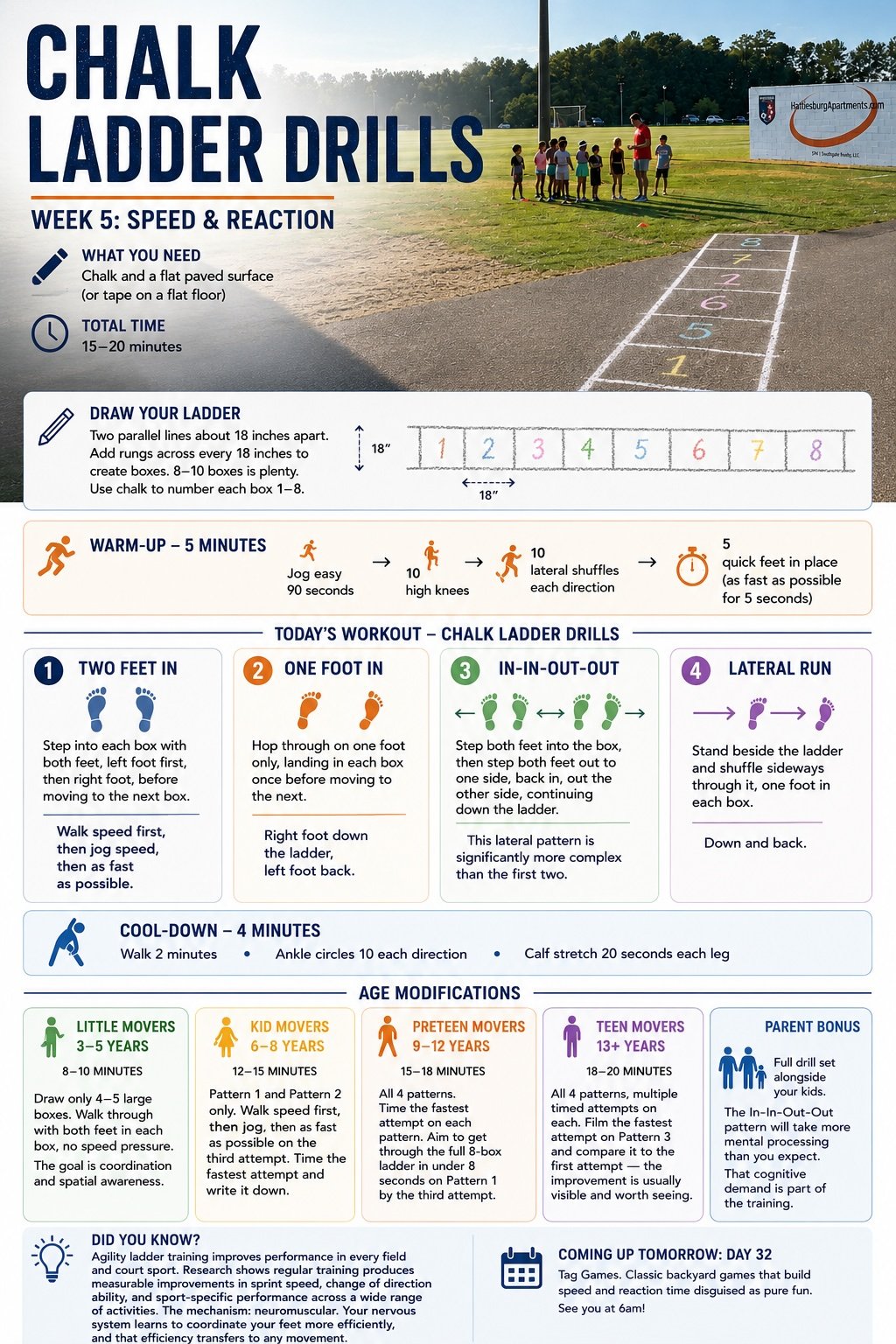
Today’s Workout: Chalk Ladder Drills
What you need: Chalk and a flat paved surface.
Total time: 15 to 20 minutes.
Warm-Up: Jog easy 90 seconds. 10 high knees in place. 10 lateral shuffles each direction. 5 quick feet in place, as fast as possible for 5 seconds.
Pattern 1: Two Feet In: Step into each box with both feet, left foot first, then right foot, before moving to the next box. Walk speed first, then jog speed, then as fast as possible.
Pattern 2: One Foot In: Hop through on one foot only, landing in each box once before moving to the next. Right foot down the ladder, left foot back.
Pattern 3: In-In-Out-Out: Step both feet into the box, then step both feet out to one side, back in, out the other side, continuing down the ladder. This lateral pattern is significantly more complex than the first two.
Pattern 4: Lateral Run: Stand beside the ladder and shuffle sideways through it, one foot in each box, moving laterally rather than forward. Down and back.
Cool-Down: Walk 2 minutes. Ankle circles 10 each direction. Calf stretch 20 seconds each leg.
Age Modifications
🟢 Little Movers: Ages 3–5 | 8–10 Minutes: Draw only 4 to 5 large boxes. Walk through with both feet in each box, no speed pressure. The goal is simply stepping in and out of a defined space deliberately, which is coordination and spatial awareness work at exactly the right level for this age.
🟡 Kid Movers: Ages 6–8 | 12–15 Minutes: Pattern 1 and Pattern 2 only. Walk speed first, then jog, then as fast as possible on the third attempt. Time the fastest attempt and write it down.
🟠 Preteen Movers: Ages 9–12 | 15–18 Minutes: All 4 patterns. Time the fastest attempt on each pattern. Aim to get through the full 8-box ladder in under 8 seconds on Pattern 1 by the third attempt.
🟣 Teen Movers: Ages 13+ | 18–20 Minutes: All 4 patterns, multiple timed attempts on each. Film the fastest attempt on Pattern 3 which is the most complex and compare it to the first attempt, the improvement within a single session is usually visible and worth seeing.
👨👩👧 Parent Bonus: Full drill set alongside your kids. The In-In-Out-Out pattern will take more mental processing than you expect. That cognitive demand is part of the training.
Did You Know?
Agility ladder training improves performance in every field and court sport. Research in sports science consistently shows that regular agility ladder training produces measurable improvements in sprint speed, change of direction ability, and sport-specific performance across a wide range of activities, soccer, basketball, tennis, track, and beyond.
Tomorrow is Day 32: Tag Games. Classic backyard games that build speed and reaction time disguised as pure fun. See you at 6am.