Day 32: Tag Games
Tag is the original athletic training tool. Before agility ladders, before sprint drills, before reaction ball games, children were chasing each other across open spaces, changing direction at full speed, reacting to the movements of another person in real time, and developing the exact athletic qualities that coaches spend decades trying to recreate in formal training environments. Today we play tag. On purpose. With intention. And with the understanding that what looks like a simple backyard game is genuinely sophisticated speed and agility training.
Why Tag Is More Athletic Than It Looks
The key difference between tag and most other speed training is that tag requires reactive agility, changing direction in response to an unpredictable human opponent, rather than planned agility, completing a known course or pattern. Reactive agility is considered by sports scientists to be significantly more sport-transferable than planned agility because it mirrors the actual demands of almost every competitive sport. A soccer player doesn't follow a chalk ladder pattern on the field. They react to another person moving unpredictably. Tag trains exactly that.
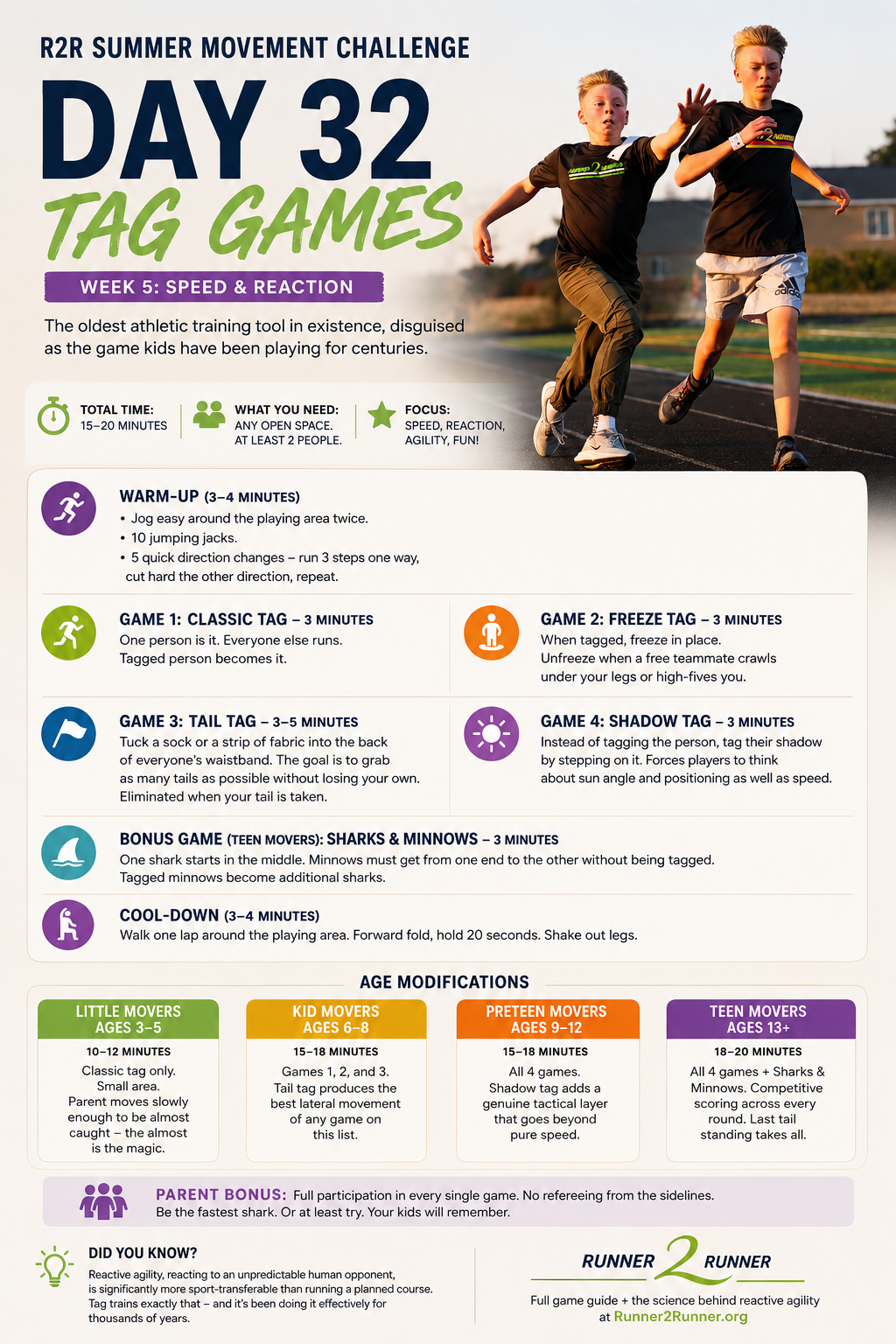
Today's Workout: Tag Games
What you need: Any open space. At least two people.
Total time: 15 to 20 minutes.
Warm-Up: Jog easy around the playing area twice. 10 jumping jacks. 5 quick direction changes, run three steps one way, cut hard the other direction, repeat.
Game 1: Classic Tag: One person is it. Everyone else runs. Tagged person becomes it. Play for 3 minutes.
Game 2: Freeze Tag: When tagged, freeze in place. Unfreeze when a free teammate crawls under your legs or high-fives you. Play for 3 minutes.
Game 3: Tail Tag: Tuck a sock or a strip of fabric into the back of everyone's waistband. The goal is to grab as many tails as possible without losing your own. Eliminated when your tail is taken. Play until one tail remains.
Game 4: Shadow Tag: Instead of tagging the person, tag their shadow by stepping on it. Forces players to think about sun angle and positioning as well as speed. Play for 3 minutes.
Cool-Down: Walk one lap around the playing area. Forward fold, hold 20 seconds. Shake out legs.
Age Modifications
🟢 Little Movers: Ages 3–5 | 10–12 Minutes: Classic tag only, with a very small playing area and a very slow it. The goal is the joy of chasing and being chased, not genuine competition. If a parent is it, move slowly enough to be almost caught but not quite, building the delicious almost-got-you tension that makes this age group absolutely love the game.
🟡 Kid Movers: Ages 6–8 | 15–18 Minutes: Games 1, 2, and 3 as written. Tail tag is the highlight for this age group, the strategic element of protecting your own tail while hunting others is genuinely engaging and produces excellent lateral movement.
🟠 Preteen Movers: Ages 9–12 | 15–18 Minutes
All 4 games as written. Shadow tag adds a genuine tactical layer that preteens find compelling, positioning relative to the sun requires spatial thinking alongside the physical reaction training.
🟣 Teen Movers: Ages 13+ | 18–20 Minutes
All 4 games, with time limits enforced and competitive scoring across all rounds, most tags in freeze tag, last tail standing in tail tag, most shadows stepped on in shadow tag. Add a fifth game: Sharks and Minnows, one shark starts in the middle of the space, minnows must get from one end to the other without being tagged, tagged minnows become additional sharks.
👨👩👧 Parent Bonus: Full participation in every game. No refereeing from the sidelines. Be the fastest shark in Sharks and Minnows, or at least try. Your kids will remember whether you actually played.
Did You Know?
Tag develops reactive agility that planned drills cannot replicate. Research published in the Journal of Sports Sciences found that reactive agility, responding to a human opponent's unpredictable movements, requires different and more complex neuromuscular processing than planned agility through a known course. Athletes who train reactive agility specifically, as opposed to only practicing planned patterns, show significantly better performance in sport-specific situations that involve opponents and unpredictable movement.
Children who engage in unstructured chase games develop better movement skills overall. Multiple studies in developmental motor science have found that children who regularly engage in chasing games, tag being the most studied, develop better fundamental movement skills, faster reaction times, and more fluid direction-change ability than children who only participate in structured, rule-heavy sport. The unstructured, reactive nature of tag is not a limitation, it is a feature. It is why tag has survived as a children's game across virtually every culture for thousands of years.
Tomorrow is Day 33: 4th of July Family Race. A special holiday edition of the sprint challenge, relay race, and a parade march that gets everyone moving on Independence Day. See you at 6am.