Day 50: The Breathing Run
Welcome to Week 8 of the R2R Summer Movement Challenge. Fifty days of consistent movement. Take a moment with that number before reading any further. Fifty days. Your family has shown up for fifty days of this challenge and today is the start of the back half’s second week. That is not a small thing. That is a habit.
This week the theme is Mind and Body and it is intentionally different from every other week in the challenge. The physical training continues throughout the week but the focus shifts inward. This week is about the connection between the mind and the body during movement, how breath affects effort, how visualization affects performance, how mental focus changes what the body can do.
Today we start with the most fundamental of all those connections. Today we learn to breathe.
Why Breathing Matters More Than Most Runners Realize
Here is something that surprises almost every runner who encounters it for the first time: breathing during running is a skill. Not an automatic process that just happens adequately, but a trainable skill that, when practiced deliberately, measurably changes how running feels, how efficiently the body uses oxygen, and how quickly it recovers between hard efforts. Most untrained runners breathe reactively, they breathe as hard and as fast as their body demands, without any conscious input. This reactive breathing is often shallow, often irregular, and often disconnected from the running rhythm. It works well enough that runners don’t notice how much better deliberate breathing works. Elite runners breathe with intention. They match their breath to their stride. They breathe through patterns that maximize oxygen uptake and minimize the energy cost of breathing itself. They use breath control as a real-time pacing tool, if the breathing pattern becomes unsustainable the pace needs to come down, and if the breathing is comfortable the pace can go up. Breathing is the most accurate internal monitor of effort that exists.
Today your family learns to use it.
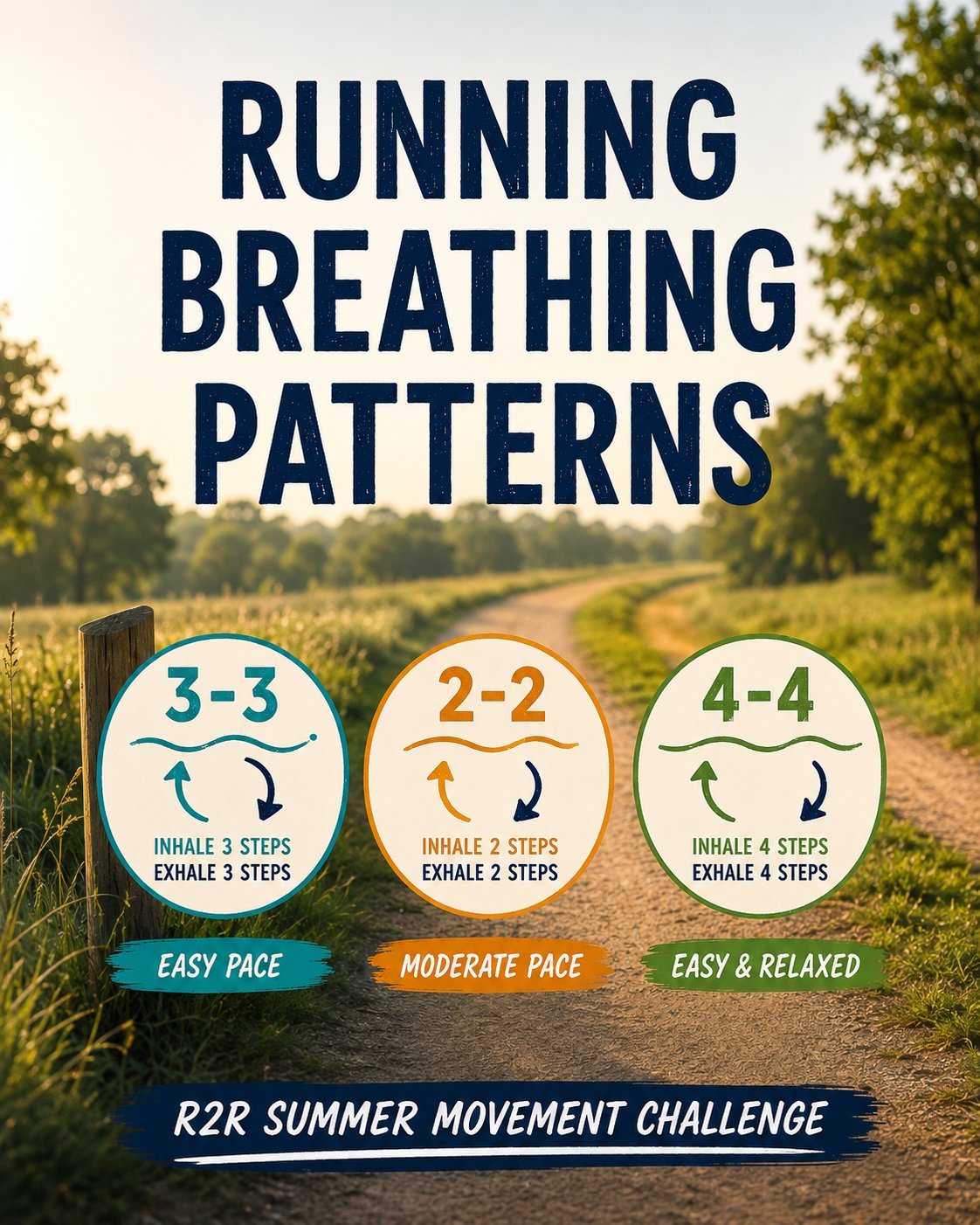
The Three Breathing Patterns
Before you run, learn the three patterns you’ll work through today.
The 3-3 Pattern: Inhale for 3 running steps, exhale for 3 running steps. This is the easiest pattern to start with and the one that feels most natural at an easy to moderate pace. Count the steps with each breath until the pattern becomes automatic.
The 2-2 Pattern: Inhale for 2 running steps, exhale for 2 running steps. This pattern suits a slightly faster pace or a harder effort. The shorter cycle keeps the breath moving more quickly which matches the increased oxygen demand of higher intensity running.
The 4-4 Pattern: Inhale for 4 running steps, exhale for 4 running steps. This is the slowest pattern and it suits the most comfortable easy running pace. Breathing this slowly while running requires genuine relaxation and is harder than it sounds. It is also deeply calming when it works.
Today’s Workout: The Breathing Run
What you need: Any running route, a neighborhood loop, a park path, or a measured course. No equipment required.
Warm-Up: Walk briskly for 90 seconds. Practice each breathing pattern while walking: 3-3, then 2-2, then 4-4, so the counting feels familiar before you run.
Segment 1: The 3-3 Run - Run at a comfortable easy pace using the 3-3 breathing pattern. Inhale for 3 steps, exhale for 3 steps. Count silently. If the count breaks, don’t worry, just start it again. The goal is to maintain the pattern as continuously as possible for the full segment. Run for 3 minutes.
Walk 1 minute.
Segment 2: The 2-2 Run - Pick up the pace slightly, to a working effort, and switch to the 2-2 pattern. Inhale for 2 steps, exhale for 2 steps. The faster cycle should feel more natural at this slightly higher effort. Run for 3 minutes.
Walk 1 minute.
Segment 3: The 4-4 Run - Slow the pace back down to the easiest possible running pace and try the 4-4 pattern. Inhale for 4 steps, exhale for 4 steps. This is the hardest pattern even though it is the slowest run — forcing the breath to slow down while the body is in motion takes genuine focus. Run for 3 minutes.
Walk 1 minute.
Segment 4: Free Choice - Run the final segment at whatever pace feels right and choose whichever breathing pattern feels most comfortable. Notice which one you choose. Notice whether you can hold it. Notice how the run feels when the breath is controlled versus when it wanders.
Run for 3 minutes. Walk home easy.
Cool-Down: Walk 2 minutes. Three slow deep breaths — in through the nose for 4 counts, hold for 2, out through the mouth for 6. Repeat three times. This is the breathing pattern used in mindfulness practice and it activates the parasympathetic nervous system — the body’s rest and recovery mode.
Age Modifications
🟢 Little Movers: Ages 3–5 | 10–12 Minutes - Skip the breathing patterns and focus on one simple breathing skill: belly breathing. Before the walk place one hand on the belly and one on the chest and take three big slow breaths, the belly hand should move more than the chest hand. That is diaphragmatic breathing and it is the most important breathing skill of all. Then walk the route normally with one instruction: every time there is an uphill, take one big deep breath at the bottom before starting it. That is the whole breathing practice for this age. It is enough.
🟡 Kid Movers: Ages 6–8 | 18–20 Minutes - Introduce the 3-3 pattern only. Walk while counting the pattern first, then jog. The count is the whole focus, not pace, not distance. If the 3-3 pattern breaks, slow down until it holds. Run Segments 1 and 4 only, with a free walk between. Skip Segments 2 and 3.
🟠 Preteen Movers: Ages 9–12 | 22–25 Minutes - All four segments as written. The 4-4 pattern in Segment 3 is the most challenging for this age group, most preteens find that forcing the breath to slow down at running pace takes more concentration than they expect. That concentration is the training. After the run ask them which pattern felt most natural and which felt hardest. That self-awareness is athletic intelligence being built.
🟣 Teen Movers: Ages 13+ | 25–28 Minutes - All four segments as written with extended run times, 4 minutes per segment instead of 3. In Segment 2 add a conscious effort to breathe through the nose only, nasal breathing at moderate running intensity is significantly harder than mouth breathing and produces meaningful adaptations in respiratory efficiency over time. Note whether nasal-only breathing is possible for the full 4 minutes or where it breaks down. That breakdown point is useful training information.
👨👩👧 Parent Bonus: Full workout as written. Pay particular attention to Segment 3, the 4-4 pattern at easy running pace. For most adults who run, the breathing is one of the most automatic and least examined aspects of their running. Deliberately slowing the breath while running is often a genuinely novel experience. Notice what it feels like. Notice whether slowing the breath also slows the mind. That connection, breath and mental state, is the whole territory of Week 8.
Did You Know?
Controlled breathing during running measurably reduces perceived effort. Research published in the Journal of Sports Sciences found that runners who used rhythmic breathing patterns, matching breath to stride in a specific ratio, reported significantly lower perceived effort at the same pace compared to runners who breathed reactively. The pace was identical. The effort felt easier simply because the breath was controlled. Today’s breathing patterns are a free performance enhancement that requires no fitness improvement, no training adaptation, and no equipment.
Nasal breathing during exercise produces different physiological outcomes than mouth breathing. Research from the University of Exeter found that nasal breathing during moderate-intensity exercise significantly increases nitric oxide production compared to mouth breathing. Nasal breathing also filters, humidifies, and warms air before it reaches the lungs, reducing respiratory stress. Elite endurance athletes increasingly train with nasal-only breathing at easy paces for exactly these reasons.
The diaphragm is a muscle, and it can be trained. The diaphragm is the primary muscle of breathing and like all muscles it can be strengthened and made more efficient with deliberate training.
This Week': Mind & Body
Here’s what’s coming the rest of Week 8:
Tuesday, Day 51: Focus and Coordination Challenge
Wednesday, Day 52: The Visualization Run
Thursday, Day 53: Obstacle Mind Maze
Friday, Day 54: Mindful Stretch Party
Saturday + Sunday, Days 55 & 56 Weekend Edition: Gratitude Run + Active Recovery
See you tomorrow at 6am. 🧡