Day 51: Focus & Coordination Challenge
Yesterday we learned to control the breath during running. Today we take the mind-body connection one step further.
The Focus and Coordination Challenge is a series of dual-task drills. Movements that require the brain and body to work simultaneously on two different things at once. Moving the feet in one pattern while the hands do something different. Running while solving a problem. Balancing while processing information. Dual-task training sounds like a cognitive exercise dressed up as a workout. It is actually one of the most sport-specific forms of athletic training available. Every sport requires the athlete to process information and execute movement at the same time. A basketball player dribbling while reading the defense, a soccer player running while tracking teammates and opponents, a relay runner executing an exchange while at full sprint. The ability to do two things simultaneously without either one degrading is a trainable athletic quality and it is exactly what today’s challenge develops.
Why Dual-Task Training Matters
The brain has a limited capacity for conscious attention at any given moment. When a movement is new and unfamiliar it demands significant conscious attention. As movement becomes practiced and automatic it demands less conscious attention. This freeing up of conscious attention is what allows experienced athletes to think tactically while moving physically. Dual-task training accelerates this process by deliberately loading the conscious attention system while movement is happening. When the brain has to do two things at once it learns to make movement more automatic faster than it would through single-task practice alone. The drills in today’s challenge are building that automaticity. Teaching the nervous system to manage movement with less conscious oversight so the mind is free for everything else that matters during competition.
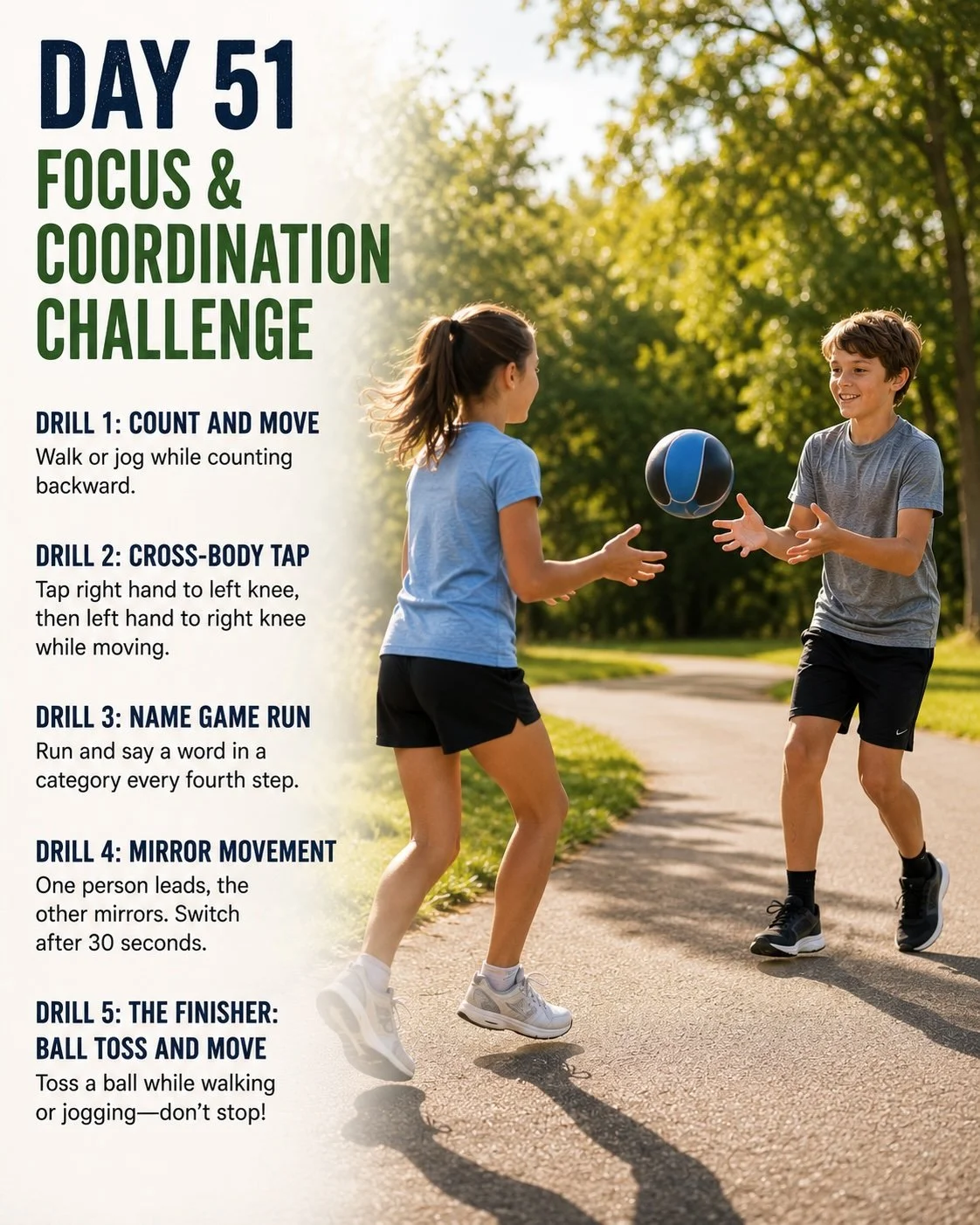
Today’s Workout: Focus & Coordination Challenge
What you need: Any open flat space. A ball optional for some drills. No other equipment required.
Warm-Up: Jog easy in place 60 seconds. 10 jumping jacks. 5 high knees each leg. 5 cross-body arm swings, right arm across to left, left arm across to right, alternating, to activate the bilateral coordination being trained today.
Drill 1: Count and Move - Walk or jog a course while counting backward from 100 by threes: 100, 97, 94, 91, and so on. The movement is easy. The counting is harder. The combination is the training. Do one full lap of the course. If counting backward by threes is too easy, count backward by sevens. If it’s too hard, count backward by twos. Adjust to find a level where both the movement and the counting require genuine attention.
Drill 2: Cross-Body Tap - Walk or jog in place. While moving, tap the right hand to the left knee as it rises, then the left hand to the right knee as it rises. Alternating cross-body taps in rhythm with the movement. This requires the two hemispheres of the brain to coordinate simultaneously and is significantly harder at running pace than it looks at standing pace. 30 seconds walking, then 30 seconds jogging. Rest 20 seconds. Repeat twice.
Drill 3: Name Game Run - Run a course while calling out a word in a chosen category on every fourth step. The category can be anything, animal names, food, countries, colors, athletes’ names. Every fourth step, one word. No repeating. No pausing. If a word doesn’t come, keep running, the pressure of not stopping is part of the drill. One full lap. Switch categories for a second lap.
Drill 4: Mirror Movement - Stand facing a partner. One person leads with slow full-body movement (arms, legs, torso) and the other mirrors it as precisely as possible with no gap between the lead and the mirror. After 30 seconds switch who leads without stopping. This drill requires sustained visual attention and full-body coordination simultaneously. Two rounds of 30 seconds each direction.
Drill 5: The Finisher: Ball Toss and Move - If a ball is available: walk or jog with a partner and toss the ball back and forth continuously. The movement must not stop when the ball is in the air and the toss must not stop when the movement is happening. Both must be continuous simultaneously. If no ball is available: walk or jog in a figure-eight pattern around two markers while clapping a rhythm, four claps per loop. The clapping and the movement must both be continuous. One full minute.
Cool-Down: Walk 2 minutes. Three slow deep breaths using yesterday’s breathing patterns. Shoulder rolls 10 each direction.
Age Modifications
🟢 Little Movers: Ages 3–5 | 8–10 Minutes - Drill 2 only, cross-body taps while marching in place. Walk while tapping right hand to left knee and left hand to right knee. Go slowly. Make it a song (tap, tap, other side, tap, tap) whatever rhythm keeps them going. 3 rounds of 20 seconds with 15 seconds rest. Then Drill 4 mirror movement with a parent. 30 seconds each leading. No Drill 5 ball toss unless they are genuinely ready, a large soft ball at very close range if attempting it.
🟡 Kid Movers: Ages 6–8 | 12–15 Minutes - Drills 1 through 4 as written with modifications. Drill 1 count backward by twos, easier than threes but still requires genuine attention. Drill 3 name game is the highlight for this age group, the pressure of naming something on every fourth step while jogging produces a combination of laughing and concentrating that is exactly the dual-task state being trained. Drill 5 ball toss if available.
🟠 Preteen Movers: Ages 9–12 | 15–18 Minutes - All five drills as written. Drill 1 count backward by sevens. Drill 3 switch categories every half lap to increase the cognitive demand. For Drill 5 increase the toss distance slightly and maintain a jogging pace rather than walking, the harder the movement and the harder the toss the more effective the dual-task training.
🟣 Teen Movers: Ages 13+ | 18–20 Minutes - All five drills as written with maximum cognitive load. Drill 1 count backward by thirteens. This will break down regularly and that breakdown is the training signal. When the count breaks, don’t stop moving, just pick up from the last number remembered and continue. Drill 4 mirror movement with eyes closed for 10 seconds at a time, the partner describes their movement verbally while the other person tries to replicate it without seeing. This adds an auditory processing layer to the coordination training.
👨👩👧 Parent Bonus: Full workout as written. Drill 1 counting backward by sevens while running is genuinely difficult for adults and that difficulty is worth sitting with rather than avoiding. The moments when the count breaks and the running continues are the moments when movement is becoming more automatic. Notice them. Drill 4 mirror movement, try to be the follower at least once with a teen leading. Following someone else’s movement precisely requires genuine ego suspension that is its own useful practice.
Did You Know?
Dual-task training improves both physical and cognitive performance simultaneously. Research published in the journal Neuropsychologia found that regular dual-task training (performing physical movement while simultaneously processing cognitive information) produces improvements in both motor automaticity and cognitive processing speed. Athletes who trained with dual-task protocols showed better sport performance, faster reaction times, and improved decision-making under pressure compared to athletes who trained physical skills in isolation. The cross-body movement pattern activates both brain hemispheres simultaneously.
Tomorrow is Day 52: The Visualization Run. See you at 6am.