Day 53: Obstacle Mind Maze
The Obstacle Mind Maze takes the obstacle course format from Day 19 and adds a cognitive layer to every single station. Before moving to the next obstacle, a mental challenge must be completed. Answer a question. Solve a problem. Remember a sequence. Name something from a category.
The combination of physical movement and mental challenge under mild time pressure is the closest thing to actual sport conditions that this challenge has produced. In real athletic competition the mind and body are never working separately. A sprinter is reading the competition while running, a relay runner is executing a technical baton exchange at full speed, a cross country runner is making tactical decisions while managing effort. Today we train exactly that combination.
Build Your Maze
Before the workout set up a course with five stations. Each station has a physical obstacle and a mental challenge card. The mental challenge card can be written on a sticky note, a piece of paper, or a chalk-written prompt on the ground. Set them up so each station requires both a physical action to enter and a mental action to exit.
Here is the station format at every level: arrive at the obstacle, complete the physical challenge, answer the mental challenge, move to the next station.
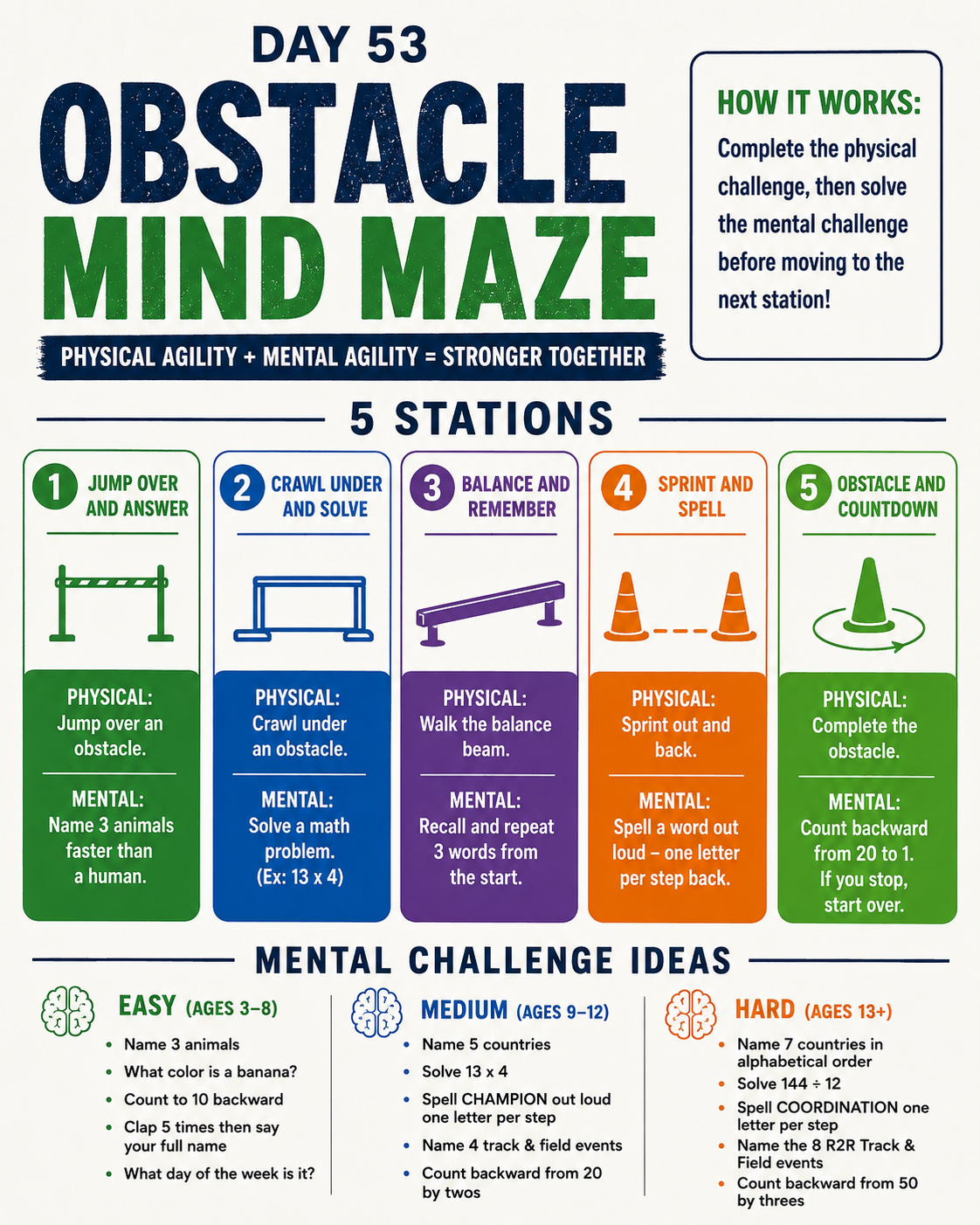
The Five Stations
Station 1: Jump Over and Answer
Physical: jump over an obstacle (a pool noodle, a rolled towel, a jump rope laid flat).
Mental challenge: name three animals that can run faster than a human before you can move to Station 2.
Station 2: Crawl Under and Solve
Physical: crawl under an obstacle (two chairs with a broomstick across them, a rope strung low between two points).
Mental challenge: solve a simple math problem appropriate to age before moving on. For younger ages: 5 + 7. For older ages: 13 x 4, or 144 divided by 12.
Station 3: Balance and Remember
Physical: walk a chalk line or balance beam for its full length.
Mental challenge: at the end of the balance line, recall and repeat back three words that were read to them at the start of the course (word 1, word 2, word 3). The three words are announced before the course starts and must be remembered across the previous two stations.
Station 4: Sprint and Spell
Physical: sprint 20 to 30 feet to a marked point and back.
Mental challenge: spell a word out loud. One letter per step on the way back. If the spelling or the rhythm breaks they must sprint the return leg again. Younger ages use simple words. Older ages use longer words.
Station 5: Obstacle and Countdown
Physical: any obstacle of choice (frog hops, crab walk, bear crawl, or a combination).
Mental challenge: count backward from 20 to 1 continuously while completing the physical obstacle. If the count stops the obstacle starts over.
Today’s Workout: Obstacle Mind Maze
What you need: Household items for obstacles. Paper or chalk for mental challenge prompts. A list of three words to memorize for Station 3.
Warm-Up: Jog easy around the course twice without obstacles. 10 jumping jacks. 5 high knees each leg.
Round 1: Learn the Maze: Move through all five stations at 70% physical effort. This round focuses on understanding the mental challenges and figuring out how to manage both simultaneously.
Round 2: Race the Maze: Full physical effort. Complete every mental challenge correctly before moving on. Time the full round. That is the baseline time.
Round 3: Beat the Time: Rest 60 seconds. Run it again. The mental challenges are now familiar, the brain can process them faster. The physical challenges are warmed up, the body can move faster. The combination should produce a faster time. If it doesn’t, identify which station cost the most time and practice that transition specifically.
Cool-Down: Walk 2 minutes. Forward fold 20 seconds. Hip flexor lunge 30 seconds each side. Three slow deep breaths.
The Mental Challenge Cards
Here is a complete set of mental challenges at three difficulty levels for every station. Choose appropriate difficulty for each age group.
Easy (Ages 3–8):
Name 3 animals
What color is a banana
Count to 10 backward
Clap 5 times then say your full name
What day of the week is it
Medium (Ages 9–12):
Name 5 countries
Solve 13 x 4
Spell CHAMPION out loud one letter per step
Name 4 track and field events
Count backward from 20 by twos
Hard (Ages 13+):
Name 7 countries in alphabetical order
Solve 144 divided by 12
Spell COORDINATION one letter per step while walking back
Name the 8 events in the R2R Track and Field program
Count backward from 50 by threes
Age Modifications:
🟢 Little Movers: Ages 3–5 | 10–12 Minutes. Three stations only. Jump over, crawl under, and sprint and spell with a 3-letter word. Mental challenges are all verbal and parent-prompted: parent asks the question and accepts any reasonable attempt as correct. The balance and remember station is replaced with a simpler version: parent shows a picture or object and child names it correctly before moving on. One full round only two if they want more.
🟡 Kid Movers: Ages 6–8 | 15–18 Minutes. All five stations with easy mental challenges. Round 1 to learn, Round 2 to race. Skip Round 3 if interest is waning, two full rounds is a complete workout. The spelling station is the highlight for this age, spelling while stepping produces a combination of concentration and physical coordination that is genuinely impressive to watch.
🟠 Preteen Movers: Ages 9–12 | 20–22 Minutes. All five stations with medium mental challenges. All three rounds as written. Time Rounds 2 and 3 and compare. After the maze ask them which station was hardest, the physical challenge, the mental challenge, or the coordination of both simultaneously. That reflection is the coaching moment.
🟣 Teen Movers: Ages 13+ | 22–25 Minutes. All five stations with hard mental challenges. All three rounds. Add a fourth round where the mental challenges are changed (new math problems, new words to spell, new categories to name) so the brain cannot rely on memory of the answers from previous rounds. The cognitive freshness of the fourth round reproduces the conditions of actual competition where the athlete cannot know in advance exactly what they will encounter.
👨👩👧 Parent Bonus: Design the course and the mental challenge cards. Compete in every round using the hard challenge set. Your specific challenge: for Round 3 attempt the course while simultaneously keeping a running count of how many total mental challenges the whole family has completed across all rounds. The meta-cognitive load of tracking the family’s performance while also performing is a genuine dual-task challenge at a level beyond the standard course.
Did You Know?
Cognitive challenges during physical training improve sport-specific decision-making.
Research from the University of Birmingham found that athletes who regularly trained with combined physical and cognitive challenges (dual-task training in a sport-specific context ) showed significantly better decision-making speed and accuracy during actual competition than athletes who trained physical skills in isolation. The brain adapts to the demand of thinking while moving and becomes faster and more efficient at exactly the combination that sport requires.
Mild time pressure during mental challenges improves cognitive performance.
Tomorrow is Day 54: Mindful Stretch Party. See you at 6am.