Day 57: Family vs. Family Relay
Welcome to Week 9 of the R2R Summer Movement Challenge.
Eight weeks of movement are behind you. You built aerobic fitness, strength, speed, reaction, flexibility, balance, and a genuine mind-body connection. That is a complete athletic foundation built in eight weeks of summer movement. This week we do something different with all of it.
Week 9 is Team Challenges and the shift is deliberate and significant. Every week until now has been fundamentally individual in its design. Even the family challenges have been each person doing their own level alongside each other. This week the challenges require genuine collaboration, the outcome depends not just on what each individual brings but on how the team works together. Today’s challenge is the most competitive team challenge of the entire summer. Today your family races each other.
Before today’s workout a word about what this week is actually training. Team athletic challenges develop qualities that individual training cannot. The ability to calibrate effort to a teammate’s needs. The awareness of how individual performance affects collective outcome. The experience of shared victory and shared disappointment and the navigation of both. The specific motivation that comes from not wanting to let someone else down. These are athletic qualities as real and as important as sprint speed or core strength. They are also life skills that go far beyond sport. Week 9 builds both simultaneously.
The Format: Family vs. Family Relay
For today’s relay your family needs at least three people and ideally more. If you have extended family nearby, neighbors with children, or friends who have been following the challenge. Today is the perfect day to invite them. The more teams, the better the relay. If your family is only two or three people, run the relay as a time trial, each configuration of runners racing the clock rather than each other, and try to beat your own time across multiple attempts.
Set Up Your Course
Mark a relay course of 30 to 40 feet with a clear start line, finish line, and exchange zone (a 10-foot section near the finish where the baton must be passed). The baton is whatever you have, a sock, a flag, a folded paper. Each runner completes their leg, passes the baton in the exchange zone, and the next runner goes.
Teams should be as evenly matched as possible, mix ages, mix speeds, mix levels. A team of one fast teen and one slow toddler will always lose to a team of two mid-pace kids, and the competition is more interesting when the outcome is genuinely uncertain.
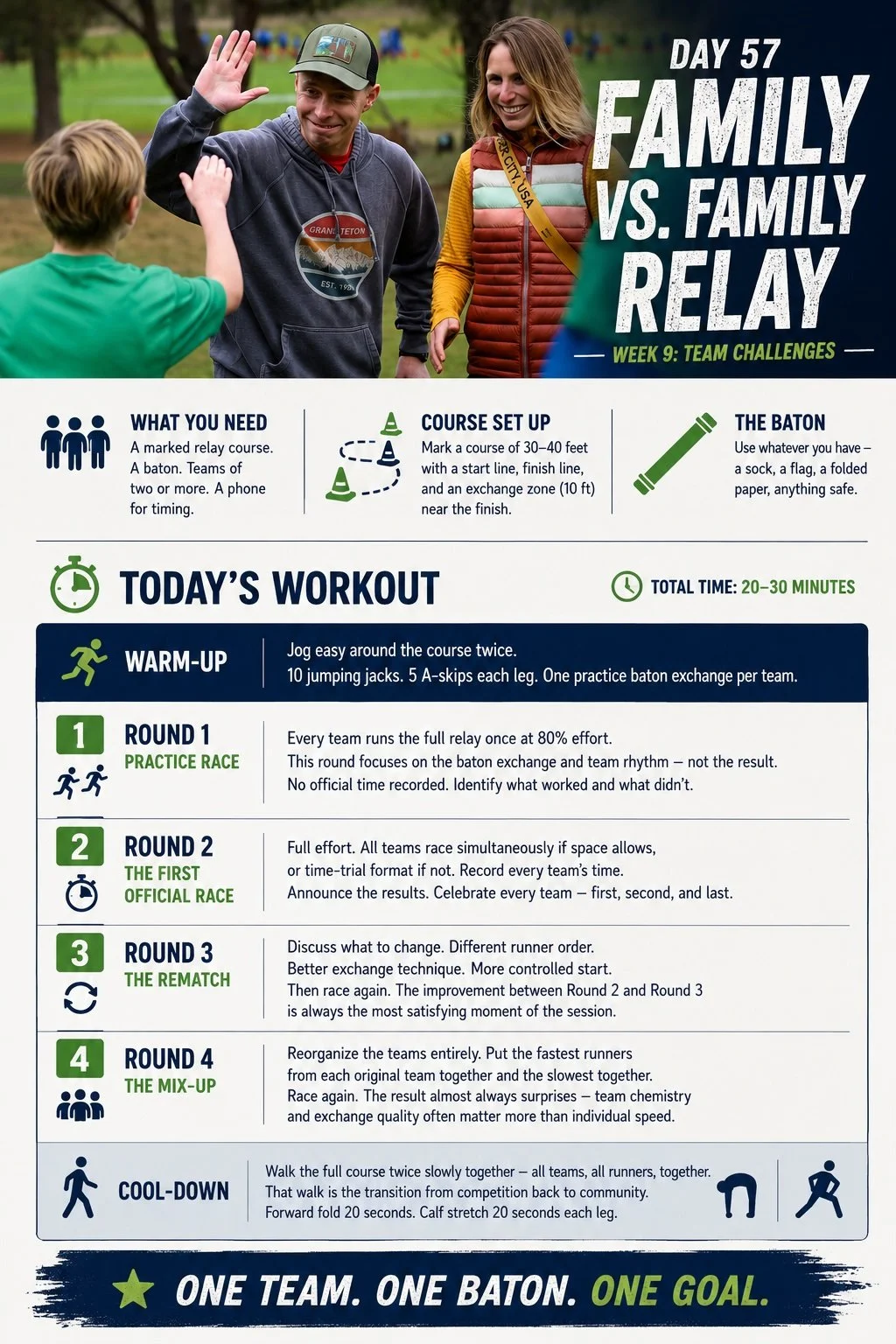
Today’s Workout: Family vs. Family Relay
What you need: A marked relay course. A baton. Teams of two or more. A phone for timing.
Warm-Up: Jog easy around the course twice. 10 jumping jacks. 5 A-skips each leg. One practice baton exchange per team.
Round 1: Practice Race. Every team runs the full relay once at 80% effort. This round focuses on the baton exchange and the team rhythm, not the result. No official time recorded. Identify what worked and what didn’t.
Round 2: The First Official Race. Full effort. All teams race simultaneously if space allows, or time-trial format if not. Record every team’s time. Announce the results. Celebrate every team, first, second, and last.
Round 3: The Rematch. Discuss what to change. Different runner order. Better exchange technique. More controlled start. Then race again. The improvement between Round 2 and Round 3 is always the most satisfying moment of the session, when teams discover that a strategy adjustment matters as much as raw speed.
Round 4: The Mix-Up. Reorganize the teams entirely. Put the fastest runners from each original team together and the slowest together. Race again. The result almost always surprises, the fastest-on-paper team doesn’t always win because team chemistry and exchange quality often matter more than individual speed.
Cool-Down: Walk the full course twice slowly together, all teams, all runners, together. That walk is the transition from competition back to community. Forward fold 20 seconds. Calf stretch 20 seconds each leg.
Age Modifications
🟢 Little Movers: Ages 3–5 | 10–12 Minutes. A simplified relay, parent runs one leg, child runs the other. The course is 15 to 20 feet. The baton exchange is a direct hand-to-hand pass with parent crouching to the child’s level. Run it three or four times. The number doesn’t matter. The experience of being a relay team with a parent matters enormously. Cheer every single finish by name.
🟡 Kid Movers: Ages 6–8 | 18–22 Minutes. Full relay format. Practice the blind exchange, reaching back for the baton without looking, twice before the competitive rounds. Kid Movers are often the most enthusiastic relay racers in the family because the team element adds a social motivation that individual running doesn’t provide. Use that energy. Let them lead the team strategy discussion between rounds.
🟠 Preteen Movers: Ages 9–12 | 22–25 Minutes. Full relay format with all four rounds. Introduce the concept of the anchor runner, the fastest or most composed runner on the team runs the final leg. Discuss as a team who that should be and why. The conversation is as valuable as the racing.
🟣 Teen Movers: Ages 13+ | 25–30 Minutes. Full relay format with full sprint effort and formal exchange technique, running start for all exchange runners, baton passed at full speed in the zone. After Round 4 add one bonus round: a mixed-format relay where each leg uses a different movement, sprint, backward run, frog hops, and bear crawl in sequence. The variety makes the exchange more challenging and the outcome genuinely unpredictable.
👨👩👧 Parent Bonus. Run a full relay leg on every round at genuine effort. In Round 3 strategy discussion be a genuine participant not a facilitator, contribute an idea, defend it, and accept when the team overrules it. The experience of collaborative decision-making within a competitive context is the specific athletic quality being developed in Week 9. Model it authentically.
Did You Know?
Team-based athletic challenges produce different motivational outcomes than individual challenges. Research in sport psychology has consistently found that athletes competing as part of a team show higher pain tolerance, greater willingness to push through discomfort, and longer sustained effort than the same athletes competing individually. The social bond of team competition activates motivational mechanisms that individual competition cannot access.
Unlike a team sport where the connection between individual effort and team outcome is complex and indirect, the relay race makes the link between individual performance and team result immediate and transparent. Every fraction of a second gained or lost on an individual leg shows up directly in the final time. This directness produces a specific kind of accountability, positive accountability, the desire not to let down the people you are running with, that is one of the most powerful motivators in athletic competition.
Here’s what’s coming the rest of Week 9:
Tuesday: Day 58: Cooperative Challenges
Wednesday: Day 59: Timed Team Circuit
Thursday: Day 60: Neighborhood Challenge
Friday: Day 61: Ultimate Backyard Tag Tournament
Saturday + Sunday: Days 62 & 63 Weekend Edition: Team Long Run + Active Recovery
See you tomorrow at 6am.