Day 58: Cooperative Challenges
Yesterday your family competed against each other. Today you compete with each other!
The distinction matters. Cooperative Challenges are athletic tasks that cannot be completed by one person acting alone, they require genuine coordination, communication, and mutual support to succeed. There is no individual winner. There is only the team succeeding together or the team figuring out why they didn’t and trying again.
This is a fundamentally different athletic experience from everything else in the challenge. The individual performance metrics that have driven the summer (faster times, more reps, longer holds, further distances) are completely irrelevant today. The only metric is whether the team completes the challenge. And the only path to completing it is working together.
Why Cooperative Athletic Challenges Matter
Research in team dynamics consistently shows that cooperative challenges particularly physical ones that require genuine interdependence build trust, communication, and collective efficacy faster and more durably than almost any other team-building activity. This is why military units use physical cooperative challenges. It is why sports teams build chemistry through shared training rather than just shared competition. It is why corporate team-building programs have incorporated physical challenges for decades. The underlying mechanism is straightforward: when people face a physical challenge that genuinely requires everyone’s contribution and they succeed together, they develop a specific belief in the team’s collective capability that individual success cannot produce. And when they fail together and figure out why and succeed on the second attempt, the bond produced is even stronger. Today your family will experience both sides of that dynamic.
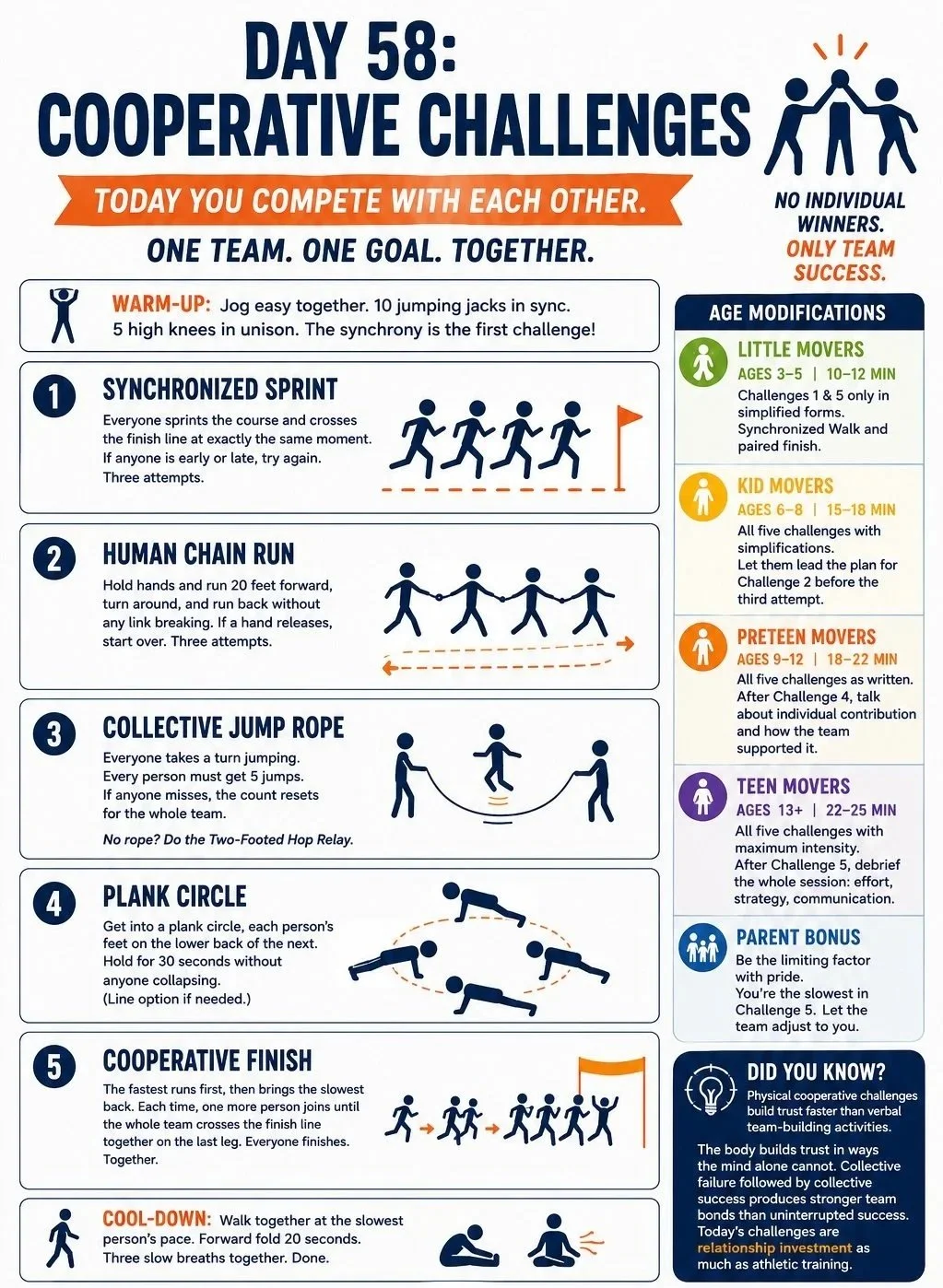
Today’s Workout: Cooperative Challenges
What you need: Any open space. A ball, a hula hoop, or a jump rope if available. No equipment required for most challenges.
Warm-Up: Jog easy around the space together (everyone at the same pace, side by side). 10 jumping jacks together in sync. 5 high knees in unison. The synchrony in the warm-up is the first cooperative challenge of the session.
Challenge 1: The Synchronized Sprint. Everyone lines up at the start line shoulder to shoulder. The goal is to sprint the full course and cross the finish line at exactly the same moment, not first, not last, exactly together. No individual winner. If anyone crosses before or after the rest the sprint doesn’t count and the team runs it again. This requires genuine communication before the start, agreeing on a pace, deciding how to account for speed differences. And it requires genuine attention during the run, watching the people next to you, adjusting your pace to match. Three attempts. The first is almost always unsuccessful. By the third the team has usually found the communication pattern that makes it work.
Challenge 2: The Human Chain Run. Everyone lines up in a chain, each person’s right hand holds the left hand of the person in front, forming a connected line. The chain must run 20 feet forward, turn around, and run back without any link breaking. If a hand releases the chain starts over from the beginning. The challenge is not the running. The challenge is adjusting stride length, pace, and direction change simultaneously with everyone connected. It requires constant communication and constant awareness of the people you are connected to. Three attempts. The turn is always the hardest moment.
Challenge 3: The Collective Jump Rope. If a jump rope is available: two people turn the rope, everyone else takes a turn jumping. The team goal is for every person to successfully complete 5 consecutive jumps. If anyone misses, the count resets to zero for the whole team, not just the person who missed. If no jump rope is available: replace with the Two-Footed Hop Relay. The whole team hops together on two feet from the start to the finish, maintaining a collective rhythm. Anyone who breaks the two-footed pattern restarts the whole team from the beginning. The collective consequence. Everyone restarting when one person misses is the most important design element of this challenge. It produces the specific experience of individual effort mattering to collective outcome that is the core of team athletic development.
Challenge 4: The Plank Circle. Everyone gets into a plank position in a circle, with each person’s feet resting on the lower back of the person next to them, a connected circle of planks. The team goal is to hold the plank circle for 30 seconds without anyone collapsing. If the group is too small for a full circle, run the plank as a line instead, each person’s feet on the ankles of the person behind them. The interdependence is total. If one person’s plank fails it makes every adjacent person’s plank harder. Success requires every person to hold simultaneously.
Challenge 5: The Cooperative Finish. One final challenge that combines movement and interdependence. Every person starts at one end of the course. The fastest runner goes first and must run to the other end and back, and on the return leg must physically bring the slowest runner with them, running side by side at the slowest runner’s pace. Then those two bring the next slowest, and so on, until the whole team crosses the final finish line together on the last leg. The fastest person runs the most. The slowest person still finishes. Everyone crosses together. That is the cooperative finish. That is the last challenge of the day and the most important one.
Cool-Down: Walk together as a group at whatever pace the slowest person sets. Forward fold 20 seconds. Three slow breaths together. Done.
Age Modifications
🟢 Little Movers: Ages 3–5 | 10–12 Minutes. Challenges 1 and 5 only in simplified forms. The Synchronized Sprint becomes a Synchronized Walk, everyone holding hands and walking together to the finish at the same pace, crossing together. The Cooperative Finish becomes a simple paired finish, parent and child run the last leg holding hands and cross the finish line simultaneously. Both experiences deliver the core feeling of cooperative athletic completion that this age group can genuinely access.
🟡 Kid Movers: Ages 6–8 | 15–18 Minutes. All five challenges with simplified versions when needed. The Human Chain Run is the highlight for this age group, the turn is always a spectacular moment of chain failure followed by significant laughter and genuine problem-solving. Let them lead the discussion of how to handle the turn before the third attempt. The solution they come up with is always more creative than the obvious one.
🟠 Preteen Movers: Ages 9–12 | 18–22 Minutes. All five challenges as written. The Plank Circle is the hardest physical challenge for this age group and the one that produces the most honest conversation about individual contribution to collective outcome. After the plank circle ask: was there a weak link? How did you know? What did the team do to support it? Those questions are the coaching moment of the day.
🟣 Teen Movers: Ages 13+ | 22–25 Minutes. All five challenges with maximum intensity. For the Synchronized Sprint the acceptable margin of error narrows to half a stride — the team must finish within half a step of each other. For the Plank Circle extend the target to 45 seconds. After the Cooperative Finish debrief the entire session: which challenge was most dependent on individual effort, which was most dependent on collective strategy, and which was most dependent on communication?
👨👩👧 Parent Bonus: Participate in every challenge at full effort and with genuine willingness to be the limiting factor. In the Cooperative Finish you are the slowest runner, and the team’s collective time depends on your pace on the final leg. Own that role. Do not apologize for it. Do not artificially speed up. Run at your genuine pace and let the team adjust to you for once instead of the other way around. That role reversal is the most valuable thing you will do today.
Did You Know?
Physical cooperative challenges build trust faster than verbal team-building activities. Research from the University of Exeter found that pairs and groups who completed a physical cooperative challenge, one that required genuine physical interdependence, showed significantly higher levels of mutual trust, liking, and coordination in subsequent tasks compared to groups who completed an equivalent verbal cooperative activity. The body builds trust in ways the mind alone cannot. Today’s challenges are relationship investment as much as athletic training. Collective failure followed by collective success produces stronger team bonds than uninterrupted success.
Tomorrow is Day 59: Timed Team Circuit. A strength and cardio circuit! See you at 6am.