Day 59: Timed Team Circuit
Yesterday everyone had to succeed together or not at all. Today everyone's individual effort adds up to a collective result. The Timed Team Circuit is a strength and cardio circuit where every person's reps, every person's holds, and every person's effort contributes to the team's final score. Nobody is doing the same exercise at the same time. Nobody is watching while others work. Everyone is working simultaneously and every rep from every person counts. This is the athletic structure of most team sports, individual contributions aggregated into a collective outcome. A relay team's total time is the sum of individual legs. A team's total score is the accumulation of individual performances. Today's circuit trains exactly that relationship between individual effort and collective result.
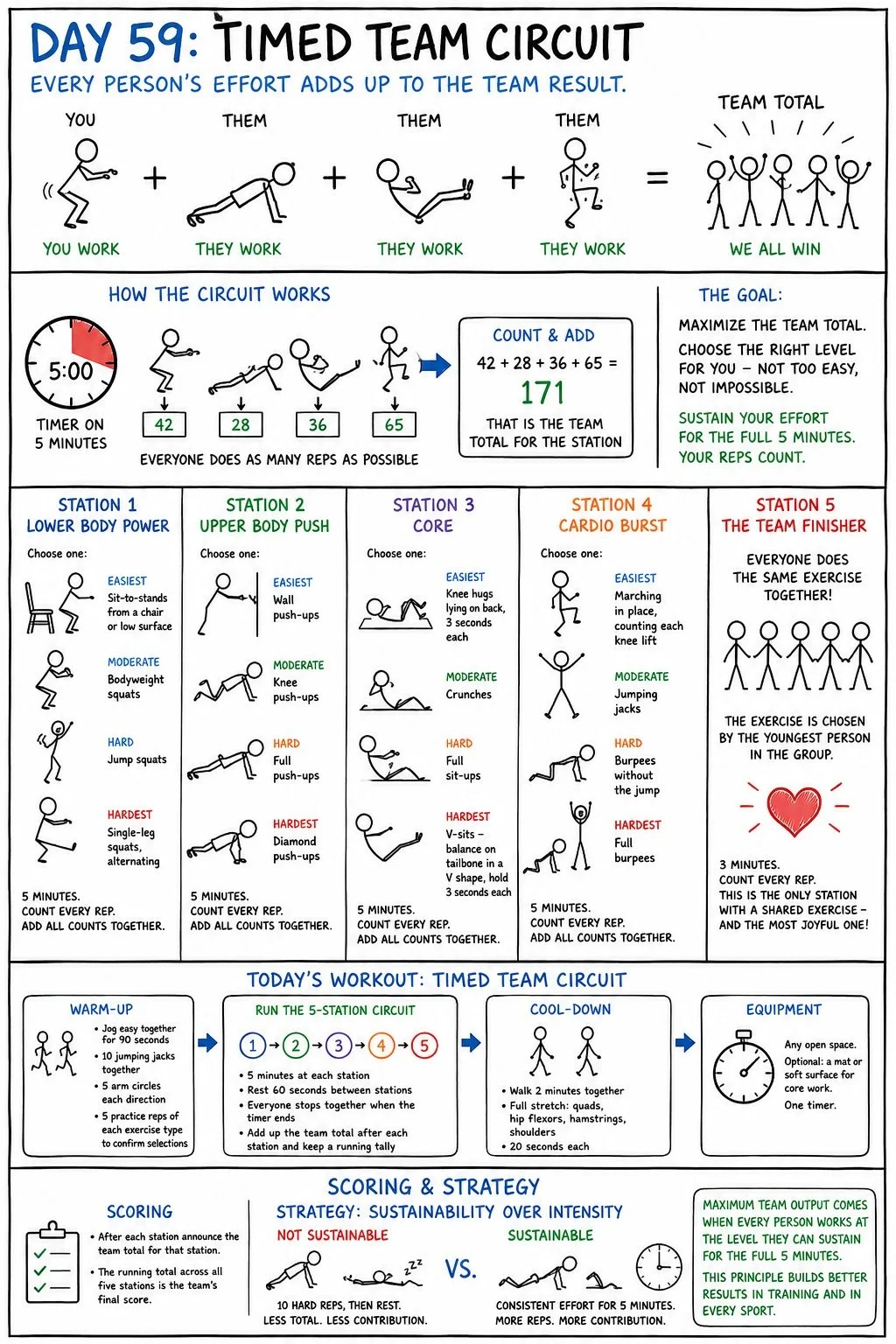
How the Circuit Works
Set a timer for 5 minutes. Every person chooses their exercise from the menu and performs as many reps as possible in the time window. When the timer ends every person counts their total reps. The team adds all individual rep counts together. That is the team's total score for that circuit station.
The goal is to maximize the team total, not any individual's count. This means each person should choose an exercise at the right level for them, not too easy, not impossible, because maximum team output requires every individual to be operating at their personal ceiling, not sandbagging and not overreaching.
The Exercise Menu
Each circuit station has a menu of exercises to choose from. Every person selects the exercise that matches their level for that station. There is no assigned exercise. The autonomy is intentional, choosing the right exercise for your level is itself an athletic skill.
Station 1: Lower Body Power
Choose one:
Sit-to-stands from a chair or low surface (easiest)
Bodyweight squats (moderate)
Jump squats (hard)
Single-leg squats, alternating (hardest)
5 minutes. Count every rep. Add all counts together.
Station 2: Upper Body Push
Choose one:
Wall push-ups (easiest)
Knee push-ups (moderate)
Full push-ups (hard)
Diamond push-ups (hardest)
5 minutes. Count every rep. Add all counts together.
Station 3: Core
Choose one:
Knee hugs lying on back, 3 seconds each (easiest)
Crunches (moderate)
Full sit-ups (hard)
V-sits — balance on the tailbone with legs and torso lifted in a V shape, hold 3 seconds each (hardest)
5 minutes. Count every rep. Add all counts together.
Station 4: Cardio Burst
Choose one:
Marching in place, counting each knee lift (easiest)
Jumping jacks (moderate)
Burpees without the jump (hard)
Full burpees (hardest)
5 minutes. Count every rep. Add all counts together.
Station 5: The Team Finisher
Everyone does the same exercise together for the final station, the exercise is chosen by the youngest person in the group. Whatever they pick, everyone does it. 3 minutes. Count every rep. This is the only station with a shared exercise and it is intentionally the most joyful one.
Today's Workout: Timed Team Circuit
What you need: Any open space. Optional: a mat or soft surface for core work. One timer.
Total time: 30 to 35 minutes including warm-up and cool-down.
Warm-Up: Jog easy together for 90 seconds. 10 jumping jacks together. 5 arm circles each direction. 5 practice reps of each exercise type to confirm selections.
Run the full five-station circuit. Rest 60 seconds between stations, everyone stops together when the timer ends. Add up the team total after each station and keep a running tally.
Cool-Down: Walk 2 minutes together. Full stretch: quads, hip flexors, hamstrings, shoulders. 20 seconds each.
Scoring and Strategy
After each station announce the team total for that station. The running total across all five stations is the team's final score. For maximum team output, a simple strategic principle applies: every person should work at the level where they can sustain effort for the full 5 minutes. A person who does 10 full push-ups and then collapses for 4 minutes contributes less than a person who does knee push-ups consistently for the full 5 minutes. Sustainability over intensity. The team score rewards consistent effort across the full window. This principle is worth discussing before the circuit starts. It is one of the most practically useful athletic concepts in the entire summer challenge, the idea that maximum sustainable output produces better outcomes than maximum momentary output. It applies to pacing in distance running, to strength training programming, and to the management of effort in every sport that involves sustained performance.
Age Modifications
🟢 Little Movers: Ages 3–5 | 10–12 Minutes. Two stations only. Station 1 lower body and Station 5 team finisher. For Station 1 all reps are sit-to-stands from a low surface. Timer is 2 minutes rather than 5. Parent counts every rep out loud with them. Station 5 is the highlight, letting them choose the exercise for everyone is a significant moment of autonomy and the exercise they choose is always delightfully unexpected.
🟡 Kid Movers: Ages 6–8 | 18–22 Minutes. All five stations with 3-minute windows rather than 5. Exercise selections from the easy to moderate options. Before each station ask them to predict how many reps they will get, the prediction builds the pacing self-awareness that this age group is beginning to develop. Compare the prediction to the actual count after each station.
🟠 Preteen Movers: Ages 9–12 | 25–28 Minutes: Full circuit as written with full 5-minute windows. Exercise selections from moderate to hard options. Introduce the sustainability principle explicitly before the circuit, explain that the goal is maximum sustainable output not maximum single-minute output and let them apply it. The difference between their first and last minute of each station is the measure of how well they applied it.
🟣 Teen Movers: Ages 13+ | 28–32 Minutes. Full circuit with hard to hardest exercise selections. Add a personal challenge element, for each station set a personal rep target before starting and try to hit it. At the end compare actual reps to target reps across all stations. The gap between intention and execution is training information. A consistently higher actual than target means the targets were too conservative. A consistently lower actual means pacing needs work.
👨👩👧 Parent Bonus: Full circuit with honest exercise selection — not the hardest option to impress, not the easiest to conserve. The right option for your current fitness level done consistently for the full 5 minutes. After the circuit reflect on which station produced your highest contribution to the team total and which produced your lowest. Those two data points tell you something useful about where your fitness is strongest and where it has the most room to grow.
Did You Know?
The Köhler effect (working harder in a group than alone) is well documented in physical performance research. Research on the Köhler motivational gain effect consistently shows that individuals performing a physical task as part of a group where their contribution is visible and meaningful work harder than when performing the same task alone. The effect is strongest when the individual perceives themselves as the weakest link on the team, the desire not to let the team down produces effort above the individual's typical solo ceiling. Every person in today's circuit will likely outperform their solo rep count because their effort is visibly contributing to a collective score. Individual effort aggregated toward a collective goal produces different motivational states than individual competition.
Tomorrow is Day 60: Neighborhood Challenge. Take the team spirit outside the yard and into the community. See you at 6am.