Day 68: Precision Relay Race
We've spent all week doing one thing at a time. Day 64 was about hitting a target. Day 65 was about landing every jump at the right point in the rope's rotation. Day 66 put your feet in specific squares at speed, and yesterday your athlete learned that a long jump lives or dies on where the takeoff foot lands. Today all four of those skills go into one course, a clock gets started, and someone is watching. That last part is the actual test. Precision that only shows up when nobody's in a hurry isn't precision yet, it's just careful. Today we find out what survives pressure.
Why We Score Accuracy, Not Just Time
Here's the rule that makes this workout work: misses cost seconds. Not do-overs, not disqualifications, time penalties, added at the end.
That single design choice changes everything about how kids run the course. If a miss just meant "try again," the fastest strategy would be to rush every station and hope. If a miss means five seconds, suddenly the fastest strategy is to slow down for the half-second it takes to aim. Kids figure this out on their own somewhere in the second heat, and watching that realization happen is the whole point of the day. Nobody has to be told to be careful. The scoring tells them. This is also how the sport actually works. A relay team doesn't lose because one runner was slow. It loses because a handoff missed the zone.
Set Up Your Course
Four stations in a loop, roughly 15–20 feet apart, on a driveway or flat yard. Chalk a start/exchange zone about 10 feet long, every handoff has to happen inside it.
Station 1: Target Toss: a bucket or laundry basket with a chalk throwing line 10 feet away (5 feet for little ones). Three beanbags or rolled socks.
Station 2: Rope Rhythm: open space, one jump rope.
Station 3: Hopscotch Lane: yesterday's or Tuesday's chalk course, or draw a fresh 10-square one.
Station 4: Takeoff Line: a short runway ending in a chalk line, with grass to land on. Use the step count your athlete found yesterday.
Your baton: a paper towel tube, a rolled sock, or a water bottle. Something that can be dropped, because it will be.
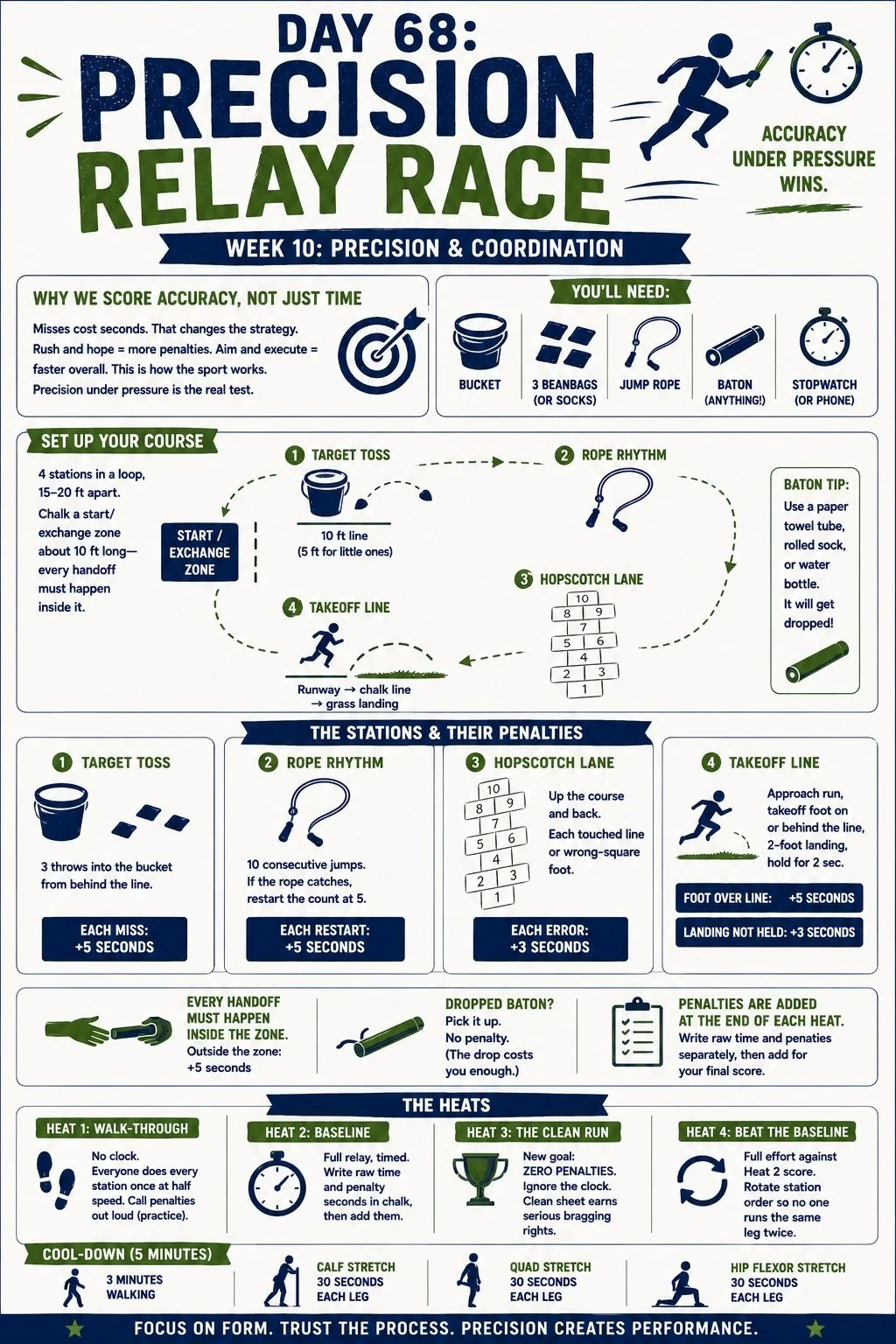
Today's Workout: The Precision Relay Race
You'll need: chalk, a bucket, 3 beanbags or rolled socks, a jump rope, a baton substitute, a stopwatch or phone timer, and a soft landing area.
Warm-up (6 minutes): 2 minutes easy jog. 10 ankle hops. 10 walking lunges. 6 single-leg landings per leg. 20 seconds of quick feet. Then one slow lap of the course touching each station without doing it (just so everyone knows where they're going).
The Stations and Their Penalties
Station 1: Target Toss. Three throws into the bucket from behind the chalk line.
Each miss: +5 seconds.
Station 2: Rope Rhythm. Ten consecutive jumps. If the rope catches, restart the count at five rather than zero, this keeps one bad rep from ending the heat.
Each restart: +5 seconds.
Station 3: Hopscotch Lane. Up the course and back.
Each touched line or wrong-square foot: +3 seconds.
Station 4: Takeoff Line. Approach run, takeoff foot on or behind the line, two-foot landing on grass, hold for two seconds before running back.
Foot over the line: +5 seconds. Landing not held: +3 seconds.
Every handoff must happen inside the chalk exchange zone. Outside the zone: +5 seconds. Dropped baton: pick it up, no penalty (the drop costs you enough already).
The Heats
Heat 1: Walk-Through. No clock. Everyone does every station once at half speed and learns what the penalties feel like. Call the penalties out loud even though nothing's being scored.
Heat 2: Baseline. Full relay, timed. Write the raw time and the penalty seconds in chalk separately, then add them for the final score. Seeing those two numbers side by side is more instructive than the total.
Heat 3: The Clean Run. New goal: zero penalties. Ignore the clock entirely. If a team gets through with a clean sheet, they've earned the right to be smug about it. Most won't on the first try.
Heat 4: Beat the Baseline. Full effort against the Heat 2 score. Rotate the station order so nobody runs the same leg twice all day.
Cool-down: 3 minutes walking, then calf, quad, and hip flexor stretches. Look at the chalk and ask which station collected the most penalties across all four heats. That's the skill to bring into next week — and it's usually not the one anyone predicted.
If You Don't Have a Full Team
Run it as a solo time trial: one athlete, all four stations, same penalties, chasing their own Heat 2 score. It works just as well and the pressure is arguably worse. With two people, alternate stations and share one score. With a parent and one child, give the parent a handicap, extra distance on the throw, a longer approach run, or +10 seconds to start.
Age Modifications
🟢 Little Movers (Ages 3–5): Two stations only: toss from 5 feet, and hop the chalk lane. Skip the clock and skip the penalties. Count made baskets out loud instead. The handoff is a high-five, and it can happen anywhere.
🟡 Kid Movers (Ages 6–8): All four stations, halved: two throws, five rope jumps, one direction on the hopscotch lane, standing long jump instead of an approach run. Keep the penalties, this age group loves a rule they can enforce on a grown-up, but drop them to 3 seconds each.
🟠 Preteen Movers (Ages 9–12): Full workout as written. Put them in charge of timing and calling penalties on one heat; officiating makes the standard concrete in a way that doing it doesn't.
🟣 Teen Movers (Ages 13+): Full workout, plus tighten the exchange zone to 5 feet and require a moving handoff, the outgoing runner has to already be running when the baton arrives. That's the real skill in a 4x100, and it's much harder than it sounds. Add a fifth heat if they're still chasing a clean sheet.
👨👩👧 Parent Bonus: Run one full heat at genuine effort before you decide the penalties are generous. Aiming while out of breath is a completely different task than aiming, and Station 1 is where you'll find that out.
Did You Know?
The men's 4x100 relay world record is 36.84 seconds. Four separate 100-meter runs by those same athletes would add up to noticeably more than that, the relay is faster than the sum of its parts, because each runner after the first is already at speed when they take the baton. All of that advantage lives inside the 30-meter changeover zone, and it vanishes completely if the handoff misses. Which is why the 4x100 is famous for being lost by the fastest team in the field. The legs are rarely the problem. The exchange is.
This weekend is Days 69 & 70: Coordination Long Run + Active Recovery. See you tomorrow at 6am.