Day 67: Long Jump Introduction
Here's the thing most people get wrong about the long jump: the hard part isn't the jump. The hard part is the eleven steps before it. An athlete can be the most explosive kid on the field and still lose every attempt by putting a toe two inches past the takeoff line. Week 10 has been about doing the right thing at exactly the right moment. Today all of it comes together in one movement. Your athlete has to run fast, arrive at a specific spot on the ground with a specific foot, and then leave the ground. That's precision under speed, and it's the whole event.
Why We Start With the Approach
New jumpers almost always want to sprint at the line and see how far they can fly. Resist that today. A long jump is only as good as the approach that sets it up, and an approach is a memorized pattern, the same number of steps, in the same rhythm, hitting the same mark every time. Once that pattern is reliable, distance takes care of itself. When it isn't, your athlete spends the whole competition guessing, stutter-stepping, and slowing down right where they need to be fastest.
There's a second reason to start slow. Landing is a skill, and today is the first time many kids will land from any real horizontal distance. We want two feet down, knees bending, weight forward, not a heels-first crash. Controlled distances teach that. Max-effort distances don't.
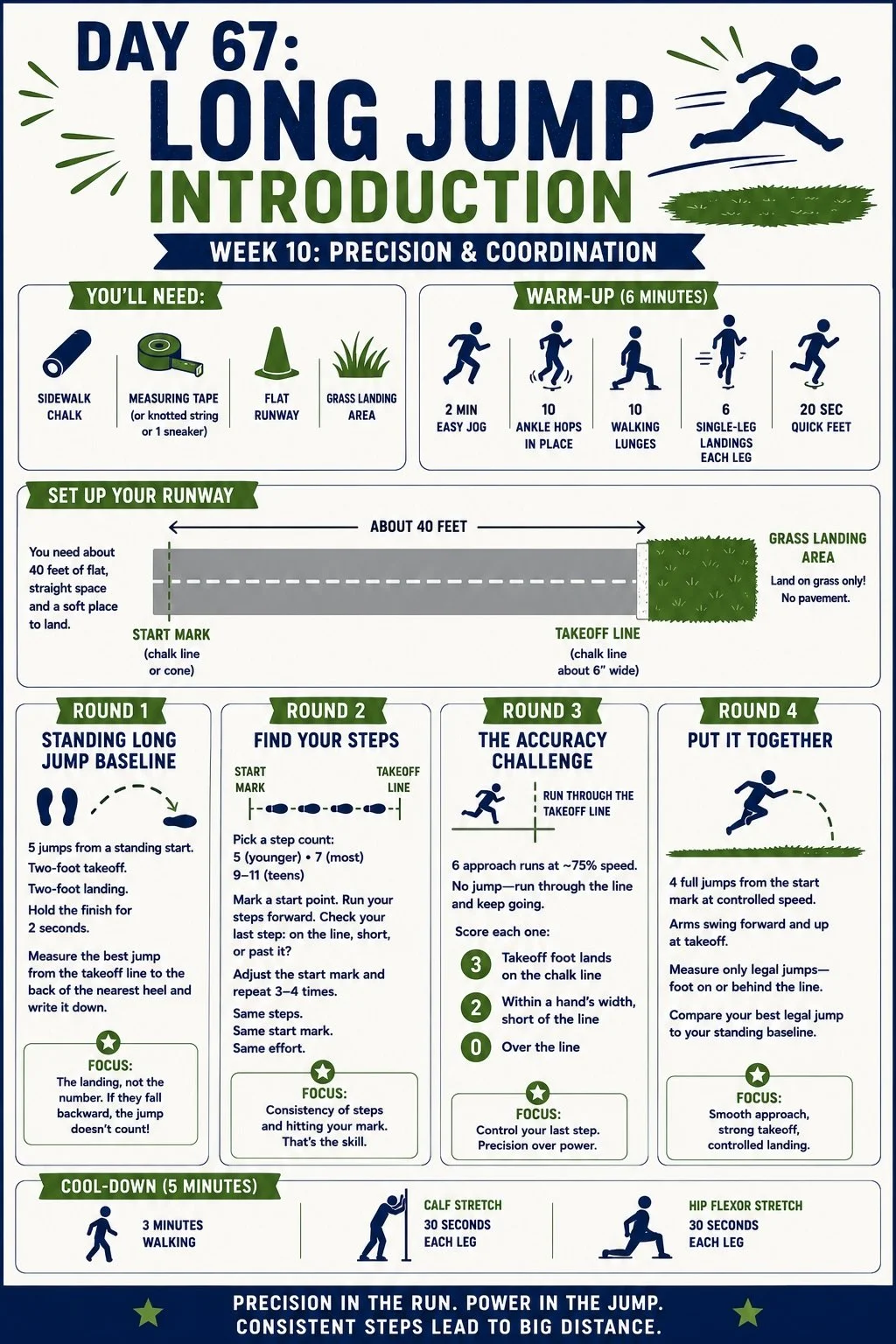
Set Up Your Runway
You don't need a pit. You need about 40 feet of flat, straight space and a soft place to land.
The runway: a driveway, sidewalk, or flat stretch of pavement. Draw a chalk takeoff line about 6 inches thick at the end of it.
The landing area: grass, immediately past the takeoff line. This is not optional — no one lands on pavement today, at any age.
The start mark: a second chalk line or a cone somewhere back up the runway. Where exactly is what Round 2 figures out.
If your grass and driveway don't meet, run the whole thing on grass and mark your takeoff line with a piece of rope or a flattened chalk stripe on a paver.
Today's Workout: Long Jump Introduction
You'll need: sidewalk chalk, a measuring tape (or a knotted string, or one sneaker used as a unit), a flat runway, and a grass landing area.
Warm-up (6 minutes): 2 minutes of easy jogging. 10 ankle hops in place. 10 walking lunges. 6 single-leg landings per leg, hop forward, land on one foot, freeze for two seconds. 20 seconds of quick feet. Ankles and hips both need to be awake before anyone leaves the ground.
Round 1: Standing Long Jump Baseline. Five jumps from a standing start, toes behind the takeoff line. Two-foot takeoff, two-foot landing, knees bending to absorb, hold the finish for two seconds before standing up. No run-up at all. Measure the best one from the takeoff line to the back of the nearest heel and write it in chalk on the driveway. The focus in Round 1 is the landing, not the number. If they fall backward, the jump doesn't count!
Round 2: Find Your Steps. This is the heart of the day. Pick a step count: 5 for younger kids, 7 for most, 9 to 11 for teens. Stand on the takeoff line facing back up the runway, then run the chosen number of steps away from it at an easy jog and mark where you finish. That's your first guess at a start mark. Now turn around and run it forward. Where does the last step land, on the line, short of it, or past it? Slide the start mark back or forward a few inches and go again. Three or four repetitions is usually enough to get close. Same start mark, same number of steps, same effort every time. That consistency is the skill.
Round 3: The Accuracy Challenge. Six approach runs at about 75% speed, no jump at the end — just run through the takeoff line and keep going onto the grass. Score each one: Eighteen points is perfect. Twelve or better is a good first day.
Takeoff foot lands on the chalk line: 3 points
Within a hand's width, short of the line: 2 points
Over the line: 0 points
Round 4: Put It Together. Four full jumps from the start mark, still at controlled speed, arms swinging forward and up at takeoff. Measure only the legal ones — foot on or behind the line. Compare the best legal jump to the standing baseline from Round 1. The run-up is usually worth a surprising amount, and seeing that gap is the payoff for all the boring accuracy work.
Cool-down: 3 minutes of walking, then calf and hip flexor stretches. Before you erase the chalk, have your athlete tell you their step count and how far back their start mark was. Write it somewhere. They'll want it later in the week.
Age Modifications
🟢 Little Movers (Ages 3–5): No approach run at all. Chalk a narrow "puddle" on the grass and practice two-foot takeoffs and two-foot landings over it, widening it a few inches each round. Frogs, bunnies, and kangaroos are all legitimate coaching cues at this age.
🟡 Kid Movers (Ages 6–8): Three-step approach. Chalk footprint targets on the runway for each step so the pattern is something they can see, not just count. Measure jumps in sneaker lengths — it's more fun and easier to picture than inches.
🟠 Preteen Movers (Ages 9–12): Full workout as written with a 7-step approach. Add the arm swing in Round 4 and see what it's worth. This is a good age to start keeping a written record of the start mark and step count.
🟣 Teen Movers (Ages 13+): Use a 9- to 11-step approach and cap speed at 80% today; full-speed approaches come later in the week once the pattern holds. Instead of chasing distance, track how many of six approaches land within a hand's width of the line. Consistency is the metric that actually transfers to a meet.
👨👩👧 Parent Bonus: Do the Round 1 standing long jump and compare it to your own height. Then try the accuracy challenge. Hitting a 6-inch line at three-quarter speed is much harder than it looks from the sidelines, and your kids will enjoy watching you find that out.
Did You Know?
The long jump is one of the oldest competitive events on record, it was part of the ancient Greek pentathlon, but the Greeks did it differently. Athletes carried stone or lead weights called halteres, one in each hand, swinging them forward at takeoff and releasing them mid-flight to add distance. The event also came with music: a flute player set the rhythm of the approach. Which, twenty-five centuries later, is more or less what Round 2 is doing for you. Rhythm first, distance second.
See you tomorrow at 6am.