Day 66: Hopscotch Sprint Series
Today’s challenge comes from somewhere unexpected. Hopscotch. The game chalked on sidewalks and driveways by children for generations, single foot, both feet, single foot, both feet, turn around, come back. It looks like a children’s game because it is a children’s game. It is also, when examined through the lens of athletic training, one of the most precisely designed footwork coordination drills in existence.
The single-leg landing demands that balance from Week 6. The transition from single to double foot requires the timing trained in yesterday’s jump rope session. The turn at the end requires deceleration, weight transfer, and reacceleration, the same mechanics trained in Day 31’s chalk ladder drills. The repeated hopping develops the ankle stiffness and calf power that sprint mechanics depend on.
Today we play it, with intent, with progressive difficulty, and with sprint intervals woven in between each pass to make the session one of the most complete athletic training days of Week 10.
Draw Your Course
Before the workout draw the hopscotch course on the driveway or sidewalk. A standard course has 10 squares (single, single-double, single, single-double, single, single-double, single, single-double, single, single-double). Number them 1 through 10. Make the squares large enough for comfortable landings, about 18 inches wide and 18 inches deep for standard play.
For the advanced version used in later levels today, draw a second course alongside the first with narrower squares, 12 inches wide for more precise foot placement.
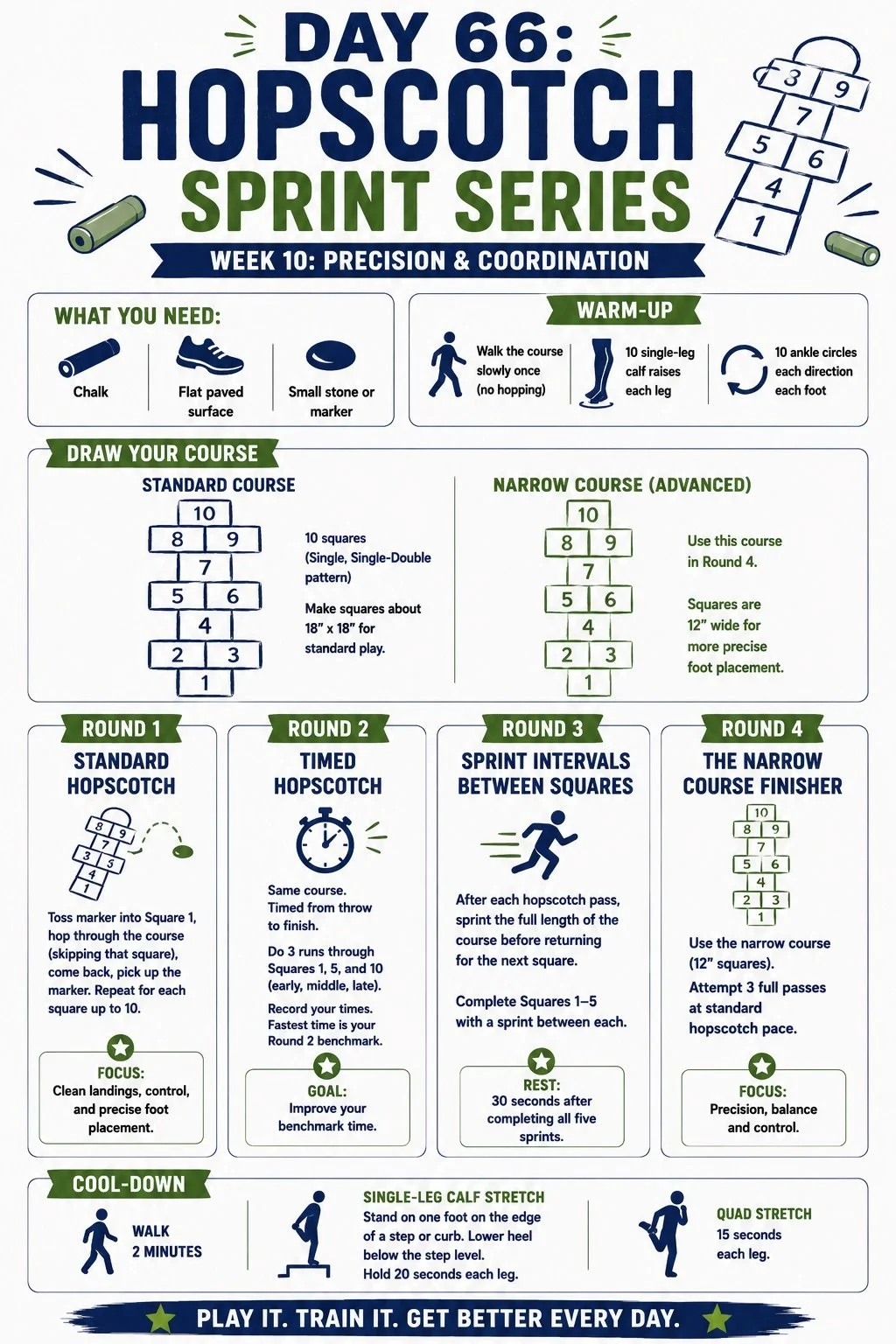
Today’s Workout: Hopscotch Sprint Series
What you need: Chalk. A flat paved surface. A small stone or marker for each player.
Warm-Up: Walk the hopscotch course slowly once, placing both feet in every square, no hopping, just walking through to learn the layout. 10 single-leg calf raises each leg. 10 ankle circles each direction each foot.
Round 1: Standard Hopscotch. Play standard hopscotch, toss the marker into Square 1, hop through the course skipping Square 1 on the way out and on the way back, pick up the marker on the return, finish. Then toss into Square 2 and repeat. Work through all 10 squares. The focus in Round 1 is form, clean single-leg landings, controlled double-foot landings, precise foot placement within each square.
Round 2: Timed Hopscotch. Same course. This time timed from the moment the marker leaves the hand to the moment both feet cross the finish line on the return. Three full runs through Squares 1, 5, and 10 only, one early, one middle, one late in the course. Record the times. The fastest time across the three squares is the Round 2 benchmark.
Round 3: Sprint Intervals Between Squares. Modify the standard play: after completing each square’s hopscotch pass, sprint the full length of the course before returning for the next square. The sprint is the cardiovascular load. The hopscotch is the coordination work. Together they mirror the demands of field sport, precise footwork alternating with explosive running, in a continuous circuit. Work through Squares 1 through 5 only with sprint intervals between each. Rest 30 seconds after all five.
Round 4: The Narrow Course Finisher. Move to the narrow course drawn alongside the standard one, 12-inch squares. Attempt three full passes of the narrow course at standard hopscotch pace. The reduced landing area requires significantly more precise foot placement and meaningfully harder balance on single-leg landings. This is the precision challenge that closes today’s session.
Cool-Down: Walk 2 minutes. Single-leg calf stretch, stand on one foot on the edge of a step or curb, lower the heel below the step level, hold 20 seconds each leg. Quad stretch 15 seconds each leg.
Age Modifications
🟢 Little Movers: Ages 3–5. Draw 5 squares only, a shorter course with larger squares, 24 inches wide. Walk through the course rather than hop, one foot in each square, both feet in the double squares, careful and deliberate. No tossing the marker, parent places it in each square. Two full passes through the course walking. If they want to try hopping, support with a hand and celebrate every successful hop.
🟡 Kid Movers: Ages 6–8. Rounds 1 and 2 as written. Round 3 replace the full-length sprint with a jog, 10 jogging steps between squares rather than a full sprint. Three full passes with the jog intervals. Skip Round 4 narrow course unless they are ready, offer it as a bonus challenge rather than a requirement.
🟠 Preteen Movers: Ages 9–12. All four rounds as written. In Round 3 use the full sprint interval as written. Time the full Round 3 circuit from first hop to the last sprint finish and compare to Round 2 times, the added sprints will slow the overall time but note whether the hopscotch precision maintains despite the sprint fatigue. That maintenance is the training goal.
🟣 Teen Movers: Ages 13+. All four rounds with two additions. In Round 2 add a backwards pass, hop the course in reverse order, from Square 10 back to Square 1, which requires recalibrating the footwork pattern in the opposite direction. In Round 4 attempt the narrow course with eyes briefly closed for one square per pass, two seconds of eyes-closed single-leg balance within the flow of the hopscotch pass. The brief visual deprivation significantly increases the proprioceptive demand of an already challenging balance task.
👨👩👧 Parent Bonus: Full workout as written. Your specific challenge: in Round 3 attempt every sprint with maximum effort, not a jog, not a comfortable run, a genuine sprint between hopscotch passes. The combination of hopscotch coordination and maximum-effort sprinting under fatigue is the most demanding version of today’s circuit and the one that produces the most complete athletic training stimulus.
Did You Know?
Hopscotch originated as a military training drill in ancient Rome. Historical records suggest that hopscotch originated as a training exercise for Roman soldiers, courses of up to 100 feet were laid out and soldiers ran through them in full armor to develop footwork and agility. The game adapted into a children’s activity over subsequent centuries but the athletic purpose that generated its design, footwork precision, single-leg balance, and lateral weight transfer, remained embedded in the structure.
Tomorrow is Day 67: Long Jump Introduction. See you at 6am.