Day 65: Jump Rope Challenge
Yesterday we combined speed and throwing precision. Today we train a different kind of precision entirely.
The Jump Rope Challenge trains timing, the ability to produce a movement at exactly the right moment in a repeating cycle. Every jump must land at precisely the right point in the rope’s rotation. Too early and the rope catches on the feet. Too late and the same result. The margin for error is small, the feedback is immediate, and the skill responds to practice in ways that are visible and satisfying within a single session.
Jump rope is one of the oldest training tools in athletics. Boxers have used it for over a century to develop footwork, timing, and cardiovascular fitness. Ballet dancers use it to develop rhythm and coordination. Track athletes use it to develop the foot speed and ankle stiffness that contribute directly to sprint mechanics. And children have been using it instinctively for generations because it is genuinely fun when it starts to flow.
Why Jump Rope Is More Athletic Than It Looks
The jump rope requires a specific and quite demanding set of athletic qualities working simultaneously.
Timing: the jump must happen at the right moment in every rotation, a consistent, repeated decision made dozens of times per minute.
Rhythm: the body must maintain a steady internal beat that matches the external rhythm of the rope, the same quality used in running cadence, in relay exchange timing, and in every sport that requires cyclical movement.
Foot speed: the ground contact time in jump rope, the brief moment each foot touches the ground between jumps, is remarkably similar to the ground contact time in sprinting. Jump rope trains the same fast-twitch ankle and calf mechanics that produce sprint speed.
Cardiovascular fitness: sustained jump rope at moderate intensity elevates heart rate to the aerobic training zone within 60 to 90 seconds and maintains it there for the duration of the session. It is one of the most efficient cardiovascular training tools available per minute of exercise.
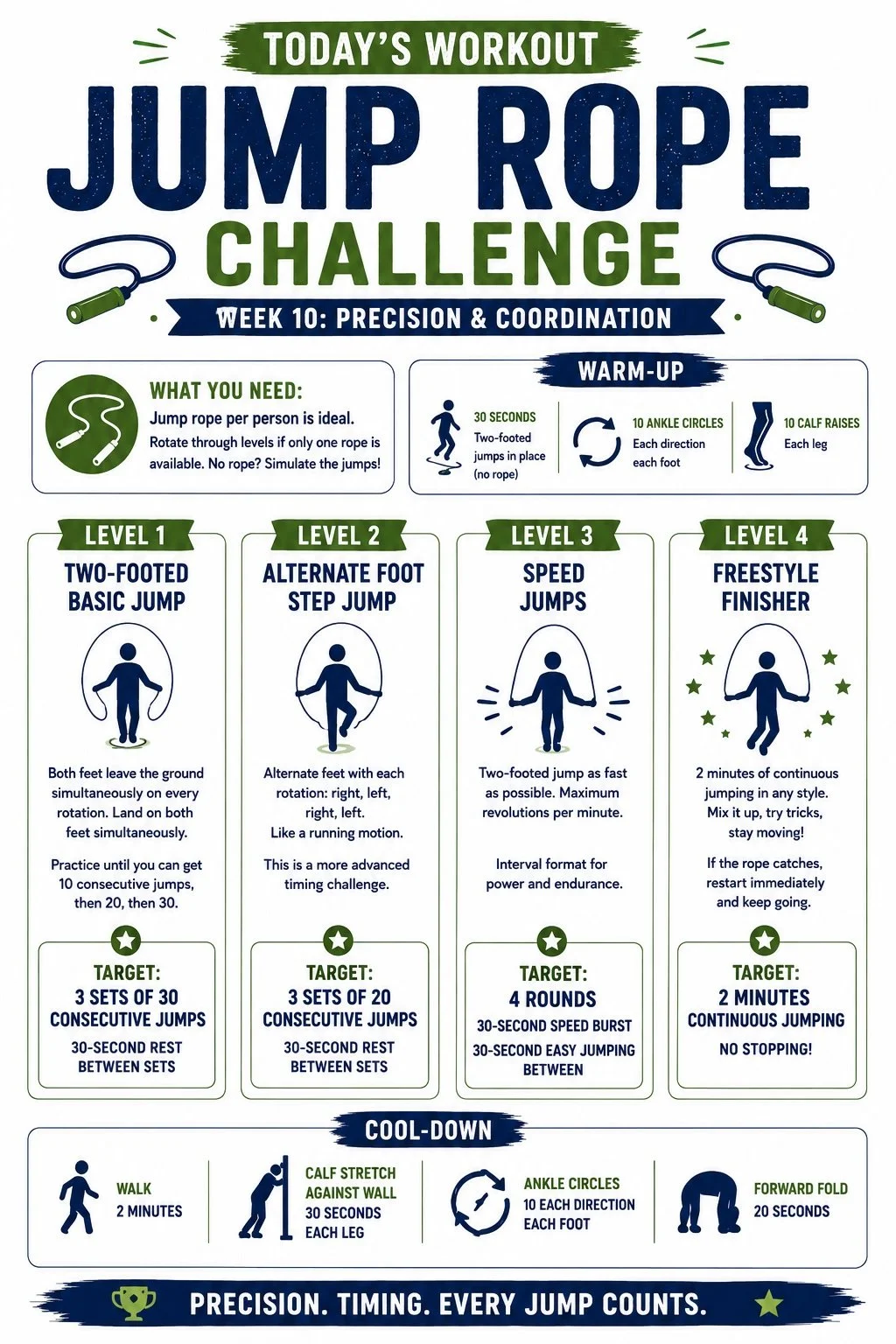
Today’s Workout: Jump Rope Challenge
What you need: A jump rope per person is ideal. If only one is available rotate through the levels while others rest or do a secondary exercise. If no rope is available, simulate jumping rope, the same jumping mechanics without a physical rope produces most of the same training benefit.
Warm-Up: 30 seconds of two-footed jumps in place with no rope, just practicing the jump rhythm. 10 ankle circles each direction each foot. 10 calf raises each leg. The ankles and calves are the primary movers today and need specific preparation.
Level 1: Two-Footed Basic Jump. Both feet leave the ground simultaneously on every rotation. Land on both feet simultaneously. This is the entry point, the jump that establishes the basic timing relationship with the rope. Practice until 10 consecutive successful jumps are achieved without the rope catching. Then go for 20, then 30.
Target: 3 sets of 30 consecutive jumps with 30-second rest between sets.
Level 2: Alternate Foot Step Jump. Instead of both feet leaving the ground together, alternate feet, right foot, left foot, right foot, left foot, like a running motion. This is closer to the boxer’s skip and significantly harder to time than the two-footed jump. The rhythm shifts from one jump per rotation to two steps per rotation.
Target: 3 sets of 20 consecutive alternate-foot jumps with 30-second rest between sets.
Level 3: Speed Jumps. Return to the two-footed jump and increase the rope speed as much as possible. The goal is maximum revolutions per minute for a 30-second burst followed by 30 seconds of easy jumping. This interval format is the jump rope equivalent of sprint intervals, maximum effort, full recovery, repeat.
Target: 4 rounds of 30-second speed bursts with 30-second easy jumping between.
Level 4: The Freestyle Finisher. Two minutes of continuous jumping in any style, mixing basic jumps, alternate foot, speed bursts, or any trick the jumper can attempt. The goal is continuous movement for the full two minutes without stopping. If the rope catches, restart immediately without counting the catch as a failure. Just restart and continue.
Cool-Down: Walk 2 minutes. Calf stretch against a wall 30 seconds each leg, the calves will have earned significant attention today. Ankle circles 10 each direction each foot. Forward fold 20 seconds.
Age Modifications
🟢 Little Movers: Ages 3–5. Skip the rope entirely and focus on the jump mechanics, two-footed jumps over a rope laid flat on the ground, not spinning. Jump over the rope forward, turn around, jump back. 8 to 10 jumps each direction. The focus is landing softly on both feet and maintaining rhythm
🟡 Kid Movers: Ages 6–8. Level 1 as the primary focus, two-footed basic jump. Build from 10 consecutive to 20 to 30 within the session. Most kids at this age can reach 10 consecutive within a few minutes of practice. The jump from 10 to 30 consecutive is the session’s main challenge and produces real satisfaction when it arrives. Attempt Level 2 alternate foot for 5 minutes at the end, getting even 5 consecutive alternate foot jumps is a genuine achievement.
🟠 Preteen Movers: Ages 9–12. All four levels as written. Level 2 alternate foot is the hardest transition for most preteens and worth spending extra time on, the cognitive adjustment from two-footed to alternate foot timing requires a complete recalibration that takes several minutes to find. Level 3 speed bursts are the cardiovascular peak of the session. Level 4 freestyle finisher, challenge them to attempt one trick during the two minutes, a cross-arm jump or a double under if they are ready.
🟣 Teen Movers: Ages 13+. All four levels with maximum effort on Level 3, the speed burst intervals should feel comparable to sprint intervals in cardiovascular demand. For Level 4 add a specific challenge: attempt double unders (the rope passes under the feet twice per jump).
👨👩👧 Parent Bonus: Full workout as written. Your specific challenge is Level 2 alternate foot, most adults who jump rope exclusively use two-footed jumps and have never properly calibrated the alternate foot timing. Spend extra time here. The rhythm shift from two-footed to alternate foot is the most athletically valuable transition in today’s session and the one that most directly transfers to running mechanics.
Did You Know?
Jump rope improves sprint speed through ankle stiffness and foot speed development. Research published in the Journal of Strength and Conditioning Research found that athletes who incorporated regular jump rope training showed measurable improvements in sprint times, specifically through improvements in ankle stiffness and ground contact mechanics that directly reduce the energy cost of each sprint stride. The ankle and calf training of jump rope produces the same mechanical improvements as dedicated plyometric training but in a more accessible and more enjoyable format.
Tomorrow is Day 66: Hopscotch Sprint Series. See you at 6am.