Day 72: The Trail Blaze Run
Yesterday your family picked a trail. Today you run it.
A trail is not a road with dirt on it. The ground moves, the footing changes every step, there are roots and rocks and unannounced hills, and every technique your athlete has built on flat pavement gets renegotiated. That sounds like a problem. It's actually the reason trail running is one of the best things a young runner can do. The terrain coaches them whether they're listening or not.
Today has three cues and one permission. The cues are eyes up, short steps, soft feet. The permission is the good part, and we'll get to it.
Why Trails Run Different Than Roads
On pavement, every stride lands on identical ground. Your athlete's body figures that out in about a minute and then stops paying attention — same push-off, same landing, same muscles, thousands of times. It's efficient, and it's also why road running is where most repetitive-strain problems come from.
A trail makes that impossible. Every footfall is slightly different: a root here, a soft patch there, a rock that shifts. The ankles, hips, and small stabilizing muscles are working constantly instead of coasting, and the feet have to adapt in real time. This is the same reason we spent Week 10 on precision, except now nobody's drawing chalk squares. The ground is drawing them.
The other difference is speed, and this is what trips kids up. Trails are slower. Always. A kid who runs a comfortable pace on the street and then hits a rooty trail will feel slow and assume they're doing badly. Say this out loud before you start: today's pace means nothing.
Find Your Trail
Use whatever you scouted yesterday. If nothing you found qualifies as a real trail, any of these work fine:
A mulched or gravel path through a park
The grass perimeter of a field or ballpark, running just off the mowed line
A wooded strip behind a school, church, or neighborhood
A dirt or gravel driveway or farm road
Even the uneven grass edge of a sidewalk, if that's what you've got
What you need is uneven ground, not wilderness. Fifty yards of bumpy grass that you loop ten times teaches the same lesson as a mile of single track.
Before you step on it: know where the trail comes out, tell someone where you're going, and go together — every age group, teens included, and teens with a buddy at minimum. Skip the headphones today; you need your ears for footing and for each other.
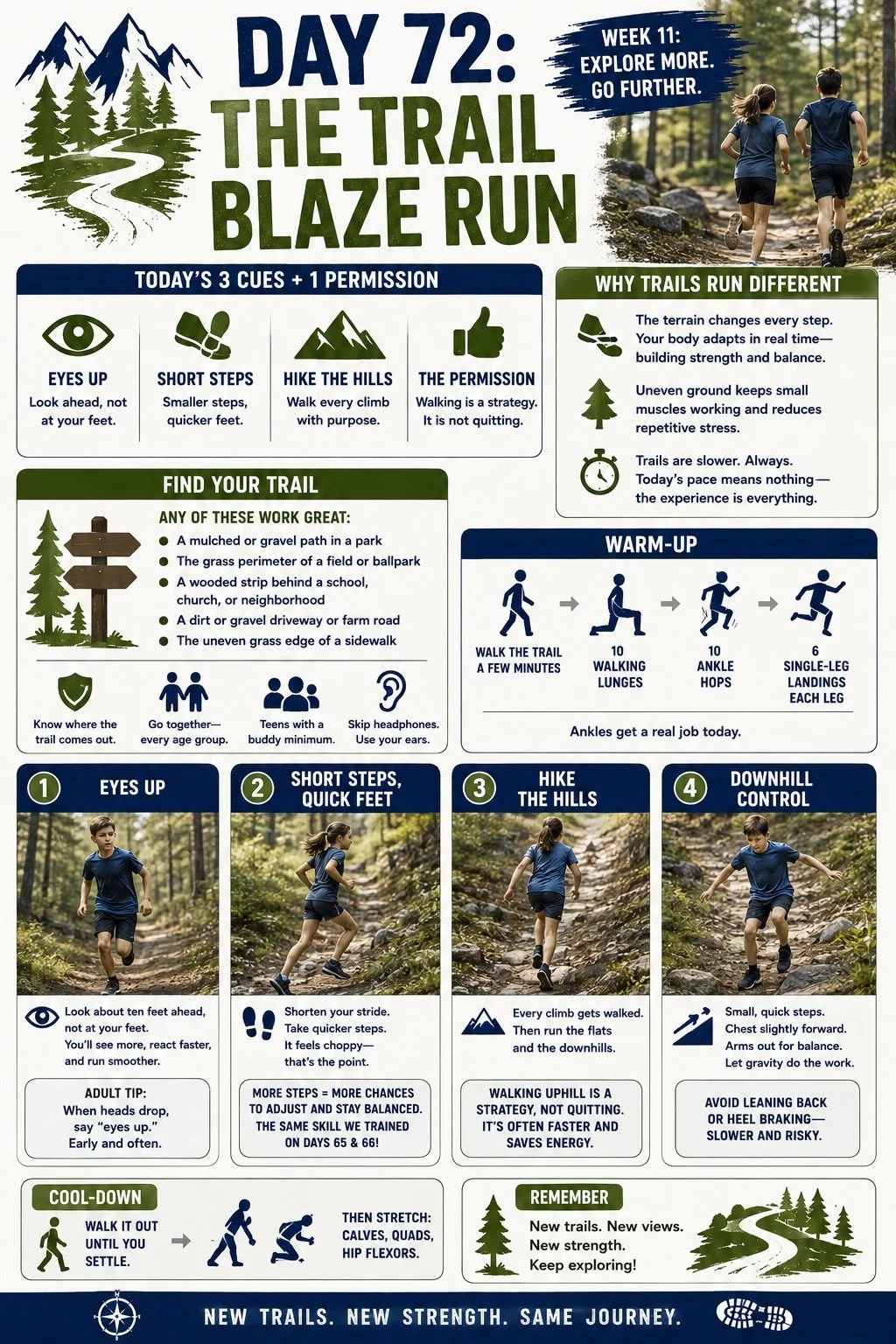
Today's Workout: The Trail Blaze Run
You'll need: shoes with tread if you own them (regular sneakers are fine), water, and long socks if you have them.
Warm-up: Walk the first few minutes of the trail before running any of it, this doubles as a look at the footing. Then 10 ankle hops, 10 walking lunges, and 6 single-leg landings per leg. Ankles get a real job today.
Segment 1: Eyes Up. Easy running, and one cue only: look about ten feet ahead, not at your feet. This is the single hardest habit to build and the one that matters most. Kids stare straight down at the ground they're already standing on, which means they find out about a root at the exact moment it's too late. Adults: every time you see a head drop, say "eyes up." You'll say it a lot in the first two minutes and much less by minute five.
Segment 2: Short Steps, Quick Feet. Now shorten the stride deliberately, smaller steps, faster turnover, feet spending less time on the ground. It should feel choppy and slightly silly. Shorter steps mean more chances to correct before something goes wrong, and it's the same skill we trained with the rope on Day 65 and the hopscotch squares on Day 66, just without the chalk.
Segment 3: Hike the Hills. Here's the permission: every climb gets walked. Not jogged, not powered through, walked, with purpose, hands on knees if you want them there. Then run the flats and the gentle stuff. On steep enough ground, hiking is genuinely faster than running for the same effort, which is why you'll see world-class mountain runners walking uphill in races they go on to win. For most kids, this is the most useful thing they'll hear all week. Walking is a strategy. It is not quitting. Ten weeks into a running challenge, that's a distinction worth handing them.
Segment 4: Downhill Control. Find a gentle descent (gentle, not steep). Small quick steps, chest slightly forward over the feet, arms out wide for balance. The instinct is to lean back and brake with the heels, which is both slower and how ankles get hurt. Let gravity do it. Two or three passes is plenty.
Cool-down: walk it out, then calves, quads, and hip flexors.
Age Modifications
🟢 Little Movers (Ages 3–5) : 10 minutes, mostly walking, on the flattest, widest path you have. The whole goal is "step over the root, step around the rock." Hold hands on anything downhill.
🟡 Kid Movers (Ages 6–8): 5 minutes. Do Segment 1 and Segment 3 only. Make "eyes up" a game, they call it on you whenever they catch your head down, and they will love this.
🟠 Preteen Movers (Ages 9–12): Full workout as written. Have them tell you afterward which segment felt hardest. It's usually the short steps, because it's the one that fights an existing habit.
🟣 Teen Movers (Ages 13+): 30 to 40 minutes on the most technical ground available, easy conversational effort throughout. Hold the hills-are-hiked rule anyway, even when they can run them, learning to hike a climb on purpose is a real racing skill and they'll resist it. Add strides on a smooth flat section at the end if they want more.
👨👩👧 Parent Bonus: Take the downhill segment seriously. Adults brake far harder than kids do, and letting go of the heel-jam on a descent is one of the fastest improvements available to an adult runner.
Tomorrow is Day 73: Park Circuit Challenge. See you tomorrow at 6am.