Day 73: Park Circuit Challenge
Yesterday your athlete learned that the ground can coach them. Today they'll learn the same thing about a playground.
Here's the reframe for the morning: the park down the street is a fully equipped gym that nobody charges you for. Benches are step-up boxes. Monkey bars are a pull-up rig. The stairs are a stair machine, the hill is a treadmill incline, the slide ladder is a climbing wall, and the field is a track. We're going to use all of it, and we're going to jog between the pieces so it stays a running workout.
Why Runners Need to Climb, Hang, and Push
Running is a beautifully narrow activity. Forward, one leg at a time, the same plane of motion, thousands of repetitions. It's wonderful for a heart and slightly unfair to everything else. A kid who only runs is loading a small set of tissues over and over and asking the rest of the body to sit this one out.
A park circuit fixes that in about twenty minutes. Climbing is pulling. Monkey bars are grip and shoulders and a full-body hang that decompresses everything running just compressed. Step-ups are single-leg strength, which is exactly what running is, except now it's happening slowly enough for the muscle to actually get stronger. Push-ups on a bench are the plane of motion running never touches.
None of this requires a weight, and at these ages it shouldn't. Bodyweight play is strength training for kids, the loading is appropriate by definition, because they can only lift what they weigh. What it builds is durability, and durability is the whole reason some kids are still running at sixteen and others stopped at eleven with shin splints.
Small thing that matters more than it sounds: hanging. Kids' grip and shoulder strength have measurably declined over the last few decades, largely because fewer of them spend time hanging off things. Today they hang off things.
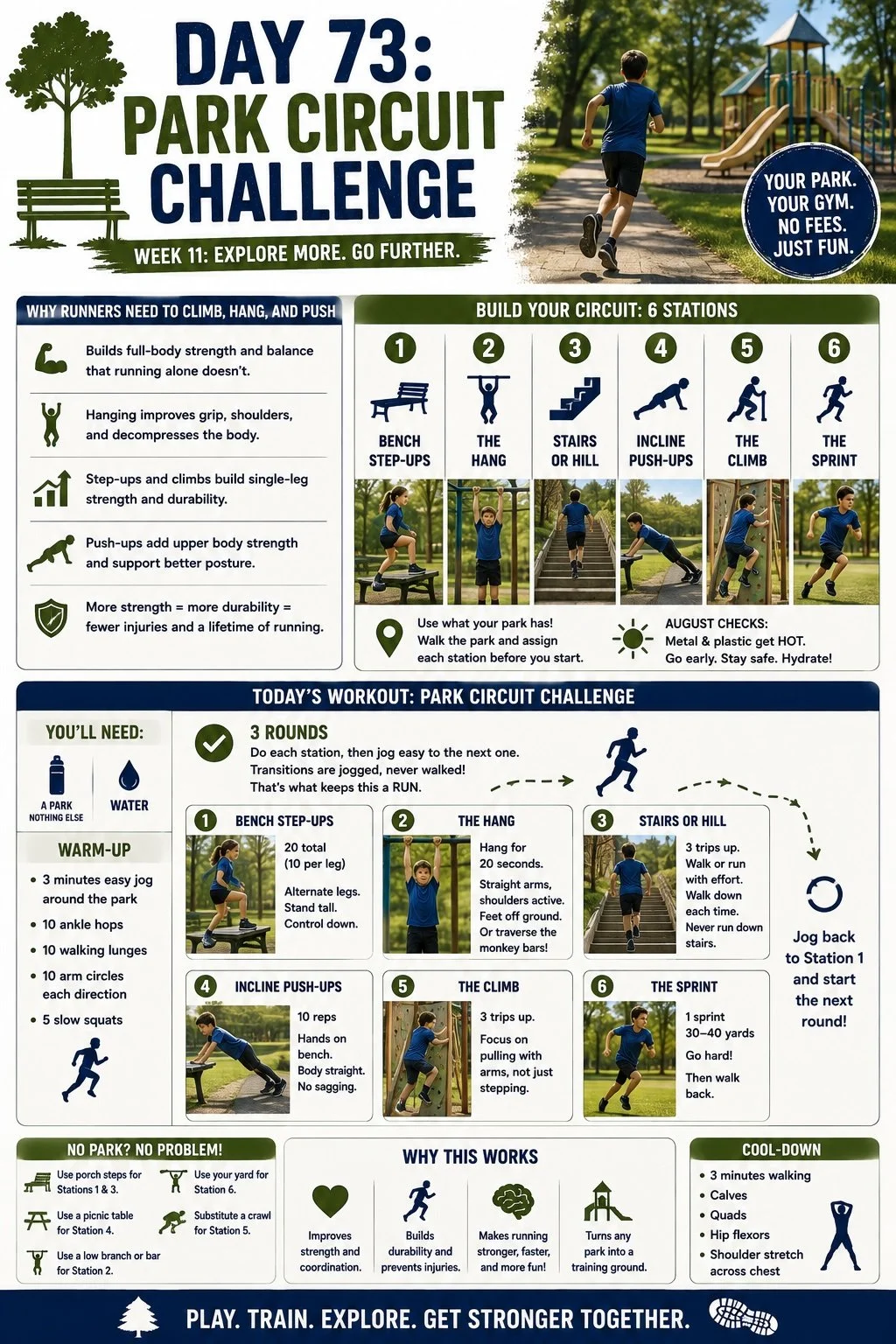
Build Your Circuit
Six stations, using whatever your park actually has. Walk the park once and assign each station to a real object before you start.
Bench Step-Ups: any bench, curb, or low wall
The Hang: monkey bars, a pull-up bar, or any overhead bar
Stairs or Hill: bleachers, a stairway, or the steepest grass slope
Incline Push-Ups: hands on a bench, feet on the ground
The Climb: a slide ladder, climbing wall, rock wall, or cargo net
The Sprint: 30 to 40 yards of open grass
No park? Porch steps for stations 1 and 3, a picnic table for 4, a sturdy low branch or bar for 2, and the yard for 6. Skip the climb or substitute a crawl.
Two August-specific checks before anyone touches anything: metal bars, slides, and dark plastic get genuinely hot in the sun, put a hand on it first. And go early. A 6am park is empty, which is the difference between a circuit and an obstacle course of toddlers.
Today's Workout: Park Circuit Challenge
You'll need: a park, water, and nothing else. A phone timer if you want to time the hangs.
Warm-up: 3 minutes of easy jogging around the park perimeter, this doubles as your station scout. Then 10 ankle hops, 10 walking lunges, 10 arm circles each direction, and 5 slow bodyweight squats.
The Circuit
Three rounds. Do each station, then jog easy to the next one, the transitions are jogged, never walked. That's what keeps this a run and not a weights session.
Station 1: Bench Step-Ups. 20 total, alternating, 10 per leg. Whole foot on the bench, stand all the way up, control the way down. Slow is the point.
Station 2: The Hang. Hang from the bar for 20 seconds. Straight arms, shoulders active, feet off the ground. If they can traverse the monkey bars, go across instead. If 20 seconds is impossible, hang as long as possible and note the number, this one improves fast and visibly.
Station 3: Stairs or Hill. Three trips up. Walk or run, but every trip is at real effort. Walk down each time, never run down stairs.
Station 4: Incline Push-Ups. 10 with hands on the bench. Body in a straight line from head to heels, chest to the bench, no sagging middle. Hands on a higher surface makes them easier, use that instead of doing sloppy ones.
Station 5: The Climb. Three trips up the ladder, wall, or net. Focus on pulling with the arms rather than just stepping with the legs.
Station 6: The Sprint. One hard sprint across the grass, then walk back. This is the only maximum-effort thing all day, and it's the last thing in each round on purpose.
Then jog back to Station 1 and go again.
Cool-down: 3 minutes walking, then calves, quads, hip flexors, and a shoulder stretch across the chest. Wash hands, playground equipment is playground equipment.
Age Modifications
🟢 Little Movers (Ages 3–5): This is just playground time with a loose order to it. Climb the ladder, hang with an adult holding their waist, walk up the steps, run across the grass. One round is plenty. Their version of this workout is indistinguishable from playing, which is correct.
🟡 Kid Movers (Ages 6–8): Two rounds, halved numbers: 10 step-ups, a 10-second hang, two stair trips, 5 push-ups, two climbs, one sprint. Let them pick the order of the stations each round.
🟠 Preteen Movers (Ages 9–12): Full three rounds as written. Have them track their hang time each round and watch it drop — that drop is the workout working, and it's a useful thing to understand.
🟣 Teen Movers (Ages 13+): Four rounds. Upgrade where you can: pull-ups instead of hangs (or negatives — jump up, lower slowly, 5 reps), stairs run instead of walked, push-ups on the ground instead of the bench, and jog the transitions at real pace. Keep the last sprint honest in every round.
👨👩👧 Parent Bonus: Do the 20-second hang. All three rounds. Most adults are surprised by round two and humbled by round three, and it's one of the better rough indicators of general fitness you can test with no equipment at all.
Did You Know?
Using a park as a gym isn't a modern fitness trend, it's a Swiss invention with a name. In the late 1960s, a Swiss insurance company built free outdoor fitness circuits in public forests: a marked running loop with wooden stations along it for pull-ups, jumps, balance work, and climbing. They were called Vita Parcours, they were free to everyone, and there are still hundreds of them scattered across Switzerland today.
Tomorrow is Day 74: Nature Scavenger Sprint. See you tomorrow at 6am.