Day 74: Nature Scavenger Sprint
Today's workout is ten hard sprints with recovery between them. Your kids are going to think it's a scavenger hunt.
Both things are true. The list is real, the finds are real, and the running is a legitimate interval session that most young athletes would refuse if you described it honestly. So don't describe it honestly. Hand them the list.
Why This Is an Interval Workout in Disguise
Two reasons this format works better than the honest version.
The first is physiological. Left to their own devices, kids don't run steadily, they play in bursts. A few seconds flat-out, then a stop, then another burst. Their spontaneous activity is intermittent by nature, and short-sprint-plus-recovery is closer to how a child's body actually likes to work than any continuous run is. We're not adapting a workout for kids today. We're using the pattern they'd choose anyway and putting a list on top of it.
The second reason is about quality, and it's the one coaches care about. Tell a ten-year-old to run ten sprints with ninety seconds of rest and you'll get two good sprints, six average ones, and two they're clearly saving energy on. Hide the rest inside a search, something absorbing enough that they forget they're recovering, and every sprint is a real one, because there's a discovery waiting at the other end of it.
The rest interval is the scavenger hunt. That's the whole trick.
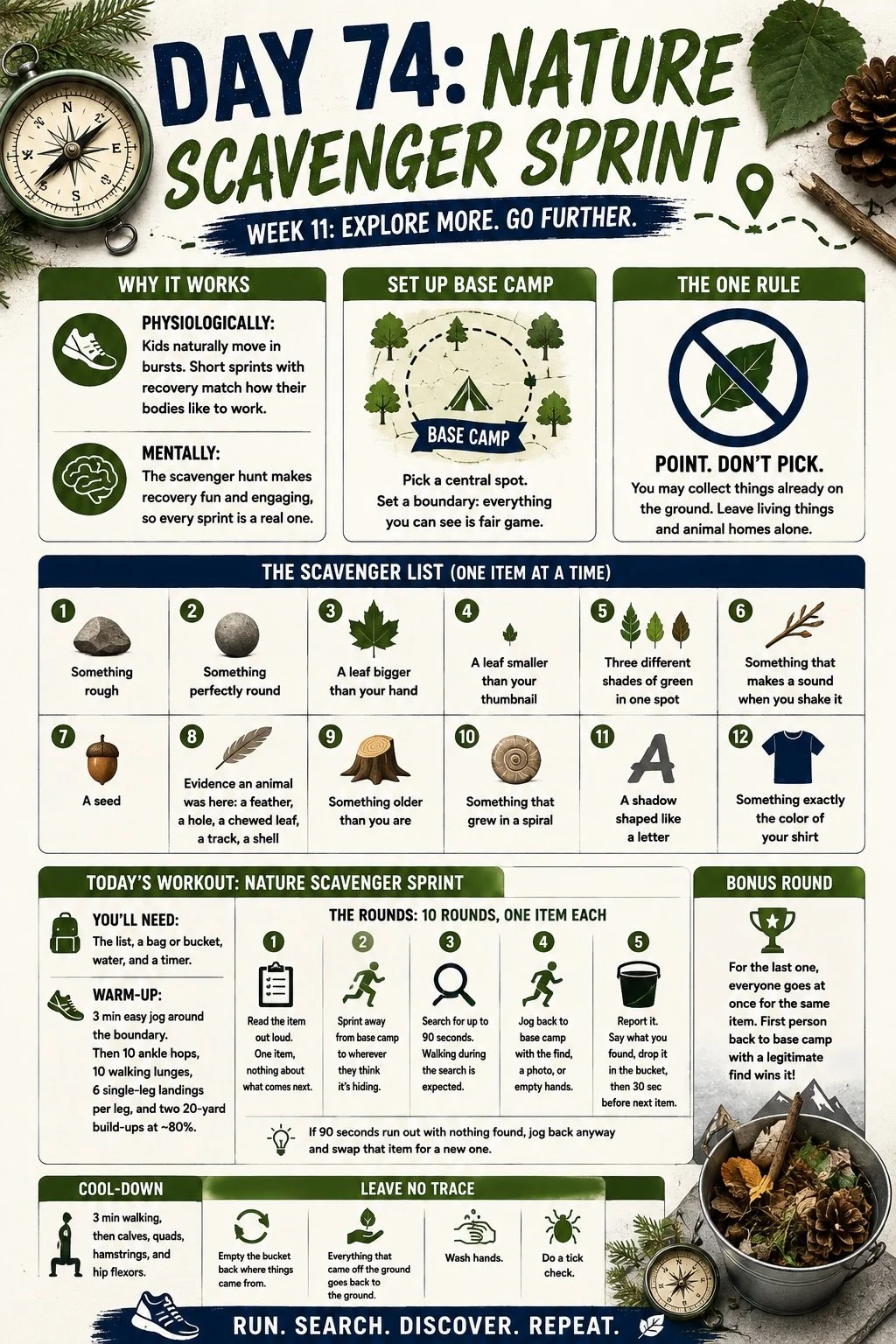
Set Up Base Camp
Pick a spot in the middle of a park, yard, field, or trailhead. That's base camp, every sprint starts and ends there. Set a boundary: everything you can see from base camp is fair game, and nothing you can't.
The One Rule. Point. Don’t pick. Or take a picture.
You may collect things already lying on the ground: a fallen leaf, an acorn, a pebble, a stick. You may not pick anything still living, disturb anything an animal is using, or move anything that looks like a home.
The List
Twelve items. Read them out one at a time; don't hand over the whole list at once.
Something rough
Something perfectly round
A leaf bigger than your hand
A leaf smaller than your thumbnail
Three different shades of green in one spot
Something that makes a sound when you shake it
A seed
Evidence an animal was here: a feather, a hole, a chewed leaf, a track, a shell
Something older than you are
Something that grew in a spiral
A shadow shaped like a letter
Something exactly the color of your shirt
Today's Workout: Nature Scavenger Sprint
You'll need: the list (on paper or on your phone), a bag or bucket at base camp, water, and a timer.
Warm-up: 3 minutes easy jogging around the boundary, this also shows everyone the search area. Then 10 ankle hops, 10 walking lunges, 6 single-leg landings per leg, and two 20-yard build-up runs at about 80%. Sprints need a real warm-up.
The Rounds
Ten rounds, one item each. Each round works the same way:
Read the item out loud. One item, nothing about what comes next.
Sprint away from base camp to wherever they think they'll find it. Full speed on the way out, that's the part being trained.
Search. Up to 90 seconds. Walking during the search is fine and expected.
Jog back to base camp with the find, a photo, or empty hands.
Report it. Say what you found, out loud, and drop it in the bucket. Then thirty seconds of standing around before the next item.
If 90 seconds runs out with nothing found, jog back anyway and swap that item for a new one. Nobody stalls out on "something perfectly round."
That's ten hard efforts of 5 to 15 seconds each with real recovery between them. It's a proper speed session.
Bonus Round
For the last one, everybody goes at once for the same item, and the first person back to base camp with a legitimate find wins it. One item, one sprint, all-out, everyone racing. It's the loudest thirty seconds of the morning and it's a good rehearsal for tomorrow.
Cool-down: 3 minutes walking, then calves, quads, hamstrings, and hip flexors. Empty the bucket back where things came from, everything that came off the ground goes back to the ground. Wash hands, and do a tick check if you were anywhere near tall grass.
Age Modifications
🟢 Little Movers (Ages 3–5): Five items, all easy and concrete: something rough, something round, a big leaf, a seed, something green. The sprint becomes "run to the tree and back," and hand-holding is fine. Their find counts no matter what it is.
🟡 Kid Movers (Ages 6–8): Eight items, 60-second searches. Skip the abstract ones (#9 and #11) and stick to what can be held or seen. Let them add two items of their own invention to the list — theirs are usually better than mine.
🟠 Preteen Movers (Ages 9–12): All twelve items, full sprints. Keep the "something older than you are" one; the conversation it starts is worth the workout by itself. Push the sprint quality, the run out should be genuinely fast, not a jog with intent.
🟣 Teen Movers (Ages 13+): Twelve items with a wider boundary and 40 to 60 yards of sprinting on each round. Cut search time to 45 seconds so the recovery stays incomplete and the session actually bites. Add a "find it and explain what it is" requirement naming the tree is harder than finding the leaf.
👨👩👧 Parent Bonus: Run the bonus round. All out, against your kids, on grass. You will find out very quickly whether you have sprinted in the last calendar year, and the answer is usually no.
Did You Know?
There's a Swedish word for exactly what your family did this morning: fartlek. It translates, almost too perfectly, as "speed play."
It was developed in the 1930s by a Swedish coach named Gösta Holmér, whose idea was that runners should get faster by running fast and slow in unpredictable bursts over natural terrain, through forests, up hills, wherever, instead of grinding out measured repetitions on a track with a stopwatch. No set distances, no fixed rest, no clock. Just fast when it feels right, easy in between, and terrain that decides some of it for you.
Fartlek became one of the foundational training methods in distance running and it's still in nearly every serious runner's week, almost a century later.
Day 75: The Great Outdoor Games. See you tomorrow at 6am.