Day 75: The Great Outdoor Games
Three quarters of the way through.
This week you walked an unfamiliar mile, ran a trail, turned a playground into a gym, and sprinted around a scavenger hunt. Today all of it turns into a competition, six events, everybody entered, points on the board, and a victory lap that nobody loses.
The Great Outdoor Games are built out of the oldest athletic events humans have: throw a heavy thing, carry a heavy thing, jump as far as you can, climb something, balance on something, and race. No equipment that isn't already lying around outside. This is the last day of Outdoor Adventure week and it should feel like the payoff for it.
Why We Finish the Week With Games
Because a competition reveals what practice hides.
All week we've been building things in low-pressure conditions, cues, technique, "notice this." That's how skills get made. But a skill isn't yours until it survives an audience, a scoreboard, and a sibling. Six events, a chalk scoreboard, and a family tally does more for that than any workout could.
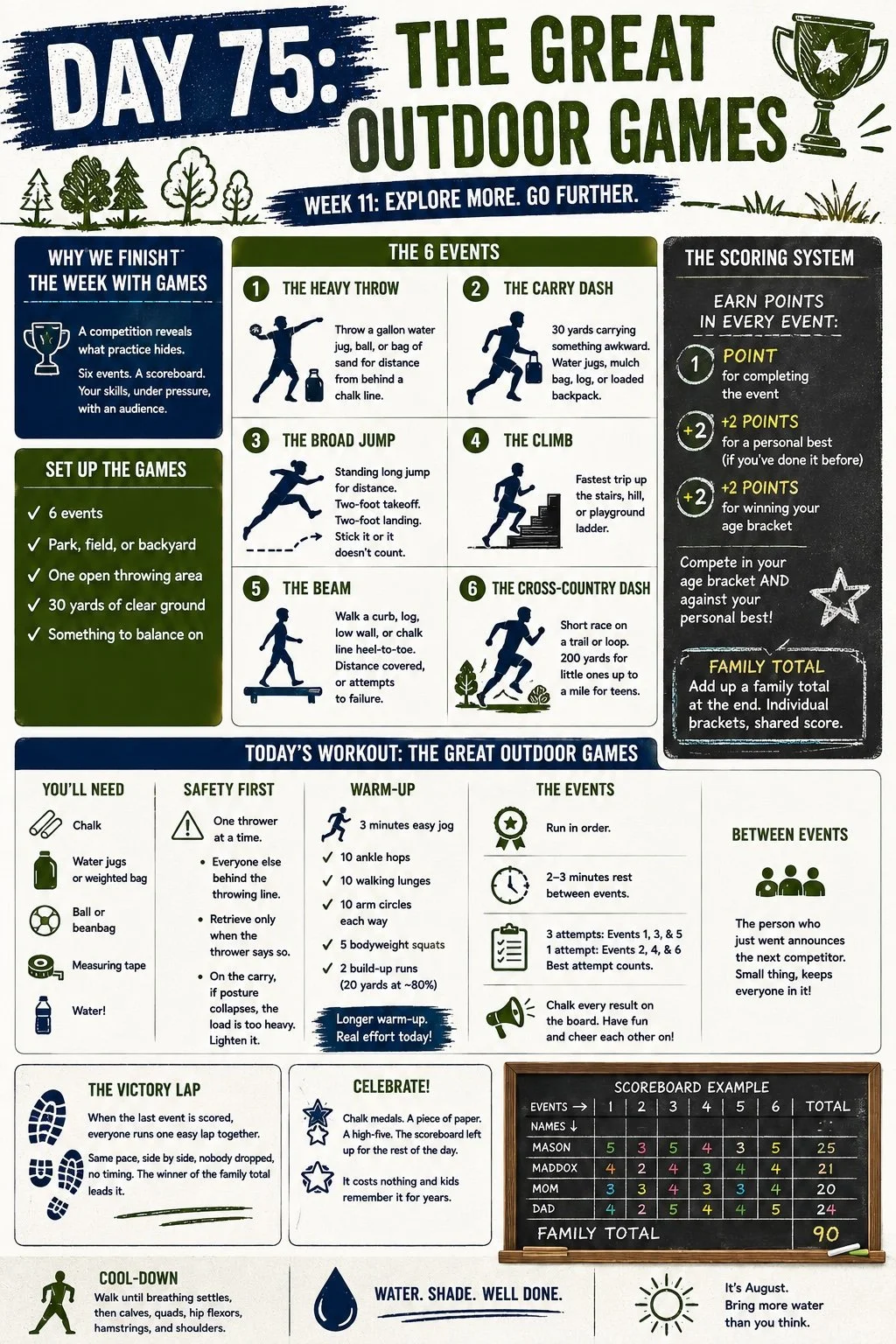
Set Up the Games
Six events, at a park, field, or backyard. You need one open throwing area, 30 yards of clear ground, and something to balance on.
Event 1: The Heavy Throw. A gallon water jug, a ball, or a bag of sand thrown for distance from behind a chalk line.
Event 2: The Carry Dash. 30 yards carrying something awkward, full water jugs, a bag of mulch, a small log, a loaded backpack.
Event 3: The Broad Jump. Standing long jump for distance, same rules as Day 67: two-foot takeoff, two-foot landing, stick it or it doesn't count.
Event 4: The Climb. Fastest trip up the stairs, the hill, or the playground ladder from Day 73.
Event 5: The Beam. Walk a curb, a log, a low wall, or a chalk line heel-to-toe without stepping off. Distance covered, or attempts to failure.
Event 6: The Cross-Country Dash. A short race on the trail or grass loop from Day 72. Anywhere from 200 yards for little ones to a mile for teens.
The Scoring System
Chalk a scoreboard on the pavement with everyone's name. In every event, each person can earn:
1 point for completing the event
+2 points for a personal best, if you've done it before
+2 points for winning your own age bracket
That last part matters. A six-year-old is not competing with a fifteen-year-old — they're each competing inside their own bracket, and everyone is competing against their own last attempt. It means the smallest kid in the family can out-score the biggest one, which is both fairer and much more fun to watch.
Add up a family total at the end, too. Individual brackets, shared score.
Today's Workout: The Great Outdoor Games
You'll need: chalk, water jugs or a weighted bag, a ball or beanbag, a measuring tape, and water for drinking. It's August, bring more than you think.
Safety, mostly about the throwing: one thrower at a time, everyone else fully behind the throwing line, and nobody retrieves anything until the thrower says so. On the carry, if posture collapses the load is too heavy, lighten it, don't tough it out.
Warm-up: 3 minutes easy jogging. 10 ankle hops, 10 walking lunges, 10 arm circles each way, 5 bodyweight squats, and two 20-yard build-up runs at about 80%. Longer than usual, because there's real effort coming.
The Events
Run them in order, with two to three minutes of rest between events. Each person gets three attempts at Events 1, 3, and 5, and one attempt at Events 2, 4, and 6. Best attempt counts. Chalk every result on the board as it happens, the visible scoreboard is half the fun. Between events, the person who just went announces the next competitor. Small thing, keeps everyone in it.
The Victory Lap
When the last event is scored, everyone runs one easy lap together. Same pace, side by side, nobody dropped, no timing. The winner of the family total leads it.
Then hand out something: chalk medals drawn on the driveway, a piece of paper with a name on it, or just the scoreboard left up for the rest of the day. It costs nothing and kids remember it for years.
Cool-down: walk until breathing settles, then calves, quads, hip flexors, hamstrings, and shoulders. Water. Shade.
Age Modifications
🟢 Little Movers (Ages 3–5); Four events: throw a beanbag, carry one small water bottle, jump over a chalk line, walk a chalk beam. No timing on anything. Everybody in this bracket wins their bracket, which is exactly the right outcome at this age.
🟡 Kid Movers (Ages 6–8): All six events with lighter loads and shorter distances, a 15-yard carry, a 200-yard dash. Put them in charge of writing the scoreboard. Being the official scorekeeper is a genuinely coveted job.
🟠 Preteen Movers (Ages 9–12): Full games as written. This is the age to introduce technique on the throw: turn the hips, don't just use the arm. The improvement between attempt one and attempt three is usually large enough to see.
🟣 Teen Movers (Ages 13+): Full games with real loads, a 40-yard carry, and a mile for the cross-country dash. Give them the job of running the meet, calling competitors, measuring, keeping order. Officiating is harder than competing and they'll discover that around Event 3.
👨👩👧 Parent Bonus: Enter everything. Not "supervise everything" enter it, on the scoreboard, with your name and your numbers next to theirs. Your kids have watched you time them for seventy-five days. Let them measure your broad jump.
Did You Know?
Two of today's events are still contested at the Olympics, and they got there from a Scottish field.
The Highland Games have run in Scotland for centuries: throwing stones for distance, hurling a hammer, tossing a caber. The stone put is the direct ancestor of the modern shot put, and the Scottish hammer became the hammer throw.
This weekend is Days 76 & 77: Adventure Long Run + Active Recovery. See you tomorrow at 6am.