Day 79: The Hardest Workout of the Summer
Today is hill repeats. Run up, walk down, do it again. It is the oldest hard workout in distance running and there is no trick to it.
Two things before we start. First: hardest does not mean longest. Little Movers are done in eight minutes and teens in twenty-five. This is the most demanding day of the challenge because of what it asks inside those minutes, not because it goes on forever, that's been true of this program since Day 1 and we're not breaking it today.
Second: there's one rule, and everything about this workout is built around it.
The One Rule: The Last One Matches the First
Time your first trip up the hill. Your final repeat has to be as fast as that one.
That's the challenge. Not "run them all as hard as possible" — anyone can do that, and what it produces is a blistering first rep, a collapse by the fourth, and a miserable trudge home. The skill being trained today is holding something back early so there's something left at the end, and then actually spending it.
It's also a rehearsal. Tomorrow is the Negative Split Run and in two weeks is the Day 92 mile. Both of them are won or lost in the first thirty seconds, by not going too hard.
Why Hills
Hills are strength training that doesn't look like strength training. Running uphill loads the glutes, hamstrings, and calves far more than flat running does, at an intensity a kid could never replicate with weights, and it happens inside an actual run, which is why nobody complains about it.
They're also gentler than they feel. Because the ground rises to meet you, uphill running produces lower impact forces than sprinting on the flat, and it's nearly impossible to overstride going up. It's one of the few ways to train hard speed with a reduced pounding cost. Hard on the lungs, easy on the joints.
And hills are honest in a way kids notice. There's no coasting, no drafting, no faking it. The hill just tells you the truth.
Find Your Hill
You need a slope that takes 30 to 60 seconds to climb at hard effort, moderate grade, decent footing, and no traffic. A park hill, a quiet street, a grassy slope, a long ramp.
No hill? Any of these work: a set of stairs or bleachers, a parking garage ramp, a bridge approach, or a treadmill at 5–7% incline. If you have nothing at all, run the same structure as 45-second hard efforts on flat ground, it's not identical, but the rule still applies and it's still the hardest day of the summer.
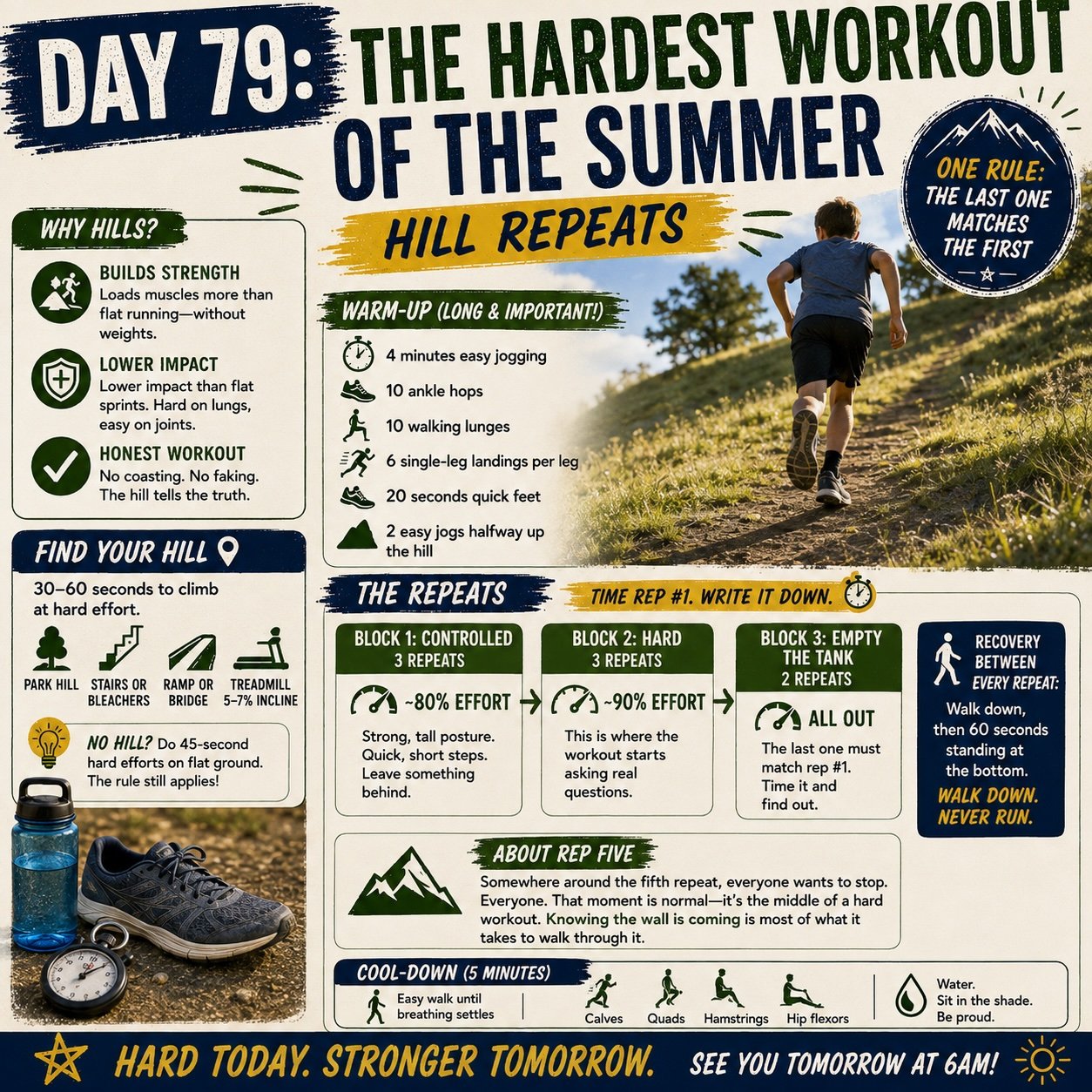
Today's Workout: Hill Repeats
You'll need: a hill, water, and a stopwatch. It's August, bring more water than you think, and if it's already hot at 6am, cut a repeat rather than pushing through it.
Warm-up: the longest of the challenge, and non-negotiable. 4 minutes easy jogging. 10 ankle hops, 10 walking lunges, 6 single-leg landings per leg, 20 seconds quick feet. Then two easy jogs halfway up the hill to let everyone feel the grade before it counts.
The Repeats
Time repeat #1. Write it down. Then work through three blocks:
Block 1: Controlled (3 repeats). About 80% effort. Strong, tall posture, quick short steps, arms driving. It should feel like you're leaving something behind, because you are.
Block 2: Hard (3 repeats). About 90%. This is where the workout starts asking real questions.
Block 3: Empty the Tank (2 repeats). All out. The last one is the one that has to match repeat #1, time it and find out.
Recovery between every repeat: walk down, then 60 seconds standing at the bottom. Walk. Never run down. Downhill running at speed is where soreness and rolled ankles come from, and the descent is your rest, not part of the workout.
About Rep Five
Tell your kids this before you start, because it makes the difference between a kid who quits and a kid who doesn't:
Somewhere around the fifth repeat, everyone wants to stop. Everyone. Adults, teens, professionals. That moment is not a signal that something is wrong or that you're not good at this, it's the normal, expected middle of a hard workout, and it shows up at roughly the same place every time.
Knowing the wall is coming is most of what it takes to walk through it.
Cool-down (5 minutes): easy walking until breathing settles, then calves, quads, hamstrings, and hip flexors. Water. Sit in the shade for a minute and let everyone be proud of themselves.
Age Modifications
🟢 Little Movers (Ages 3–5): 5 to 8 minutes. Three or four trips up a small grassy slope, any way they want: run, march, crawl, be a bear. Roll down if the grass is clean. No timing, no rule, no wall.
🟡 Kid Movers (Ages 6–8): 10 to 12 minutes. 5 repeats on a shorter hill of 20 to 30 seconds. Keep the one rule, time the first, chase it on the fifth. Let them name the hill. It works.
🟠 Preteen Movers (Ages 9–12): 15 minutes. 8 repeats of 30 to 45 seconds, in the three blocks as written. This is the age where the last-equals-first rule really teaches something, because their instinct is to sprint rep one and they will feel the consequence by rep four.
🟣 Teen Movers (Ages 13+): 20 to 25 minutes. 10 repeats of 45 to 60 seconds: 4 controlled, 4 hard, 2 all out. Full walk-down recovery, no shortcuts on it. If rep 10 matches rep 1, they paced it correctly and they should know that's the harder achievement.
👨👩👧 Parent Bonus: Match your child's repeat count, at your own effort. You've been the crew since Day 1, but this is the day of the summer worth being seen doing. Kids who watch a parent walk into the fifth repeat learn something no encouragement delivers.
Did You Know?
The most famous hill in running is not steep. Heartbreak Hill sits in Newton, Massachusetts, on the Boston Marathon course. It climbs about 88 feet over roughly half a mile, a grade most runners wouldn't notice on a Tuesday morning. What makes it legendary is where it is: right around mile 20, the last of four hills, arriving at the exact point in a marathon where the body runs out of easy fuel. It got its name in 1936. Defending contender Johnny Kelley caught the leader, Ellison "Tarzan" Brown, on that hill and gave him a pat on the shoulder as he went by. Brown responded by surging back past him and going on to win. A reporter wrote that Brown had broken Kelley's heart, and the name stuck for the next ninety years.
Tomorrow is Day 80: The Negative Split Run. See you tomorrow at 6am.