Day 80: The Negative Split Run
Legs are sore this morning. That's what yesterday was for, and easy running is the best thing you can do about it.
Today asks for almost nothing physically and quite a lot mentally. The workout is a simple out-and-back run. The challenge is: the way back has to be faster than the way out, and the only way to do that is to run the first half slower than your body wants to.
That's harder than it sounds. Holding back when you feel good is one of the least natural things in running, and it's the exact skill that decides how Day 92 goes.
What a Negative Split Is
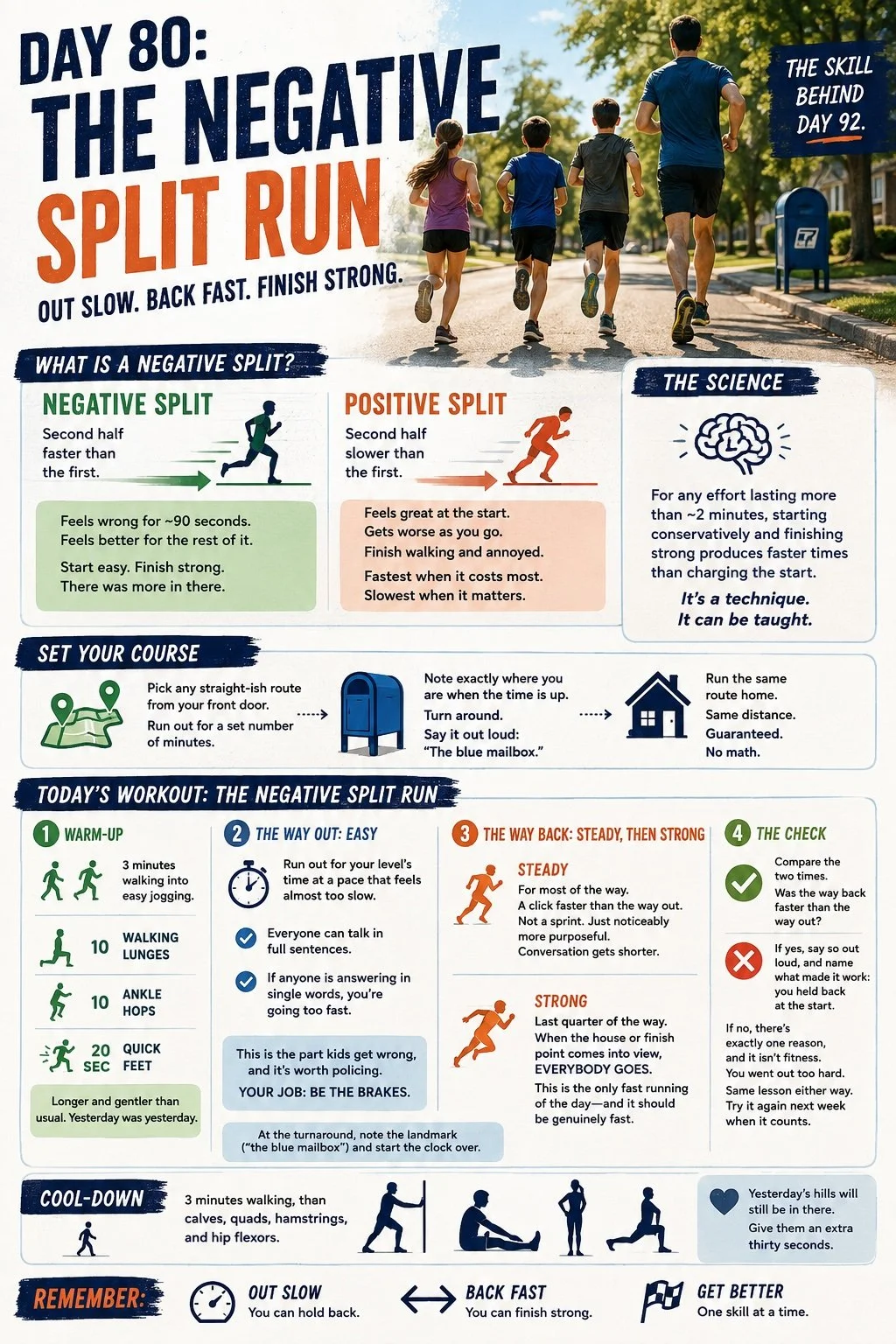
Split a run in half. If the second half is faster than the first, you ran a negative split. If the second half is slower, which is what happens to almost everyone, almost always, that's a positive split.
Here's what a positive split actually looks like: your kid takes off at the start feeling fantastic, holds it for a couple of minutes, gradually gets grimmer, and finishes walking and annoyed. They ran their fastest when it cost them the most and their slowest when it mattered.
The negative split version feels wrong for about ninety seconds and better for all the rest of it. You start at a pace that feels too easy, you finish passing people, and you cross the line knowing there was more in there.
Physiologists who study pacing keep landing in the same place: for any effort lasting more than about two minutes, going out conservatively and finishing strong produces faster times than charging the start. It's not a personality trait. It's a technique, and it can be taught in one morning.
Set Your Course
You don't need a measured route. Out and back does the measuring for you.
Pick any straight-ish route from your front door, sidewalk, path, park loop, road with a good shoulder. Run out for a set number of minutes, note exactly where you are when the time is up, turn around, and run the same route home. Same distance, guaranteed, no math.
The turnaround landmark matters. Say it out loud when you hit it: "the blue mailbox." That's the halfway point and everyone should know it.
Today's Workout: The Negative Split Run
You'll need: water, a stopwatch, and a route you can turn around on.
Warm-up: 3 minutes of walking into easy jogging, longer and gentler than usual, because yesterday was yesterday. Then 10 walking lunges, 10 ankle hops, and 20 seconds of quick feet.
The Way Out: Easy. Run out for your level's time (below) at a pace that feels almost too slow. The test: everyone can talk in full sentences the entire way. If anyone is answering in single words, the whole family is going too fast.
This is the part kids get wrong, and it's worth policing. Your job for these minutes is to be the brakes.
At the turnaround, note the landmark and start the clock over.
The Way Back: Steady, Then Strong
Run the same route home in two pieces:
Steady for most of it, a click faster than the way out. Not a sprint. Just noticeably more purposeful. Conversation gets shorter.
Strong for the last quarter. When the house or the finish point comes into view, everybody goes. This is the only fast running of the day and it should be genuinely fast.
The Check
Compare the two times. Was the way back faster than the way out?
If yes, say so out loud, and name what made it work: they held back at the start. If no, there's exactly one reason, and it isn't fitness. They went out too hard. Same lesson either way, and you get to try it again next week when it counts.
Cool-down: 3 minutes walking, then calves, quads, hamstrings, and hip flexors. Yesterday's hills will still be in there, give them an extra thirty seconds.
Age Modifications
🟢 Little Movers (Ages 3–5): 3 minutes out, 3 minutes back, mostly walking. Frame it as a game: "can we get home faster than we got here?" Sprint the last twenty steps to the door. That's a negative split and they'll have no idea.
🟡 Kid Movers (Ages 6–8): 4 minutes out, 4 minutes back. Give them the job of picking the turnaround landmark. On the way out, if they can't chat, slow them down, that instruction is the whole workout at this age.
🟠 Preteen Movers (Ages 9–12): 6 minutes out, 6 minutes back. Have them predict, before starting, how much faster the return will be. Then check. The gap between the prediction and the result is a better conversation than either number alone.
🟣 Teen Movers (Ages 13+): 10 minutes out, 10 minutes back. Real discipline on the out leg, it should feel embarrassingly easy for the first five minutes. Target a return that's 30 to 60 seconds faster. If they nail it, they've just found the strategy for the Day 92 mile.
👨👩👧 Parent Bonus: Run the out leg at your child's pace, no exceptions, and hold your own strong finish for the last quarter alongside them. Adults are the worst offenders on going out too fast, mostly because we remember being faster than we are.
Did You Know?
How you finish changes how you remember it. Psychologists studying how people rate experiences found something strange and consistent: our memory of an event is shaped disproportionately by its most intense moment and by how it ended, not by how long it lasted or what the average was like. Two runs of identical difficulty get remembered completely differently depending on whether they finished strong or fell apart at the end.
Tomorrow is Day 81: Personal Best Day. See you tomorrow at 6am.