Day 81: Personal Best Day
Here's the format: one event, three attempts, and one specific thing you change between them. Not four events. Not ten attempts. One number, attacked properly.
Why "Try Harder" Doesn't Work
Ask a kid how they plan to beat their jump and they'll say "jump harder." Then they'll do exactly what they did last time, with a redder face.
Effort is almost never what's missing. On Monday your athlete already went at these tests at full effort, the ceiling they hit wasn't a motivation ceiling, it was a technique ceiling. Every one of these events has a specific, fixable thing most people do wrong, and changing it is worth more than any amount of additional grimacing.
The second reason "try harder" fails: more attempts make you worse, not better. This is why real track meets cap field events at three attempts. Explosive efforts degrade fast, by attempt six, everyone in the family is more tired and less coordinated than they were at attempt one, and the numbers go down. Three good attempts beat ten desperate ones.
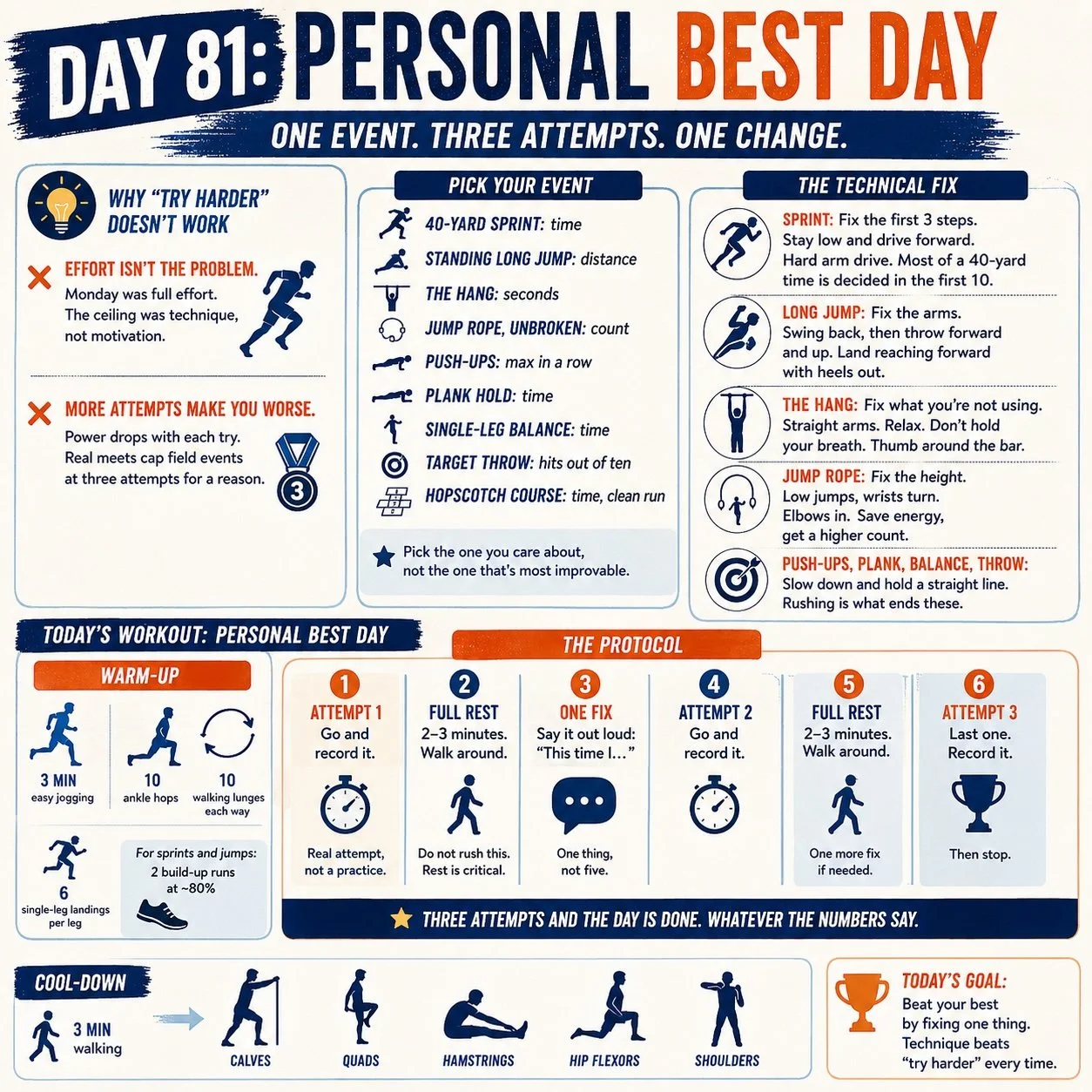
Pick Your Event
One per person. From anywhere in the summer:
40-yard sprint: time
Standing long jump: distance
The hang: seconds
Jump rope, unbroken: consecutive count
Push-ups: max in a row
Plank hold: time
Single-leg balance: time
Target throw: hits out of ten
Hopscotch course: time, clean run
Different family members can pick different events. Pick the one they care about, not the one that's most improvable.
The Technical Fix
Read the one that matches your event. This is the actual workout.
Sprint: fix the first three steps. Almost every kid stands up too fast. Out of the start, the body should be leaning forward with the chest low for three or four steps, pushing back against the ground rather than bouncing up. Add hard arm drive. Most of a 40-yard time is decided in the first 10.
Standing long jump: fix the arms. Swing them back, then throw them forward and up hard as the feet leave the ground, and land reaching forward with the heels out in front. Kids jump with their legs and forget they have arms attached. This one alone is often worth several inches.
The hang: fix everything you're not using. Grip is a finite tank and most people drain it by clenching their whole body. Hang from straight arms, let the shoulders be long, keep legs still and relaxed, and breathe normally instead of holding your breath. Thumb wrapped around the bar, not alongside the fingers.
Jump rope: fix the height. Most kids jump six inches when two would do, and they turn the rope with their whole arms. Elbows stay in at the sides, wrists do the turning, and the feet barely leave the ground. Lower jumps mean less fatigue, which means a much higher count.
Push-ups, plank, balance, throwing: the fix is nearly always the same: slow down and hold a straight line. Rushing is what ends these.
Today's Workout: Personal Best Day
You'll need: whatever your event requires, a stopwatch, a measuring tape, chalk, and Monday's numbers.
Warm-up: this is part of the attempt. A poor warm-up costs more than a poor technique. 3 minutes easy jogging. 10 ankle hops, 10 walking lunges, 10 arm circles each way, 6 single-leg landings per leg. Then, for sprints and jumps only, two build-up runs at about 80%.
The Protocol
Attempt 1: go, and record it. This is a real attempt, not a practice.
Full rest. Two to three minutes. Walk around. Do not rush this, rushing rest is the most common way families sabotage this day.
One fix. Say it out loud: "this time I swing my arms." One thing, not five.
Attempt 2: record it.
Full rest, one more fix if needed.
Attempt 3: the last one. Record it.
Then stop. Three attempts and the day is done, whatever the numbers say.
Cool-down: 3 minutes walking, then calves, quads, hamstrings, hip flexors, and shoulders.
Age Modifications
🟢 Little Movers (Ages 3–5): Pick one thing they love: jump over the line, hang, hop on one foot. Three tries, loud celebration on all three. No tape measure needed, “further than last time" by eye is plenty, and at this age it's almost always further.
🟡 Kid Movers (Ages 6–8): One event, three attempts, and an adult handles the timing and measuring so the kid only has to do the thing. Give them the technical fix in five words or fewer. "Swing your arms." That's it.
🟠 Preteen Movers (Ages 9–12): Full protocol, and they choose their own fix after attempt one. Ask "what would you change?" before you offer anything. They're usually right, and a fix they chose gets executed far better than one they were handed.
🟣 Teen Movers (Ages 13+): Full protocol on their chosen event. If they finish and want more, they can run a second event, but three attempts there too, with real rest between. Teach the discipline of stopping. And explicitly name it: today is a PR attempt, the same structure a real meet uses.
👨👩👧 Parent Bonus: Pick your own event, chalk your own number, and let your kids coach you through the technical fix. Being coached by a nine-year-old is good for everyone involved, and their cue will be better than you expect.
Did You Know?
The greatest personal best in the history of sport broke the measuring equipment. At the 1968 Olympics in Mexico City, an American long jumper named Bob Beamon hit the board on his first attempt and flew so far that the optical measuring device mounted on the rail, designed to slide along and read the landing, ran out of rail. Officials had to go find an old-fashioned steel tape measure. The distance was 8.90 meters, about 29 feet 2 inches. The record stood for 23 years.
Tomorrow is Day 82: The Gauntlet. One course, every week of the summer in it. See you tomorrow at 6am.