Every parent, coach, or spectator who has ever cheered at a youth fun run has witnessed the exact same phenomenon: the signal sounds, and every child on the starting line rockets forward at maximum speed.
Within ninety seconds, half the field is walking, holding their sides, or feeling discouraged.
At Runner2Runner, our core mission is centered on Fun First: building a foundation of lifelong movement for every child. We believe that physical activity should empower kids, not leave them exhausted or overwhelmed. Teaching children how to pace themselves isn’t about setting race records; it’s about giving them control over their bodies, preventing early fatigue, and building long-term confidence through play.
Why Do Kids Sprint Right Away?
Young children operate largely on instant feedback and high enthusiasm. Their central nervous systems are still developing an internal clock, and their concept of time and distance is still forming. When they feel excited, their immediate instinct is to run as fast as humanly possible!
We never want to crush that natural excitement. Instead, we can give them simple analogies and play-based tools that help them discover different "gears" at their own pace.
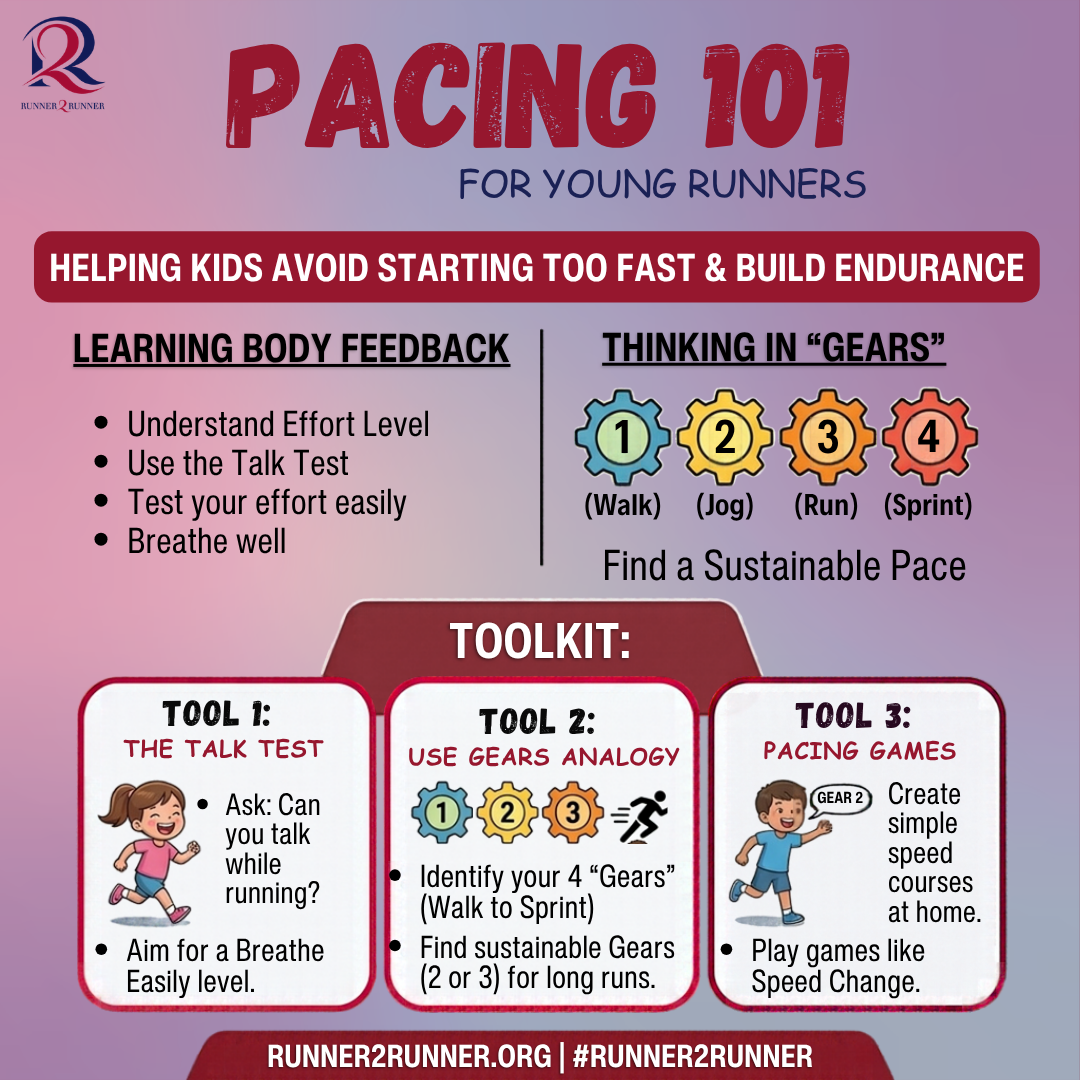
The "Car Gears" Framework for Kids
Abstract concepts like "80% effort" or "pacing" don't resonate with a 7-year-old. Instead, frame effort levels like shifting gears in a car:
🚗 Gear 1 (Low Gear): A relaxed, comfortable walking pace.
🚙 Gear 2 (Conversation Gear): A smooth, easy jog where you can comfortably speak a full sentence to a friend without gasping for breath.
🏎️ Gear 3 (Cruise Gear): A strong, steady pace used during games, relays, and longer runs.
🚀 Gear 4 (Turbo Gear): A fast sprint saved exclusively for tag games or the final finish-line push!
3 Fun Pacing Games to Play at Home
You don't need a track or stopwatch to teach pacing, just a backyard, hallway, or local park!
1. "Red Light, Green Light" (Pacing Edition)
In traditional Red Light, Green Light, kids sprint and stop. Try this pacing variation:
Yellow Light: Easy "Gear 2" jog.
Green Light: "Gear 3" steady cruise.
Purple Light: "Gear 1" walking cooldown.
Red Light: Complete stop.
Why it works: It trains the brain to switch speeds smoothly on command rather than relying on an all-or-nothing sprint.
2. The "Talking Song" Challenge
During a family walk or backyard run, challenge your child to sing a simple nursery rhyme or recite a favorite movie line while jogging alongside you in "Gear 2." If they are gasping for air mid-word, gently remind them to "shift down a gear" so their lungs and muscles can catch up.
3. The Reverse Relay (Negative Splits)
Set up two cones (or shoes) about 30 yards apart in the yard or park.
Round 1: Have your child move from Cone A to Cone B in "Gear 2" (easy jog).
Round 2: Have them move back from Cone B to Cone A slightly faster in "Gear 3" (cruise).
Why it works: This introduces the concept of a "negative split,” finishing the second half of a run stronger and more controlled than the first half.
3 Practical Tips for Parents
Avoid Yelling "Slow Down!": "Slow down" can feel like a punishment to an excited child. Instead, try positive form cues like "Find your Gear 2!" or "Keep your feet light!"
Focus on Effort, Not Time: Praise their body awareness ("I loved how you kept a steady pace the whole time!") rather than how fast they finished.
Model it Together: Join in! Kids learn pacing best by matching the rhythm and stride of a parent or coach running at a steady, relaxed pace beside them.
Building Longevity, Not Stopwatches
When children realize they don't have to spend every run out of breath, running transforms from a tiring chore into an empowering, enjoyable experience. Keep it light, celebrate their awareness when they shift gears smoothly, and always put Fun First!